Home / Blog / MicroBT Whatsminer M30S++
Field report · Oct 18, 2026 · 5 min read
Paused through autumn 2024, the Whatsminer M30S++ crossed to Nigeria and has paid for its box
MicroBT's 31 J/TH M30S++ was bought in October 2023, six months before the halving, and stood idle in autumn 2024 when Argentina's 6¢ stopped paying. It crossed once to Nigeria, where it has run ever since. Its line sits within a few percent of a halved hashprice at bitcoin's old high.
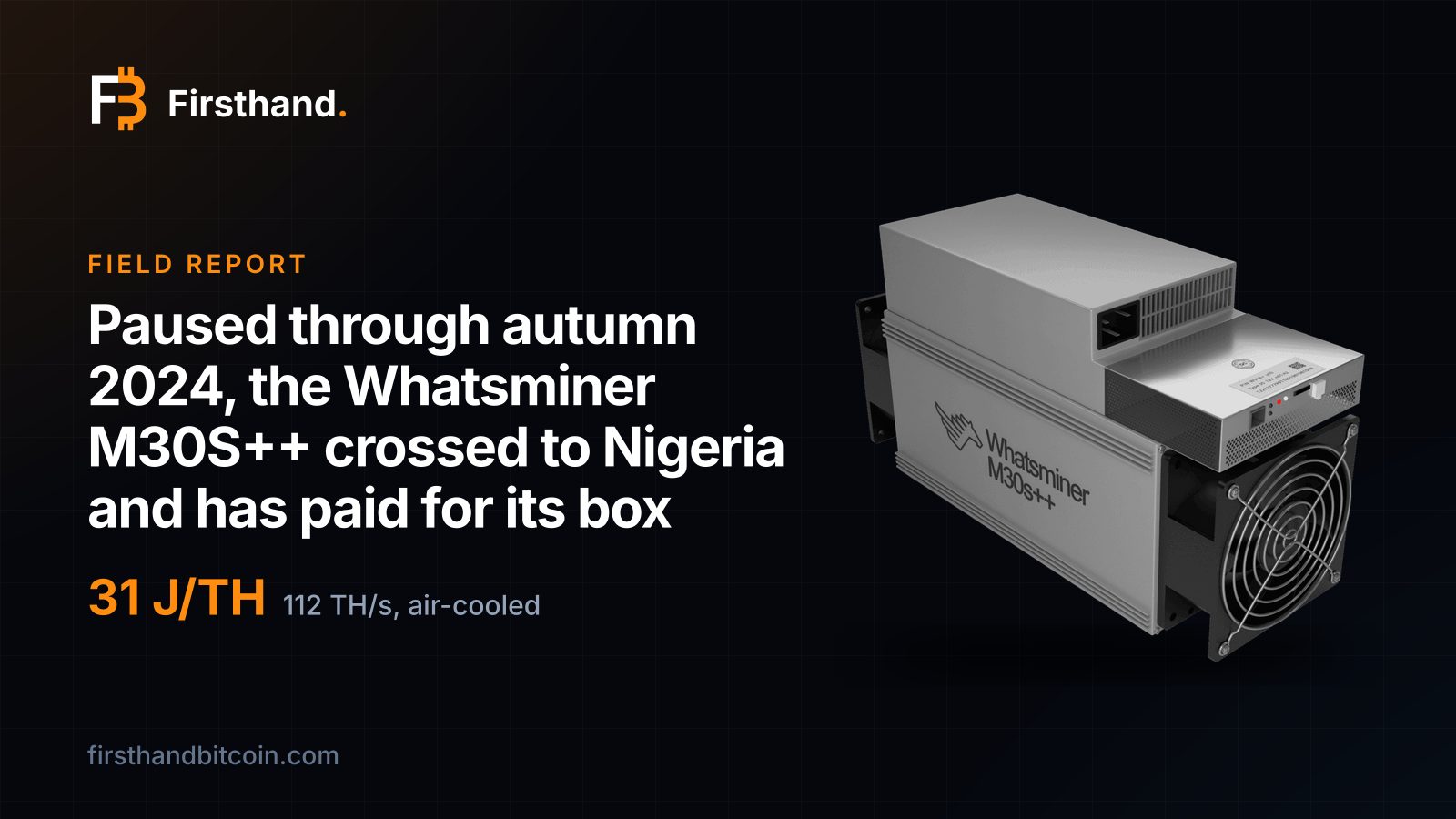
MicroBT Whatsminer M30s++ (112 TH/s)
A box bought for $1,105 has kept 0.0835 bitcoin
The Whatsminer M30S++ is a MicroBT air-cooled machine at 31 J/TH. MicroBT's own shop page lists it at 102 TH/s from 3,162 W in a 13.5 kg chassis, 430 mm long, 155 mm wide and 226 mm tall, with a working temperature of -5 °C to 35 °C and a one-year warranty. The unit we follow is the 112 TH/s bin, which our store lists at 3,472 W.
Bought once its price settled, on 4 October 2023, it cost $1,105. Landed at our Argentina site, the all-in cost was $2,137. In 1,020 days since it has mined and kept 0.0835 BTC, worth about $6,815 today, for $3,512 of electricity. That is $3,303 of cashflow, or 155% of its landed cost, with every coin kept: it has paid for its box 1.5× over.
Half its coins came in the first 199 days
The M30S++ was bought six months before the April 2024 halving. In the 199 days before it, it kept 0.0430 BTC, 52% of everything it has mined, in 20% of its life so far, and those coins are worth about $3,510 today. A petahash earned $62.27 a day on the day we bought it and $123.75 on 21 April 2024, the day after the halving, on our hashprice chart.
After the halving it kept 0.0405 BTC in 821 days. Its cash margin after electricity, at the prices of each day, was about $4.67 a day before it and about $1.08 a day after. A machine bought ahead of a halving is paid for in advance by the months before it, and the M30S++ was.
At 31 J/TH, Argentina's 6¢ stopped paying in August 2024
A machine's line is the hashprice at which it stops covering its own power. At 31 J/TH a petahash uses 744 kWh a day: $44.64 at Argentina's 6¢, and $29.02 at Nigeria's 3.9¢. On 15 August 2024 hashprice was $43.01, and the M30S++ stood switched off from 15 August 2024. It came back on 31 October, when hashprice had recovered to $53.09, and ran 39 days more in Argentina.
Then it made its one move. On 9 December 2024 it crossed to Nigeria, after 14 months in Argentina, on a day when hashprice was $61.58. It was not forced out: 6¢ was still clearing it. But a year of figures said that cheap power was the better home for a 31 J/TH machine, and a crossing is freight, customs and downtime at both ends, so a machine makes it once and does not shuttle. That is the rule in a machine crosses to cheap power once. It has run 664 days in Nigeria since, with a few short pauses along the way: four days in March 2026 and eleven from the end of June, when the 30-day average hashprice reached its lowest in the run.
Over the whole run it has stood switched off for 91 days, almost all of them in the autumn of 2024.
On 15 August 2024 hashprice was $43.01, under the $44.64 it takes to cover 31 J/TH at 6¢. The machine stood idle until the end of October.
Nigeria's line has held, and Argentina's has not
Since the halving, hashprice has been under Argentina's $44.64 line on 421 of 912 days, so at 6¢ the machine would have been losing money on nearly half of them. Under Nigeria's $29.02 line it has been on 17 days. The lowest was $27.74 on 6 June 2026, 4% under it, and the lowest 30-day average was $30.09, to 3 July, 4% above it.
Hashprice was $38.92 a petahash a day on 18 October, 34% above Nigeria's line and 13% under Argentina's. That is the whole case for where the M30S++ lives. At 6¢ it would not be running today, and at 3.9¢ it earns.
What is left, and what the halving does to it
Today a coin costs it about $66,400 of electricity at Nigeria's 3.9¢, against a bitcoin price of $81,897. At 6¢ the same coin would cost about $102,200, which is more than a coin is worth. A new owner would see 9% in a first year in Nigeria.
The April 2028 halving halves the coins a petahash earns. At today's price and difficulty that puts hashprice near $19.46, well under even the Nigerian line of $29.02. The forward figures assume what every forward projection does, that bitcoin returns to its previous high. At $124,493 a halved hashprice would be about $29.68, 2% above Nigeria's line, so the machine's last stretch hangs on the price recovering and on nothing else going wrong. The forward figures to the halving add 0.022 BTC, worth about $2,691 at that price, which would take cashflow to about 2.8× the landed cost.
A machine that no site can pay for is switched off rather than mined at a loss, and it keeps every coin it has made.
What it says about the next machine you buy
Machines are the roof, not the building, as the roof guide puts it: the test is whether a machine earned enough to buy its replacement. The M30S++ has banked $3,303 after electricity against a $2,137 landed cost, so it has.
We found no operator survey of this machine to cite, so reliability is unknown rather than good. What exists is a repair shop's guide: D-Central says a buck-boost fault on one hashboard leaves that board dropping out while the other boards keep hashing. That is a troubleshooting reference and not a failure rate, and MicroBT's one-year warranty ran out long ago.
The arithmetic for its replacement is plain. A machine at 13.5 J/TH has a line of $19.44 at 6¢, under a halved hashprice, so it keeps clearing at 6¢ after the halving where the M30S++ needs the price to recover even at 3.9¢. The figure below ranks what we would put in its place today, on cost per coin and then year-one return.
- MicroBT Whatsminer M74S+ (332 TH/s) — 12 J/TH, In stock, $25,722 of electricity per bitcoin, 31% year one
- MicroBT Whatsminer M73S (560 TH/s) — 13 J/TH, In stock, $27,866 of electricity per bitcoin, 37% year one
- MicroBT Whatsminer M7DS (672 TH/s) — 13.5 J/TH, In stock, $28,938 of electricity per bitcoin, 40% year one
Sources and further reading
- WhatsMiner M30S++ — MicroBT shop, 2026
- Whatsminer M30S++ buck-boost fail — D-Central, 2026
Which machines this covers
Disclosure
Firsthand Bitcoin sells and hosts mining hardware, including this machine. No manufacturer, distributor or affiliate programme paid for or reviewed this page and we take no commission on the links above. Historical figures are computed from daily bitcoin price and network hashprice, each day valued at its own prices. Nothing here is investment advice.