Guide · Oct 29, 2026 · 6 min read
What a bitcoin block is, and why one arrives about every ten minutes
A block is a batch of a few thousand payments, stamped with a prize for whoever finishes it first. The network is built so that one is found about every ten minutes, 144 a day, and every machine you might buy is a ticket in that race.
A block is a batch of payments, with a lid on it
Every bitcoin payment waits in a queue until someone puts it in a block. A block is just a batch: a list of payments, bundled together, with a short label on the front that says which block came before it. Bitcoin's developer guide puts it plainly: "Every block must include one or more transactions."
The label matters more than it looks. Each block carries a fingerprint of the one before, so the blocks form a chain. Change a payment in an old block and its fingerprint changes, which breaks the label on the next block, and the next. That is why nobody can quietly rewrite history, and why the record is called the blockchain.
In the 30 days to 28 October, a block on our block size chart held about 4,700 payments and ran to about 1.6 megabytes on average. A typical block is roughly the size of a photo from a phone.
Payments that are not in a block yet wait in a holding area called the mempool. A block has limited room, so the miner picks the payments that pay the best fee first. On 29 October about 53,000 payments were waiting on our mempool chart, and the fee for the fastest slot was about 2 satoshis per byte, so almost nothing had to wait long. In a busy week the queue is longer and the fee for a seat is higher.
The first line of every block pays the miner
Here is where mining comes in. The person who assembles a block gets to write its first line, and that line is special. Satoshi Nakamoto's original paper says it in one sentence: "the first transaction in a block is a special transaction that starts a new coin owned by the creator of the block."
That first line pays the block reward. Today it is 3.125 new bitcoin, which the rules cut in half at every halving, plus whatever fees the payments in the block chose to pay. Fees are small right now: they averaged about 0.019 bitcoin a block over the 30 days to 28 October, less than 1% of the new coins. The guide to where a miner's bitcoin comes from has the split.
At $80,809, the close on 28 October, a block's reward of about 3.14 bitcoin was worth roughly $254,000. That is what the whole network of mining machines is competing for, 144 times a day.
Only one miner gets each block, and finding it takes guesses
To close a block, a miner has to find a number that, when mixed with the block's contents and run through a fixed recipe called a hash, produces an answer that starts with a long run of zeros. There is no shortcut. You can only guess a number, check the answer, and guess again. The first miner to hit a qualifying answer broadcasts the block, everyone checks it in a moment, and the race starts again on the next block.
The guessing is what a machine's hashrate measures. A machine that does 200 terahashes a second makes 200 trillion guesses every second. The guide to what a hash is explains the unit, and the one on solo mining shows why one machine almost never wins a block alone. That is why machines work in a mining pool, which shares the reward out by the guesses each machine contributed.
Only the winner's block counts. Every other miner's work on that block is discarded, which is why the reward is worth so much. It pays for the electricity of everyone who guessed and lost, too.
Why ten minutes: the difficulty is set to make it so
Nothing in the rules fixes how long a block takes. What bitcoin fixes is how hard the guess is, and it re-tunes that every 2,016 blocks. The developer guide says the network uses the timestamps in the blocks, that "the ideal value is 1,209,600 seconds (two weeks)" for 2,016 blocks, and that the difficulty goes up if blocks arrive faster and down if they arrive slower. Divide two weeks by 2,016 blocks and you get 600 seconds: ten minutes, or 144 blocks a day.
That is the whole mechanism. If more machines join, blocks come faster, and at the next adjustment the guess gets harder until the pace is back to ten minutes. If machines leave, blocks slow down and the guess gets easier. The guide to what mining difficulty is follows what that does to your machine's earnings.
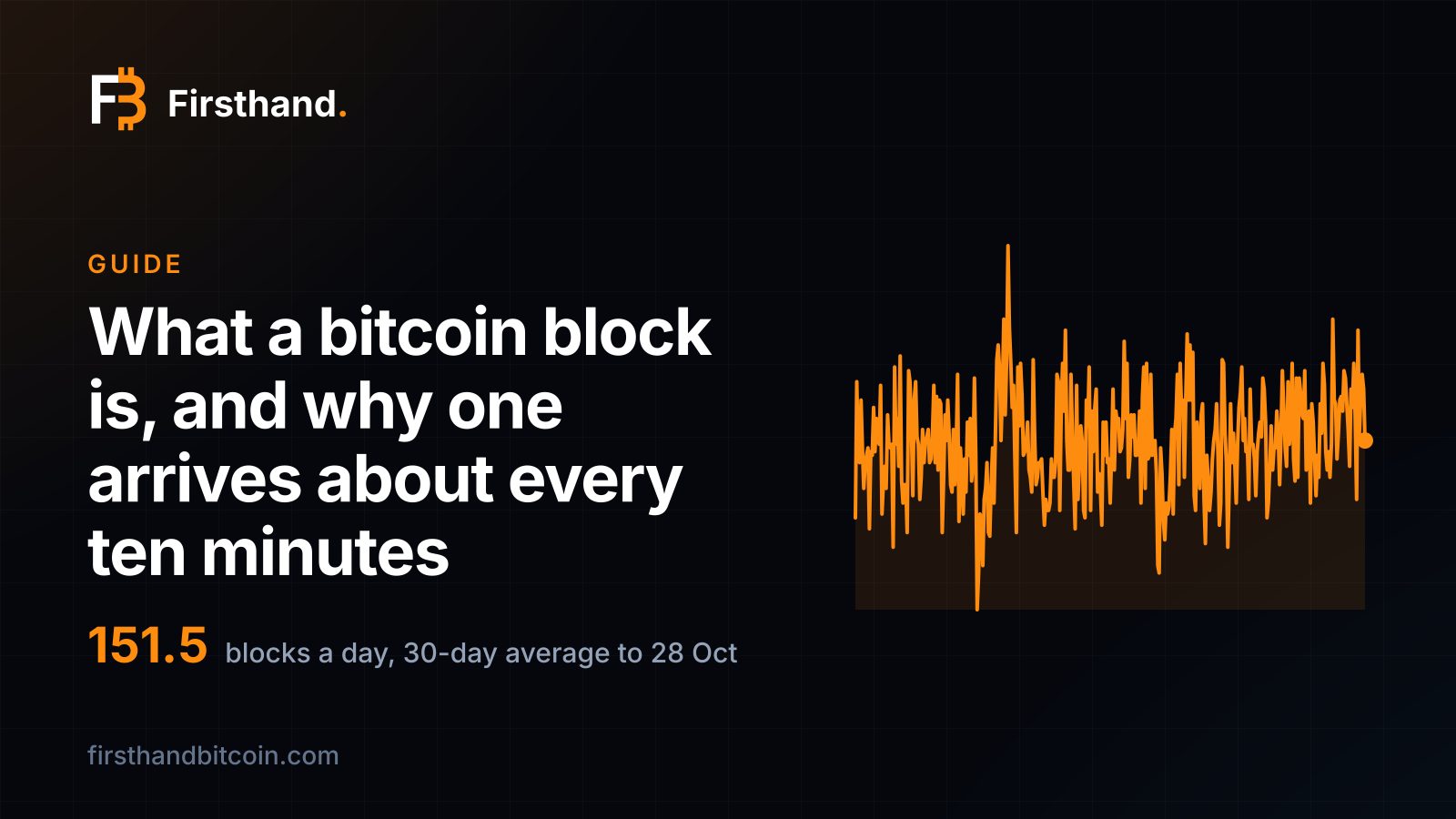
You can see it happen. Over the 30 days to 28 October the network found 151.5 blocks a day on average, one every 9.5 minutes, because machines had returned and the previous adjustment had not yet caught up. On 16 October difficulty rose 5.9%, to 140.58 trillion, to pull the pace back. Over the full year to 28 October the average was 143.4 a day, within 1% of the target.
Bitcoin does not fix how long a block takes. It fixes how hard the guess is, and re-tunes it every two weeks.
Ten minutes is an average, not a timer
Because mining is guessing, blocks do not arrive on a clock. Two can land a minute apart, and then twenty minutes can pass with none. Nobody can predict the next one, which is the point: nobody can arrange to win it either.
The daily count shows the spread. In the year to 28 October the network found as few as 98 blocks in a day and as many as 197, with an average within 1% of the target. A day with 98 blocks is a slow stretch of luck, not a fault. The median wait for a payment to be confirmed on 28 October was 12.5 minutes, and over the previous 30 days it averaged 10.9, which is what you would expect when one block takes about ten.
For a machine owner, the useful consequence is that your earnings are an average too. A machine's expected coins per day is steady, because it is a small, constant share of the guesses. What you actually see on a given day moves around that figure, and a pool's payout rules smooth it out for you.
What it means for a miner
Everything you earn comes from blocks, and the maths of a block is the same for every machine on the network. About 450 new bitcoin are issued each day, in 144 blocks, and the machines on the network share them in proportion to their guesses. The more machines there are, the smaller your share, which is what difficulty tracks, and in April 2028 each block's reward halves, which the halving guide covers.
That sets the job of a machine: make its share of the guesses for as little electricity as possible. On our best case, an Antminer S23 XP Hyd at 8.9 J/TH on Nigeria's 3.9¢ power, electricity makes a bitcoin for about $18,538 at today's hashprice, against a market price of $79,857 on 29 October. That is electricity only, and output is not guaranteed. Mining is how a coin gets made for far less than it costs to buy, and every block is a chance to make 3.125 of them.
About 450 new bitcoin a day, in 144 blocks, shared by every machine on the network.
Sources and further reading
- Block Chain, Bitcoin developer guide — Bitcoin.org, 2026
- Bitcoin: A Peer-to-Peer Electronic Cash System — Satoshi Nakamoto, 2008
Disclosure
Firsthand Bitcoin sells and hosts mining hardware, including this machine. No manufacturer, distributor or affiliate programme paid for or reviewed this page and we take no commission on the links above. Historical figures are computed from daily bitcoin price and network hashprice, each day valued at its own prices. Nothing here is investment advice.