Guide · Oct 8, 2026 · 6 min read
What the bitcoin halving is, and what it does to a mining machine's earnings
Every 210,000 blocks, about every four years, the bitcoin a miner is paid for each block is cut in half. A machine's daily coins fall by about half with it, its power bill does not, and that is the whole reason efficiency matters. Here is the halving, step by step.
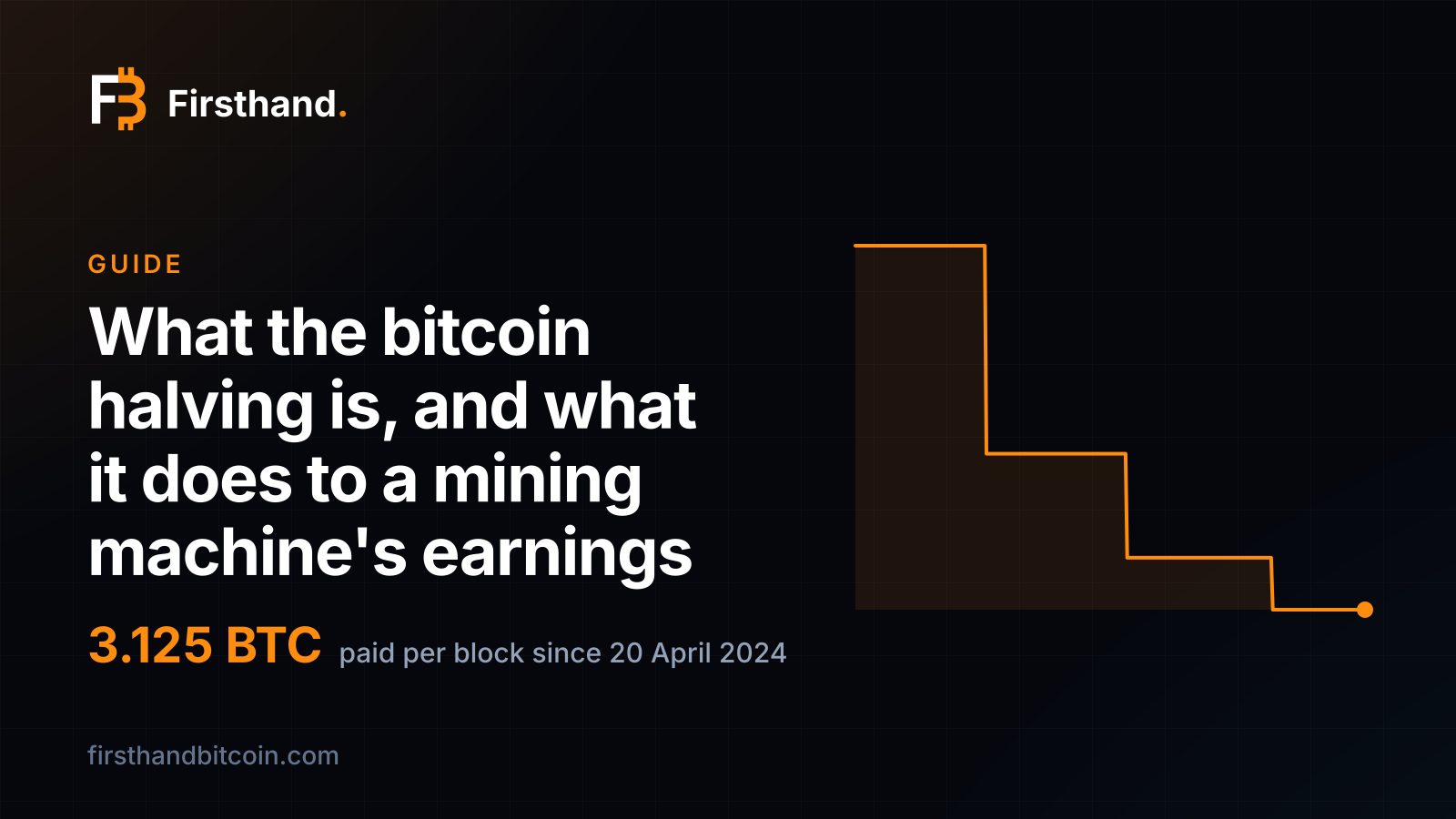
The halving cuts the reward for every block in half
Every block that is added to the bitcoin chain pays the miner who found it with new bitcoin. That payment is called the block reward, or the subsidy. It started at 50 bitcoin per block, and the software that runs the network says in plain words that it "is cut in half every 210,000 blocks which will occur approximately every 4 years", in the Bitcoin Core source code. That cut is the halving.
Our own data series shows three of them. The reward was 25 bitcoin when our records begin in January 2013, fell to 12.5 on 9 July 2016, to 6.25 on 11 May 2020 and to 3.125 on 20 April 2024, which is where it stands today. Nothing about a halving is decided on the day. The date follows from counting blocks, and everyone can see it coming years ahead.
The schedule is also what caps bitcoin at 21 million coins. Fifty bitcoin, then twenty-five, then 12.5 and so on adds up, over 210,000 blocks at each step, to just under 21 million. On 7 October 2026 our supply series shows 20.09 million already mined, more than 95% of the total. The last coins arrive ever more slowly, one halving at a time.
A machine earns about half the coins the next day
The reward is what the whole network shares out, in proportion to hashrate. So when it halves, every machine's share of it halves too, unless the network's hashrate falls at the same time. A machine does nothing differently. It is paid less for the same work.
Our data shows it each time. On 19 April 2024, the day before the last halving, one petahash of mining power earned about 0.00163 bitcoin a day. A month later, on 20 May, it earned about 0.00078. For a 200 TH/s machine, which is a fifth of a petahash, that is about 0.000325 bitcoin a day falling to about 0.000156. In 2020 the same comparison, 10 May against 10 June, gives 0.0177 and 0.0084 bitcoin for a petahash, and in 2016, 8 July against 8 August, gives 2.53 and 1.27.
In all three the figure landed within a few percent of half. Fees paid by users add a little on top of the reward, and difficulty moves the number up and down by a few percent in the weeks around it, but the big step is the halving itself.
The reward halves on one block. The power bill does not change at all.
The power bill does not halve
A machine uses the same electricity the day after a halving as the day before. That is the point that matters for anyone buying one. Revenue falls by half at a stroke and the cost of running the machine stays where it was, so the margin between them shrinks.
The margin is thin or thick depending on how much power a machine needs for each terahash it produces, which is its efficiency, written in joules per terahash, J/TH. Take a petahash running for a day. A machine at 13.5 J/TH uses 324 kWh to produce it, which costs $19.44 at 6¢ a kilowatt-hour. A machine at 20 J/TH uses 480 kWh, which costs $28.80 at the same price. Hashprice, the figure for what a petahash earns in a day, was $40.74 on 7 October on our hashprice chart. Both machines clear their power at that level. Cut it in half, to about $20, and only the first still does. The guide to hashprice explains the figure, and the guide to efficiency and halvings takes the 13.5 J/TH and 20 J/TH cases further.
Three checks to make before you buy a machine
First, find the machine's J/TH. It is on every spec sheet, and the guide to reading a spec sheet shows where. The lower the number, the less power each terahash costs you.
Second, turn it into a daily power cost. Multiply the J/TH by 24 to get the kilowatt-hours a petahash uses in a day, then by the price you will pay for a kilowatt-hour. At 12 J/TH that is 288 kWh a day, and $17.28 at 6¢ or $11.23 at 3.9¢. The guide to what electricity costs a miner covers the power price itself.
Third, put it beside half of today's hashprice. At today's price and difficulty, held flat and not as a forecast, the next halving would take hashprice from $40.74 to about $20. A machine whose daily power cost sits under that line still earns after the halving. A machine above it earns only if bitcoin's price rises to make up the difference.
It is simple arithmetic, and it is the arithmetic behind why a machine can cross to cheaper power once, when a full year of figures says the cheaper site is decisively better.
What bitcoin's price did after the last three
The coins a machine earns halve. The dollars they are worth depend on bitcoin's price, and that is not something a halving sets. In our price series, bitcoin closed at $663 on the day of the 2016 halving and at $2,455 a year later. On the day of the 2020 halving it closed at $9,318, and a year later at $56,908. On 20 April 2024 it closed at $64,286, and a year later at $84,774.
That is a record, not a prediction. A price can do anything over two and a half years, and nobody knows what it will do. It is why our forward figures assume that bitcoin returns to its previous high, as every projection on the site does, and why they say so. The machine's efficiency is the part of the sum you can check today.
When the next one comes
The next halving comes at block 1,050,000, five times 210,000. On 8 October 2026 the chain stood at block 970,455 on our halving page, which leaves about 79,500 blocks. At the usual rate of a block every ten minutes that is around April 2028, about a year and a half from now. The reward will drop from 3.125 bitcoin to 1.5625.
Blocks sometimes arrive faster than every ten minutes, when more machines have switched on, and the date moves earlier by days. The count of blocks does not move.
Weaker machines switch off, and difficulty eases
A halving does not leave the network as it was. Some machines, the least efficient ones on the dearest power, stop clearing their electricity and are switched off. With less hashrate competing for blocks, mining difficulty is adjusted down at a following retarget, and each machine still running earns a little more of the reward than before.
The last two halvings show it in our series. Difficulty stood at 16.1 trillion on the day of the 2020 halving and 13.7 trillion a month later. On the day of the 2024 halving it stood at 86.4 trillion and a month later at 83.2 trillion. The easing is real but small beside the halving itself, and it takes a few weeks to arrive. It rewards the machines that were efficient enough to stay on.
What it means for a miner
A halving is a certain, dated, visible event, and a miner has years to prepare for it. The ones who are ready are the ones running efficient machines on cheap power, because for them the margin is still there the day after.
If you are choosing a machine, do the three checks. If you are hosting, the power rate you pay is the other half of the same sum. And whatever the price does, the bitcoin a machine has already mined stays in your wallet. Nobody has to sell it to pay the power bill. Output is never guaranteed.
Efficiency decides how many halvings a machine survives.
Sources and further reading
- Bitcoin Core: GetBlockSubsidy (src/validation.cpp) — Bitcoin Core, 2026
Disclosure
Firsthand Bitcoin sells and hosts mining hardware, including this machine. No manufacturer, distributor or affiliate programme paid for or reviewed this page and we take no commission on the links above. Historical figures are computed from daily bitcoin price and network hashprice, each day valued at its own prices. Nothing here is investment advice.