Guide · Oct 28, 2026 · 6 min read
What a satoshi is, and how to read the small amounts a bitcoin miner earns
One bitcoin splits into 100 million satoshis, and a miner's daily pay is counted in thousands of them: on 27 October a 270 TH/s machine earned about 12,100 sats, or $9.71. Once you can move between bitcoin, sats and dollars, every pool dashboard makes sense.
Short answer: a satoshi is one hundred-millionth of a bitcoin
A satoshi, usually called a sat, is the smallest piece of bitcoin that is recorded on the blockchain. The Bitcoin Wiki) puts it in one line: "It is a one hundred millionth of a single bitcoin (0.00000001 BTC)." The unit is named after Satoshi Nakamoto, the creator of bitcoin.
So one bitcoin is 100,000,000 sats. That is the only fact you have to remember. Everything else in this guide is arithmetic on that number.
Miners count in sats because their pay is small and the decimals are long
A mining machine does not earn a bitcoin a day. It earns a sliver. A pool dashboard may show a day's earnings as 0.00012132 BTC, and it is hard to tell at a glance whether that is a good day or a bad one. The same amount written as 12,132 sats is easier to compare with yesterday, and with what your electricity cost.
Nothing about the money changes. It is the same amount written with the zeros taken out, the way you would say 250 cents and not 0.0000025 million dollars.
Step 1: turn bitcoin into sats by moving the decimal point eight places
Take the bitcoin figure and move the decimal point eight places to the right. 0.00012132 BTC becomes 12,132 sats. In the other direction, divide by 100,000,000, which is moving the point eight places to the left. The table has the amounts you will meet most often on a dashboard.
If you are ever unsure, count the zeros. A figure that starts 0.00 is in the hundreds of thousands of sats or fewer, and a figure that starts 0.0000 is in the thousands or fewer.
| In bitcoin | In sats |
|---|---|
| 0.00000001 BTC | 1 sat |
| 0.00001 BTC | 1,000 sats |
| 0.0001 BTC | 10,000 sats |
| 0.001 BTC | 100,000 sats |
| 0.01 BTC | 1,000,000 sats |
| 1 BTC | 100,000,000 sats |
Step 2: turn sats into dollars with one number, sats per dollar
Divide 100,000,000 by the bitcoin price and you have how many sats one dollar buys. On our bitcoin price series bitcoin closed at $80,000.34 on 27 October 2026, so a dollar was worth about 1,250 sats, and one sat was worth about 0.08 of a cent.
Now the day's earnings: 12,132 sats divided by 1,250 is $9.71. When the price moves, only the sats-per-dollar number changes, so work it out again each time you look. Earlier in the year, at $60,771 on 6 June, a dollar was worth about 1,646 sats.
A worked example: what one machine earns in a day, in sats
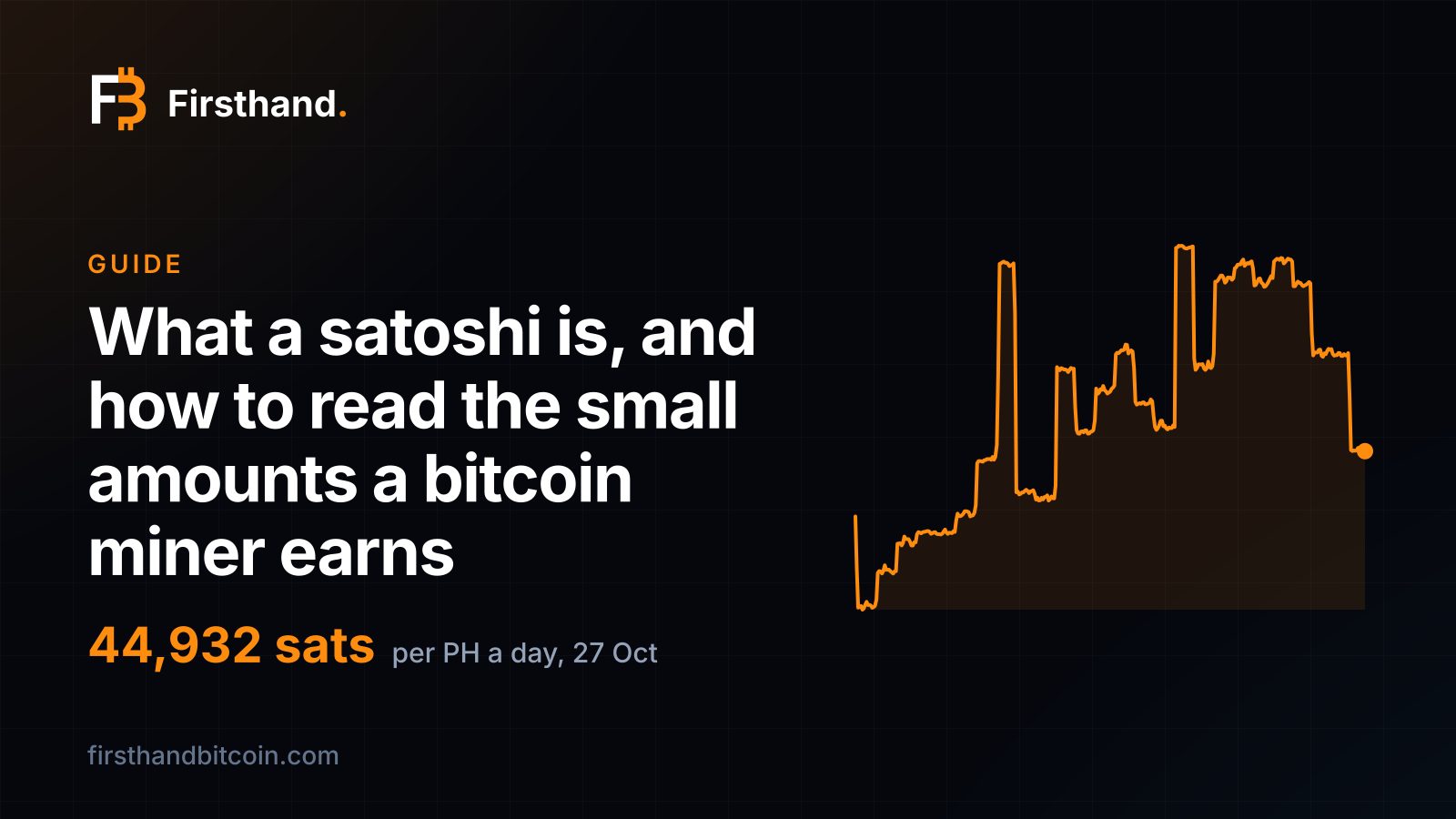
Our hashprice chart shows what one petahash of the network earns in a day: 0.000449 bitcoin on 27 October, which is 44,932 sats. A petahash is 1,000 terahashes. A machine rated at 270 TH/s is 0.27 of a petahash, so its share of that day was 0.27 times 44,932, about 12,132 sats, worth $9.71. Over a 30-day month at the same rate that is about 363,950 sats, which is 0.0036 BTC, or $291.
Over the last 365 days a petahash earned between 40,492 and 50,686 sats a day on our chart, so the day above is a typical one. What hashprice is, and where the figure comes from, is in what hashprice means for your miner. This is the network average per petahash before the pool's fee. What your own machine earns depends on its real hashrate and its uptime, and it is not guaranteed.
The same sum for a smaller and a bigger machine
The method does not change with the size of the machine. Convert its hashrate to petahashes by dividing the terahashes by 1,000, multiply by the day's sats per petahash, and divide by sats per dollar for the dollar value. The table runs it for three sizes at the 27 October figures: 44,932 sats per petahash per day, and 1,250 sats to the dollar.
Notice that the dollar column is the sats column divided by the same number each time. If you remember one row, you can rebuild the others by scaling it up or down.
| Machine | Sats a day | Dollars a day | Sats in 30 days |
|---|---|---|---|
| 100 TH/s | 4,493 | $3.59 | 134,800 |
| 270 TH/s | 12,132 | $9.71 | 363,950 |
| 600 TH/s | 26,959 | $21.57 | 808,800 |
Step 3: put the power bill in sats too
A machine's earnings only mean something next to what it costs to run. Take the 270 TH/s machine and give it a power draw of 3,645 W, which is the rating of the Antminer S21 XP. Over a day that is 3,645 watts times 24 hours, 87.5 kilowatt-hours. At Argentina's 6¢ that is $5.25 of electricity, and $5.25 times 1,250 is about 6,560 sats.
The day's earnings were 12,132 sats, so about 5,570 sats are left, which is $4.46. At Nigeria's 3.9¢ the same electricity costs $3.41, about 4,270 sats, and about 7,870 sats are left. Writing both sides in sats shows how much of each day's coin goes to the power company, and how much stays in your stack. It is the same sum as a machine's power line on the hashprice chart, with the units changed.
Reading a pool's payout minimum in sats
Pools quote their payout minimums in bitcoin, and sats make them easier to picture. Our pool guide lists minimums as low as 0.0002 BTC, which is 20,000 sats, and as high as 0.005 BTC, which is 500,000 sats. Pools change them, so read the pool's own page on the day you join.
Divide the minimum by the day's sats. At 12,132 sats a day, before the pool's fee, the 270 TH/s machine reaches 100,000 sats, which is 0.001 BTC, in about eight days, and 500,000 sats in about 41. If the first payout has not arrived in the first week, that is the arithmetic and not a fault.
Three checks before you trust a number
Check 1: count the zeros. The commonest mistake is a decimal slip, and it is a tenfold error: 0.0001 BTC is 10,000 sats, and 0.001 BTC is 100,000 sats. Move the point eight places and look at the result before you act on it.
Check 2: keep sats and dollars apart. A sat is not a cent. One sat is worth a fraction of a cent, and about 1,250 of them make a dollar at today's price.
Check 3: compare like with like. A daily figure of 12,132 sats is a day. A pool's payout threshold, which is in the pool guide, is a balance. Divide one by the other to see how many days it takes to arrive, and when the payout lands at the wallet address you gave, you can read the amount the same way: what a wallet address is and how payouts reach it.
What it means for a miner
Counting in sats is counting the stack. Every sat a machine earns is a piece of bitcoin you keep, and the question for a machine is how much power it takes to make one. On the best machine in stock, the Antminer S23 XP Hyd at 8.9 J/TH on Nigeria's 3.9¢ power, electricity makes a bitcoin for about $18,540. A dollar of that electricity makes about 5,394 sats.
At the market price of $81,046 on 28 October a dollar buys about 1,234 sats. That is electricity only, at today's hashprice, and output is not guaranteed. The gap between the two numbers is the reason to mine, and the sats are how you keep score. A simple habit helps: write down your pool balance in sats once a week, and the difference between two weeks is what the machine earned. Set it beside the row of the table that matches your machine's size.
A dollar of electricity makes about 5,394 sats on our best machine. A dollar at the market buys about 1,234.
Sources and further reading
- Satoshi (unit) — Bitcoin Wiki, 2024
Disclosure
Firsthand Bitcoin sells and hosts mining hardware, including this machine. No manufacturer, distributor or affiliate programme paid for or reviewed this page and we take no commission on the links above. Historical figures are computed from daily bitcoin price and network hashprice, each day valued at its own prices. Nothing here is investment advice.