Home / Blog / MicroBT Whatsminer M63
Progress report · Sep 29, 2026 · 2 min read
Nearly two years in, the Whatsminer M63 has stopped once and moved once
At 20 J/TH the M63 is the kind of hardware a weak hashprice tests first, and 2026 tested it: it stood switched off in March and crossed to cheaper power in May. Here is what it has banked and what the forward figures say.
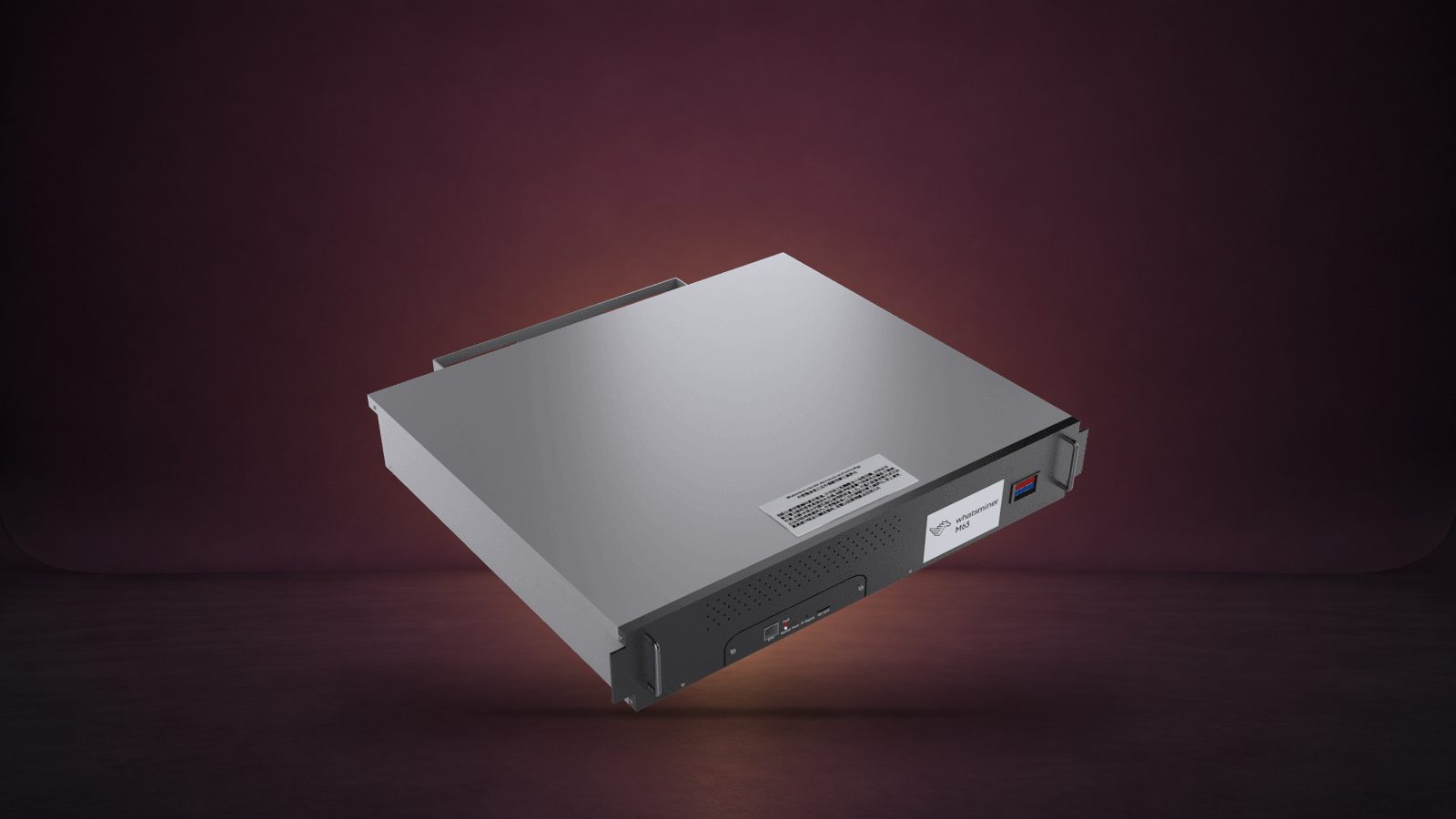
MicroBT Whatsminer M63 (360 TH/s)
Nearly two years in
MicroBT unveiled the M63 in Dubai on 26 October 2023, a hydro-cooled machine rated at 334 to 366 TH/s and 19.9 J/TH. The 360 TH/s unit we list draws 7,200 W. Bought at its settled price of $5,972 in October 2024, and landed at $7,719 at our UAE site, it has now run 704 days.
In that time it has mined and kept 0.1218 BTC, worth $10,287 today, for $7,050 of electricity: about $57,900 a coin over its whole run. That is $3,237 of cashflow, or 42% of what it cost to land, with more than half of a four-year life still to go.
The only pause in its life was 17 days in March
At 20 J/TH this machine burns twice the power per terahash of the S23 generation, and it feels a soft market first. Our engine's rule is simple: a machine is switched off when its trailing month at its current site would have lost money, and back on when a month pays again. On 11 March 2026, after a run of low hashprice, the M63 stopped. It stood idle for 17 days.
The cause was the market, not the machine. Hashprice was $52.22 a petahash a day on 6 October 2025 and $38.07 on 2 January 2026. On 11 March it was $30.54, and the hashprice chart went on to its low of $27.74 on 6 June. A machine that sips power keeps earning through that. One at 20 J/TH runs out of margin at a 6¢ site.
It is the only pause the engine has given it. A machine that is switched off keeps every coin it has already mined, and it came back on as soon as a trailing month paid again.
At 20 J/TH a machine cannot ride out a soft hashprice the way a newer one can.
It crossed to Nigeria on 19 May 2026
The machine has made one move, the way every machine we host does: on 19 May 2026 it went to Nigeria, where power costs 3.9¢ instead of 6¢. The rule for it is a trailing year in which cheap power is decisively better, and by May 2026 the year said so. It has spent 134 days there since.
Nigeria's uptime is lower than the UAE's, 73.6% against 99.3% on our sites page, so it mines fewer coins per day. It also pays a third less for the power. Today a coin costs this machine about $42,400 in Nigeria against $65,300 in the UAE, and its first-year return at today's price is about 47%, against 30% in the UAE. The crossing is the reason the machine is still earning its keep. The guide to crossing once explains why it is made only once.
What is left in it
At today's difficulty, and with bitcoin back at its previous high of $124,493, it has another 0.072 BTC in it before the April 2028 halving, worth about $8,948. That would leave it at roughly 1.6× its landed cost covered by the halving, and still running.
It will do that on cheap power, not on efficiency. At 20 J/TH it is not the machine we would point a new buyer at for a 6¢ site today. But at $1,814 a unit, $5.04 a terahash, it has the lowest entry price it has ever had, and in Nigeria it is a proven machine at a settled price. How efficiency decides how many halvings a machine survives shows where the line sits.
- Bitmain Antminer S23 Hyd (563 TH/s) — 9.5 J/TH, In stock, $31,296 of electricity per bitcoin, 27% year one
- Bitmain Antminer S21j XP Hyd (495 TH/s) — 12 J/TH, In stock, $39,387 of electricity per bitcoin, 41% year one
- Bitdeer SealMiner A3 Pro Hyd (666 TH/s) — 12.5 J/TH, In stock, $40,645 of electricity per bitcoin, 33% year one
Sources and further reading
- MicroBT debuts WhatsMiner M60 series in Dubai — GlobeNewswire, 26 Oct 2023
Which machines this covers
- MicroBT Whatsminer M63 (360 TH/s)
- MicroBT Whatsminer M63 (368 TH/s)
- MicroBT Whatsminer M63 (370 TH/s)
- MicroBT Whatsminer M63 (372 TH/s)
- MicroBT Whatsminer M63 (374 TH/s)
- MicroBT Whatsminer M63 (376 TH/s)
- MicroBT Whatsminer M63 (336 TH/s)
Disclosure
Firsthand Bitcoin sells and hosts mining hardware, including this machine. No manufacturer, distributor or affiliate programme paid for or reviewed this page and we take no commission on the links above. Historical figures are computed from daily bitcoin price and network hashprice, each day valued at its own prices. Nothing here is investment advice.