Data insight · Oct 26, 2026 · 5 min read
Zcash earns 27% less than in September, and a Z15 Pro still covers its power 13 times over
Zcash's price slid for four weeks after its 26 September high and then held. Its network barely changed, so a machine mines the same coins and earns about a quarter less. At 6¢ power, the Antminer Z15 Pro still takes in about thirteen times what it burns.
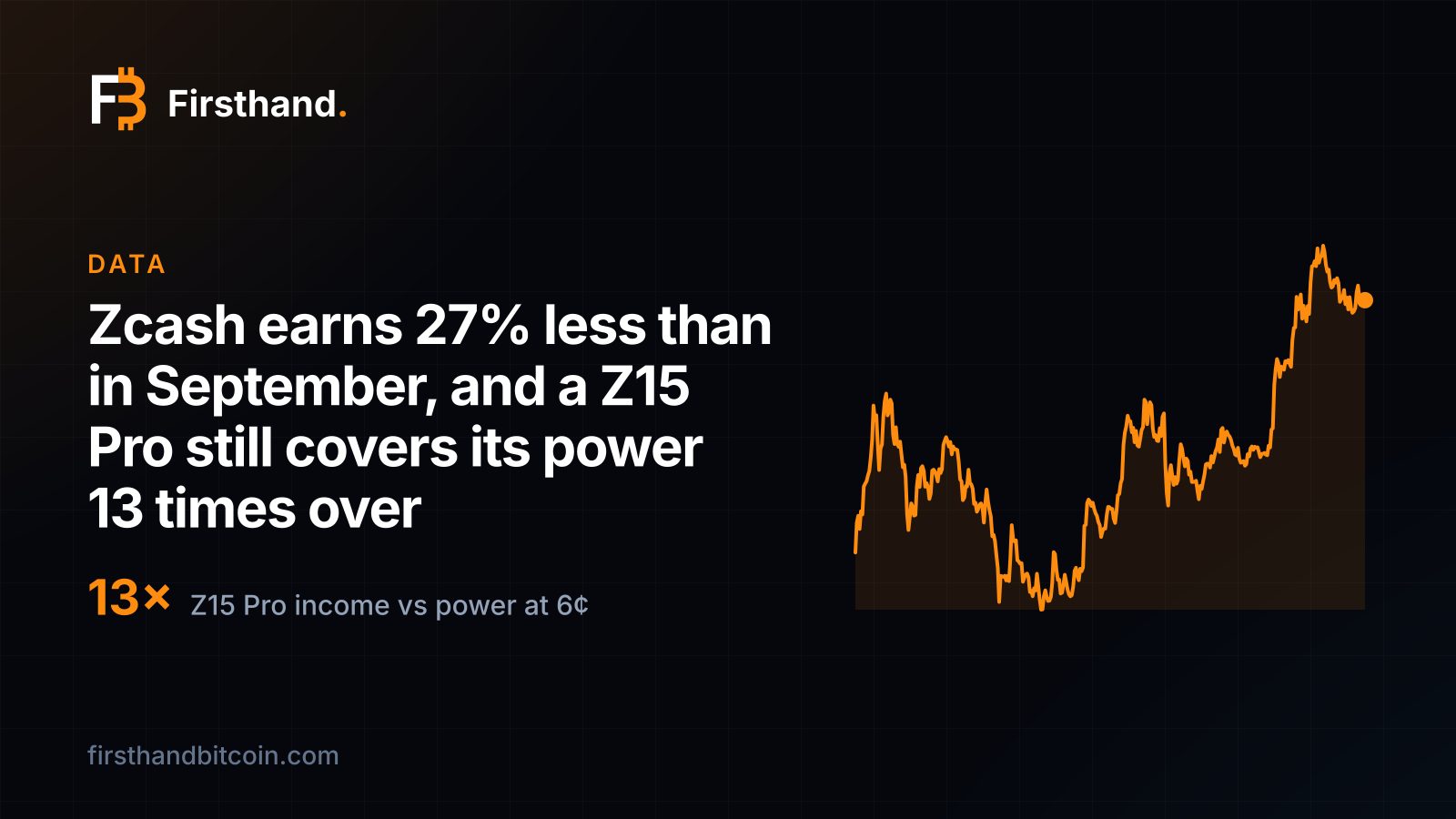
Zcash's price slid for four weeks, then held
Zcash reached $1,654.38 on 26 September, the highest in the year of Zcash data we hold, and read $1,203 on 26 October: 27% lower. Daily readings swing, so we compare weeks. The average price was $1,563 in the week of 21 to 27 September, $1,376 in the next, $1,276 in the next and $1,165 in the week of 12 to 18 October. The most recent week, 19 to 25 October, averaged $1,216, a little higher. The slide has stopped for now; it has not reversed.
It had been a fast climb up. CoinDesk reported on 4 September that Zcash jumped 20% in a day to about $1,000, a week or so after Grayscale's spot Zcash ETF began trading, with $34.5 million of short positions force-closed in 24 hours. The price in our series then went on to $1,654 within three weeks, so the four weeks since have given back a part of a very large gain.
Over the same weeks bitcoin's average went from $84,458 to $81,998, down 2.9%. Zcash moved about eight times as much, which is what a coin that has risen nine-fold in a year tends to do. We looked for a single cause of the four-week slide and did not find one in a source we could open, so we do not give one.
The network barely moved, so a machine mines the same coins
A Zcash machine's coins depend on the network's hashrate, because the reward per block is fixed. Blockonomi reported that the November 2024 halving cut it to 1.5625 ZEC a block, that miners receive 80% of it, and that the next halving is expected in late 2028.
The network hashrate averaged 30.3 GSol/s in the week of 21 September and 32.7 in the week to 25 October, a rise of 8%. The daily readings are estimates and noisy: across these five weeks they ran from 20.6 to 40.2 GSol/s, so only the weekly averages can be compared. On those, a machine mines about 7% fewer coins than it did in September.
Put the 8% more hashrate together with 22% less price and you get the Zcash hashprice, the dollar value of what each kilosol a second earns in a day: $0.0857 in the week of 21 September, $0.0624 in the week to 25 October, down 27%.
The coins per machine moved 7%. The price moved 22%.
A Z15 Pro against its own power bill
Our store lists the Antminer Z15 Pro at 840 kSol/s from 2,780 W. At last week's hashprice that is about $52 a day gross, against $72 in the week of 21 September. Its power at 6¢, the rate at our Argentina and UAE sites, is $4.00 a day, and at Nigeria's 3.9¢ it is $2.60.
Income divided by power was 18 times at 6¢ in the September week and is 13 times now. At 3.9¢ it fell from 28 times to 20. The rate at which the machine would stop covering its power is about 79¢ a kilowatt-hour today, against 108¢ in September. These are the network's typical figures before pool fees, and output is not guaranteed.
The lowest weekly hashprice in the five weeks was $0.0612, in the week of 12 to 18 October. At that level the Z15 Pro still took in about $51 a day against $4.00 of power at 6¢, nearly thirteen times. The newer Z15k, which our store lists at 525 kSol/s from 2,483 W, takes in about $33 a day against $3.58 of power at 6¢, 9.2 times.
| Antminer Z15 Pro | Week of 21 Sep | Week to 25 Oct |
|---|---|---|
| Zcash hashprice, $ per kSol/s per day | 0.0857 | 0.0624 |
| Income per day at 840 kSol/s | $72.0 | $52.4 |
| Power per day at 6¢ (2,780 W) | $4.00 | $4.00 |
| Income divided by power at 6¢ | 18.0× | 13.1× |
| Income divided by power at 3.9¢ | 27.7× | 20.2× |
| Power rate at which it stops covering power | 108¢ | 79¢ |
Per kilowatt-hour, a Zcash machine earns about seven times a bitcoin one
A bitcoin machine of the same size shows how wide the gap is. A petahash earned $36.27 a day on 25 October on our hashprice chart. An Antminer S21 XP at 13.5 J/TH burns 324 kWh a day to make that petahash, so it stops covering its power at about 11.2¢. The Z15 Pro's 79¢ is about seven times that.
The reason is in our piece from 2 October: Zcash's price rose faster than its hashrate. The weekly average price is $1,216 against $133 a year ago, 9.1 times as much, while the hashrate is 32.7 GSol/s against 8.0, 4.1 times as much. Each unit of hashrate earns more than it did, and that gap is what draws machines to the network. When more arrive, hashrate rises and each machine's share of the coins falls; the 8% rise since September has taken about 7% off each machine's count.
It is not a reason to expect the next move, in either direction. It is the reason a Zcash machine's income is far more sensitive than a bitcoin machine's to what other miners do.
What it means for a miner
A Zcash machine's output is a count of coins, and the count has barely changed since September; what changed is what each coin is worth. The price slid and a machine still took in thirteen times its power at 6¢.
The same rule holds for a bitcoin machine, with a smaller margin: efficiency decides how far you are from the line, and the coins kept are the ones that count. The best-case figure on our side is a coin for about $18,551 of electricity on an 8.9 J/TH Antminer S23 XP Hyd at Nigeria's 3.9¢, against a price of $79,765.
Zcash machines are in our store: the Z15 Pro and the Z15k. Their income moves with a coin that has gone up and down a great deal this year, and with every miner who joins the network. The live hashprice and the power rate are the two numbers that decide it.
Sources and further reading
- How Does Zcash's Halving Impact Miner Revenue and Long-Term Supply? — Blockonomi, 19 Jun 2026
- Zcash jumps 20% to landmark $1,000 level as short sellers lose $34 million — CoinDesk, 4 Sep 2026
Disclosure
Firsthand Bitcoin sells and hosts mining hardware, including this machine. No manufacturer, distributor or affiliate programme paid for or reviewed this page and we take no commission on the links above. Historical figures are computed from daily bitcoin price and network hashprice, each day valued at its own prices. Nothing here is investment advice.