Data insight · Oct 2, 2026 · 4 min read
Zcash is up eleven-fold in a year. Its hashrate has not kept up
Zcash's price rose from about $133 to about $1,498 in a year, weekly averages, and its network hashrate rose under four-fold. That gap is why a Zcash machine earns several times what it did, and why bitcoin machines earn a fraction of it per kilowatt.
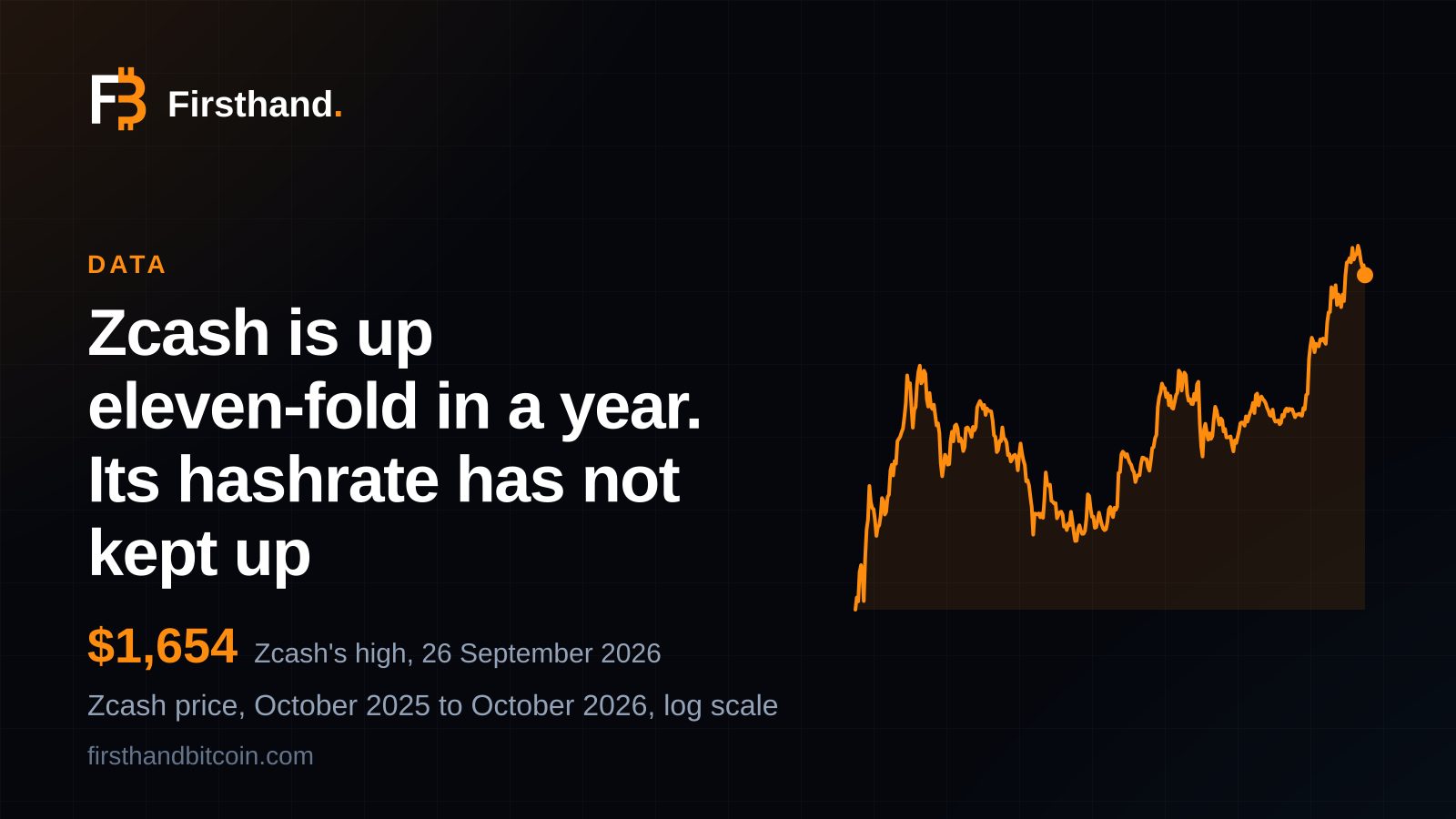
The price rose eleven-fold, the hashrate under four
Zcash closed at $74.11 on 1 October 2025, on our Zcash price chart. It reached $1,654.38 on 26 September 2026, the highest in the year of Zcash data we hold, and was $1,338.58 on 1 October. Daily readings swing, so we compare weeks: the average from 25 September to 1 October was $1,498, against $133 in the first week of October 2025. That is eleven times as much.
One caution on method: the daily hashrate reading is an estimate and it is noisy. In the last week alone it ran from 22.9 GSol/s on 25 September to 40.2 on 28 September and back to 25.8 on 1 October, so a comparison between two single days can say almost anything. Weekly averages smooth that out, and every ratio below uses them.
Over the year the network hashrate went from an average of 8.0 GSol/s to 29.0 GSol/s: a rise of about 3.6 times. Priced in bitcoin, a Zcash coin rose about sixteen-fold on the same weekly averages, from $133 when bitcoin averaged $121,448 to $1,498 when it averaged $84,001. Zcash gained against the dollar and against bitcoin together.
A machine now gets under a third of the coins, and worth far more
The reward Zcash pays per block has not changed in this window. The second halving was in November 2024, and Blockonomi reports that miners receive 80% of each block reward, with the next halving expected in late 2028. With the reward fixed, the coins each unit of hashrate earns move opposite to the network's hashrate. At 3.6 times the hashrate, a machine earns about 28% of the coins it did a year ago.
Each of those coins is worth 11 times as much, so the dollar income per unit of hashrate has risen by roughly 3.1 times (11.2 divided by 3.6, on weekly averages). That is the whole story of the year: most of the price rise has gone to miners as dollars, with a fraction taken back by new hashrate. The same arithmetic runs on bitcoin, where it is called hashprice.
The price rose 11 times. The coins each unit of hashrate earns fell to 28% of what they were.
Six weeks after the ETF, the hashrate is up a fifth
The sharpest leg started in late August. CoinDesk reported on 4 September that a Grayscale spot Zcash ETF, ticker ZCSH, had begun trading on NYSE Arca in late August, and that Zcash had jumped about 20% to the $1,000 level that day.
Compare the week of 11 to 17 August, before it, with the latest week. The price averaged $489 and is now $1,498, up about 3.1 times. The hashrate averaged 23.9 GSol/s and is now 29.0, up about 21%. Per unit of hashrate, the dollar income has risen about two and a half times in six weeks, and the network has barely moved to share it.
Bitcoin did something similar on a smaller scale. Over the same six weeks its price rose 33%, from an average of $63,385 to $84,001, and its hashrate rose 7%, from 915 to 979 EH/s. When the price rises faster than the machines can be plugged in, the miners have the gap.
What a Z15 Pro earns per kilowatt, next to a bitcoin machine
Our series carries a Zcash hashprice from late September. On 1 October it was $0.0732 per kSol/s per day, down from $0.0872 on 26 September as the price fell 19% from its high. The Antminer Z15 Pro in our store is listed at 840 kSol/s from 2,780 W. At that day's hashprice it grosses about $61 a day, or about $22 per kilowatt per day, before electricity.
On the same day bitcoin's hashprice was $39.95 per petahash per day. The most efficient bitcoin machine we sell, the S23 XP Hyd, is listed at 8.9 J/TH, which is 112 TH/s per kilowatt, and grosses about $4.49 per kilowatt per day. A Z15 Pro earns about 4.9 times that per kilowatt before power.
Power is the same for both. At 6¢ a kilowatt costs $1.44 a day, so the gap is not eaten by electricity. What it rests on is a coin that rose eleven-fold in a year, and a dollar hashprice that moved from $0.0872 to $0.0732 in five days on the price alone.
What it means for a miner
The pattern is the one that shapes every coin a miner can earn. A price rise lifts what a unit of hashrate earns until enough new machines are plugged in to split it, and then each machine's coin count shrinks. Zcash has had the first half in full and a small share of the second. We cannot say how long the gap lasts, and nothing here is a price call.
For a bitcoin miner the lesson is the same one the bitcoin chart gives, only louder: the coins a machine earns depend on the network's hashrate as much as on the price. Coins already in the wallet do not shrink when more hashrate arrives, which is why the house view is to keep them. Efficiency decides how long a machine earns once the gap closes, and the guide to efficiency and halvings is where that is worked through.
A higher price pays miners first. New hashrate is what pays it back to the network.
Sources and further reading
- Zcash jumps 20% to landmark $1,000 level as short sellers lose $34 million — CoinDesk, 4 Sep 2026
- How Does Zcash's Halving Impact Miner Revenue and Long-Term Supply? — Blockonomi, 19 Jun 2026
Disclosure
Firsthand Bitcoin sells and hosts mining hardware, including this machine. No manufacturer, distributor or affiliate programme paid for or reviewed this page and we take no commission on the links above. Historical figures are computed from daily bitcoin price and network hashprice, each day valued at its own prices. Nothing here is investment advice.