Home / Blog / MicroBT Whatsminer M63S
Machine review · Oct 25, 2026 · 5 min read
Whatsminer M63S review: 18.5 J/TH on water, and Nigeria is where it pays best
MicroBT's M63S is a water-cooled Whatsminer at 18.5 J/TH, held now at close to the lowest entry price we have recorded for it. It clears its power at 6¢ with room to spare today, and it needs Nigeria's 3.9¢ once the 2028 halving halves what a petahash earns.
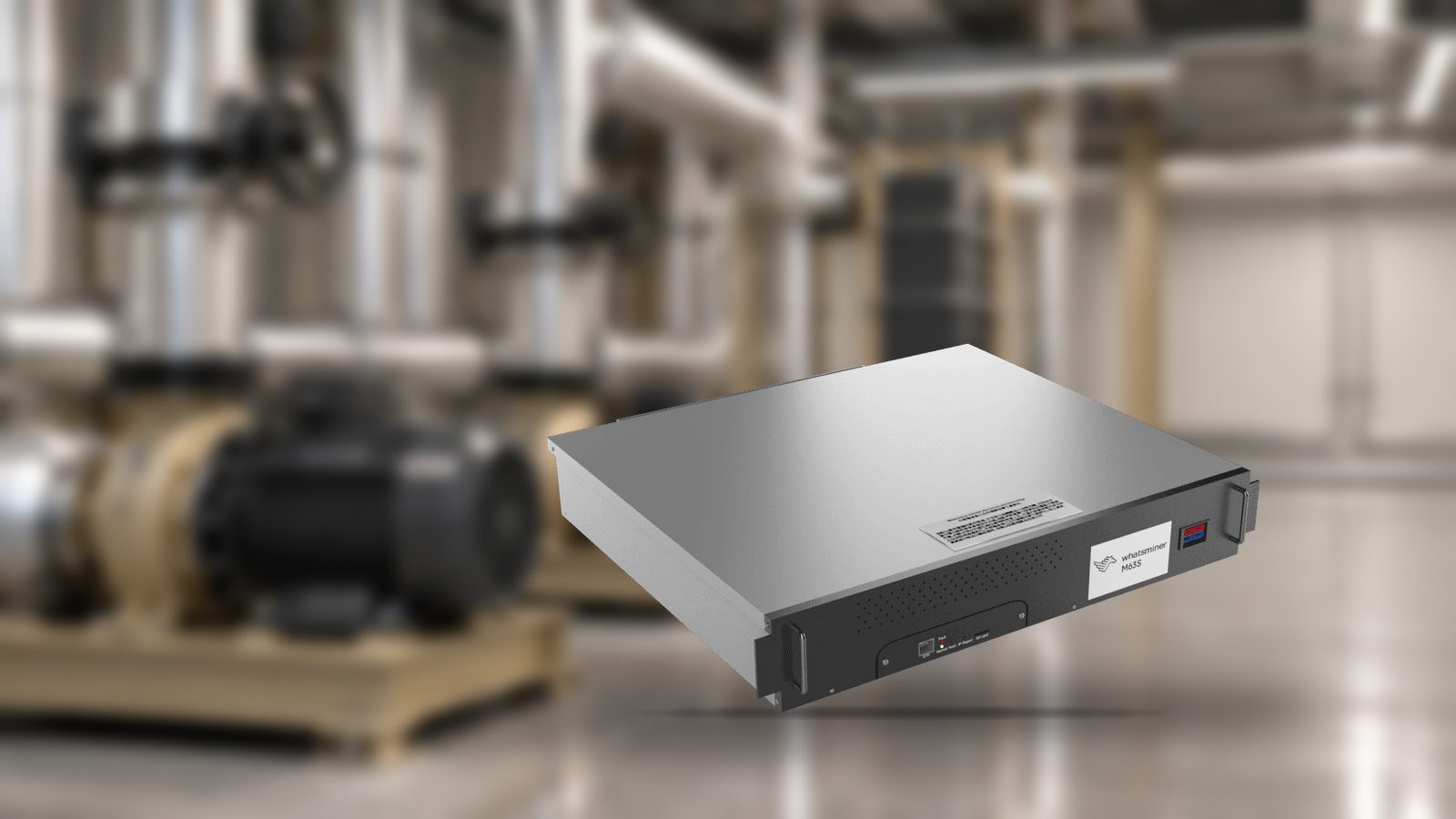
MicroBT Whatsminer M63s (400 TH/s)
The bottom line
The M63S is MicroBT's water-cooled Whatsminer at 18.5 J/TH: 400 TH/s from 7,400 W in the bin we use here. In the UAE, at 6¢, it makes a bitcoin for about $63,900 of electricity and returns roughly 22% in its first year at today's price. At Nigeria's 3.9¢ the same coin costs about $41,500 and the first year returns 36%.
Bought once its price settled, in October 2025, it has mined and kept 0.0683 BTC for $4,225 of power: $1,315 of cashflow against a $6,304 landed cost, 21% of the box in 377 days, and it crossed to Nigeria once, on 13 October 2026. Between now and the 2028 halving it has another 0.072 BTC in it, worth about $8,942 with bitcoin back at its previous high of $124,493: roughly 1.6× its hardware by the halving.
What you are buying is a proven water-cooled machine at a settled price, with a margin over its power line at 6¢ today and a much better one at Nigeria's rate. What you are not buying is the cheapest coin: the S21+ Hyd makes one in the UAE for about $52,200 and the M63S++ for about $51,800, against this machine's $63,900.
Scores
| Criterion | Score | Why |
|---|---|---|
| Cashflow | 4.5/10 | Makes a bitcoin for about $63,900 of electricity at 6¢ and about $41,500 at 3.9¢, and returns roughly 22% in year one in the UAE. It has covered 21% of its hardware so far and is on track for about 1.6× by the 2028 halving. The S21+ Hyd returns about 40%. |
| Longevity | 4/10 | At 18.5 J/TH its line is $26.64 a petahash a day at 6¢ and $17.32 at 3.9¢. Half of today's hashprice, $18.21, is under the first and above the second, so after the halving it is a Nigeria machine. |
| Efficiency | 3/10 | Mid-table among the water-cooled machines we stock: the M63S++ runs 15 J/TH, the S21+ Hyd 15, the S21j XP Hyd 12 and the S23 Hyd 9.5. |
| Quality control | 5/10 | Scored as unknown rather than as good. We found no operator reports of the M63S in the field that we could cite, and a repair shop's guide is a troubleshooting reference, not a failure rate. |
| Serviceability | 6.5/10 | MicroBT lists a one-year warranty with repair services within its scope. Water-cooled, so it lives in the UAE, where a manufacturer warranty centre is close to the facility and an in-warranty board goes direct. |
Cashflow and efficiency count most, because they decide how many halvings a machine clears. Reliability is scored as unknown, not as good, so it holds the total down.
Buy it if
- Your power is at or below 4.1¢ and you plan past the 2028 halving. Half of today's hashprice, $18.21, covers an 18.5 J/TH machine's line up to 4.1¢; Nigeria's 3.9¢ line is $17.32.
- Your power is between 4.1¢ and 8.2¢ and you are buying hashrate for the run to the April 2028 halving. At $36.42 a petahash a day the machine clears its line at every rate up to 8.2¢.
- You want hashrate on water at a low price per terahash: $2,856 for the 400 TH/s unit, $7.14 a terahash, against $8.50 for the M63S++ and $11.55 for the S21j XP Hyd.
- You have, or are hosted at, a site with a coolant loop and a three-phase 380 to 480 V supply.
Walk away if
- You want the cheapest coin. The S21+ Hyd returns about 40% in year one in the UAE against this machine's 22%, and the M63S++ 37%.
- Your power is above 8.2¢. At today's hashprice the machine does not clear its line there.
- Your power is between 4.1¢ and 8.2¢ and you plan to run past April 2028 at today's conditions held flat. In that band it clears today and not after the halving.
- You want a public failure record before you buy. We found no operator reports of the M63S that we could cite, so we score reliability as unknown.
18.5 J/TH on water, from MicroBT's M63 line
MicroBT showed its M63 series at Blockchain Life 2023 in Dubai. Bitcoin Magazine reported on 24 October 2023 that the hydro-cooled models ran at 18.5 and 19.9 J/TH.
MicroBT's own shop page lists the M63S at 408 TH/s from 7,344 W at the wall, 18 J/TH, in a case 86 mm tall, 483 mm wide and 663 mm deep with its handles, 27.5 kg net. It takes three-phase 380 to 480 V, needs about a litre of coolant per machine and carries a one-year warranty with repair services within its scope. Our store lists in-stock bins from 370 to 402 TH/s at 18.5 J/TH, and the figures in this review are the 400 TH/s bin at 7,400 W, which is our store record.
It sits below the M63S+ at 17 J/TH and the M63S++ at 15, and it has its own look-back from the UAE and Nigeria.
A settled price for a proven water-cooled box
The first price we hold for the 400 TH/s unit, on 21 August 2025, was $12.92 a terahash. A purchase once the price settled, in October 2025, cost $4,956. It is $2,856 today, $7.14 a terahash, for the same 400 TH/s at the same 18.5 J/TH, and the lowest we have held for it is $7.04 a terahash, on 5 August 2026. The hashrate is the same as it was in 2025, and this is within a dime of the best entry price the machine has had.
Against the water-cooled machines it competes with, it asks less per terahash than the M63S++, about what the S21+ Hyd does, and more per coin than either. The S21+ Hyd is $6.93 a terahash at 15 J/TH, the M63S++ $8.50 at 15, and the S21j XP Hyd $11.55 at 12. A machine's price per terahash settles to where its efficiency, its maker and its age put it, and the guide to what a miner costs all-in shows what sits on top of the box.
A coin costs it more than the 15 J/TH machines, and Nigeria closes most of the gap
In the UAE, at 6¢, the M63S makes a bitcoin for about $63,900 of electricity today, against a bitcoin price of $80,203. At Nigeria's 3.9¢ the same machine makes one for about $41,500, with Nigeria's lower uptime already counted. The S21+ Hyd makes one in the UAE for about $52,200, the M63S++ for about $51,800 and the S21j XP Hyd for about $41,700.
In its first year the M63S returns about 22% in the UAE and 36% in Nigeria at today's price and difficulty. The S21+ Hyd returns 40% in the UAE and the M63S++ 37%. The gap between this machine's two figures is the point: at 18.5 J/TH it is built for cheap power.
A machine starts at its home site and crosses once, when a year of figures says so. The one in our run crossed after 364 days, on 13 October 2026. Over its run since October 2025, electricity has averaged about $61,800 a coin. That is a lifetime average over 377 days, mostly at 6¢ before the move; the figure to plan on is today's.
Where the halving puts it
A machine's line is the hashprice at which it stops covering its own power. At 18.5 J/TH a petahash uses 444 kWh a day: $26.64 at 6¢, and $17.32 at Nigeria's 3.9¢. On our hashprice chart, network hashprice was $36.42 a petahash a day on 24 October, so the M63S clears the 6¢ line with $9.78 to spare and Nigeria's with $19.10.
Neither line has been crossed since the 2024 halving. Hashprice reached a low of $27.74 on 6 June 2026, $1.10 above the 6¢ line, and on no day has it been under the Nigerian one; the count for a 19 J/TH machine shows how that line has fared.
The 2028 halving halves the coins a petahash earns. At today's price and difficulty that puts hashprice near $18.21, under the line at 6¢ and 89 cents over Nigeria's. That is today's conditions held flat, not a forecast: it is why every projection we publish assumes the old high returns, and the forward figures here do the same. The M63S is a machine for the run to April 2028 at 6¢, and after it a machine for Nigeria's rate or better.
The guide to efficiency and halvings shows where the line sits at every J/TH, and the guide to crossing once explains why the move to Nigeria is made one time.
What a fault costs you here
We looked for operator threads on the M63S and found none we could stand behind. What exists comes from a repair shop. D-Central's M63S repair page says the boards are "among the densest in any production miner" and advises a bench diagnosis when a unit trips a breaker or keeps losing boards, and its page on error 5070 names the M63S among the hydro models where firmware can throttle a board when it cannot confirm coolant flow. A repair shop sells repairs, so we treat both as a troubleshooting reference and not a failure rate, and the M63S is scored as unknown on quality control.
What a fault costs is the part that matters. In the UAE a manufacturer warranty centre is close to the facility, so an in-warranty unit goes direct, and a water-cooled unit is serviced where the plant already exists: a failed hashboard is a line item, not a catastrophe. The coolant loop is the reason the machine lives there, and the guide to cooling explains what water changes.
We found no operator reports of the M63S we could cite. We score that as unknown, not as good.
Our two cents
The M63S is a plain, proven machine at a settled price. It clears its power at 6¢ today with room to spare, it fits the water plant we already run, and the one move it will make, to Nigeria, is where its figures improve most: a coin there costs about $41,500 to make, against $63,900 in the UAE.
If the aim is the cheapest coin on water, the S21+ Hyd makes one for about $52,200 and the M63S++ for about $51,800. The figure below ranks what beats this machine on cost per coin and then on first-year return, in stock today. A coin that costs less to make is a coin you keep more of.
- Bitmain Antminer S23 Hyd (563 TH/s) — 9.5 J/TH, In stock, $33,157 of electricity per bitcoin, 24% year one
- Bitmain Antminer S21j XP Hyd (495 TH/s) — 12 J/TH, In stock, $41,728 of electricity per bitcoin, 35% year one
- Bitdeer SealMiner A3 Pro Hyd (666 TH/s) — 12.5 J/TH, In stock, $43,061 of electricity per bitcoin, 28% year one
Sources and further reading
- MicroBT Unveils Highly Anticipated WhatsMiner M60 Series At Blockchain Life 2023 In Dubai — Bitcoin Magazine, 24 Oct 2023
- WhatsMiner M63S — MicroBT shop, 2026
- Whatsminer M63S repair — D-Central, 2026
- Whatsminer error 5070 (water velocity abnormal) — D-Central, 2026
Which machines this covers
- MicroBT Whatsminer M63s (400 TH/s)
- MicroBT Whatsminer M63s (402 TH/s)
- MicroBT Whatsminer M63s (398 TH/s)
- MicroBT Whatsminer M63s (390 TH/s)
- MicroBT Whatsminer M63s (376 TH/s)
- MicroBT Whatsminer M63s (374 TH/s)
- MicroBT Whatsminer M63s (372 TH/s)
- MicroBT Whatsminer M63s (370 TH/s)
Disclosure
Firsthand Bitcoin sells and hosts mining hardware, including this machine. No manufacturer, distributor or affiliate programme paid for or reviewed this page and we take no commission on the links above. Historical figures are computed from daily bitcoin price and network hashprice, each day valued at its own prices. Nothing here is investment advice.