Data insight · Oct 24, 2026 · 4 min read
Bitcoin has moved inside a 6% range for 30 days. A petahash still earned 6% fewer coins.
From 24 September to 23 October bitcoin's close stayed between $81,315.73 and $86,488.03, narrower than all but 129 of the 5,016 thirty-day stretches in our record. A petahash still earned 6% fewer coins, because difficulty rose 5.9% in a single step.
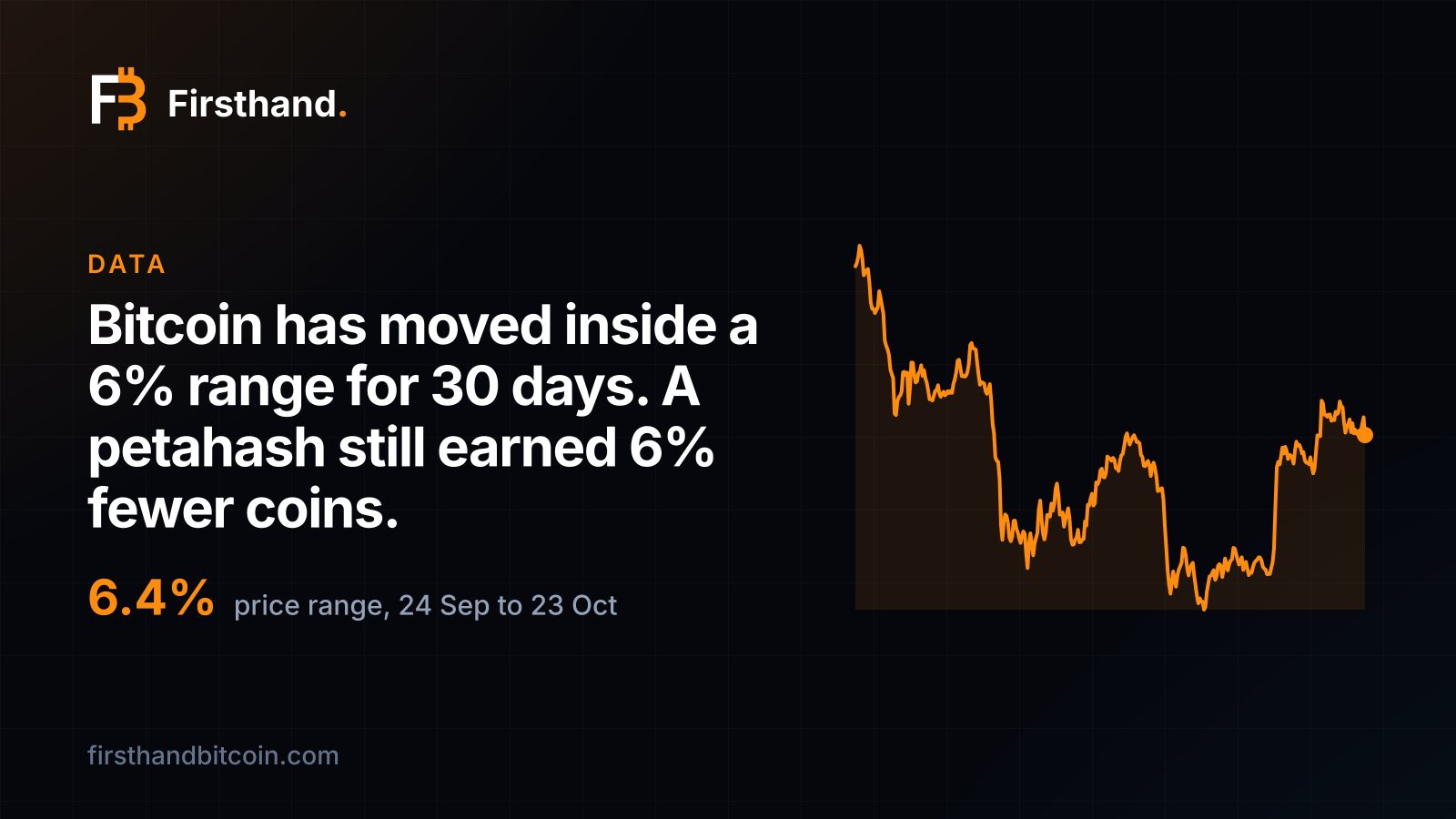
A month in which bitcoin barely moved
From 24 September to 23 October, bitcoin's daily close never went above $86,488.03, reached on 5 October, or below $81,315.73, on 23 October. From lowest to highest that is a range of 6.4%, across 30 days.
Most months look nothing like that. Our price series starts in January 2013, and of the 5,016 thirty-day stretches since then, only 129 were narrower. The most recent ones ended between 2 and 19 August this year, the narrowest at 5.1%, and before that came the summer of 2023, October 2022 and July 2020.
A flat price does not mean flat pay
The bitcoin a petahash of mining power earns is set by the network, not by the price. The block reward is fixed at 3.125 bitcoin, about 450 a day, and every machine shares it in proportion to its hashing power. When more machines join, difficulty rises to keep blocks arriving every ten minutes, and each petahash gets a smaller slice. The guide to difficulty walks through it.
That is what happened in these 30 days. Difficulty stepped up 5.9% on 16 October, from 132.72 trillion to 140.58 trillion, and the bitcoin a petahash earns in a day fell from 0.0004777 on 24 September to 0.0004492 on 23 October, down 6.0%. The fall came in one day: 0.0004768 on 15 October, 0.0004509 on 16 October.
Difficulty moved pay more than the price did
Take the price alone and a petahash would have lost 3.6% of its dollar income between 24 September and 23 October. Take difficulty alone and it would have lost 5.6% of its coins. Together they account for almost all of the 9.4% fall in hashprice, from $40.31 to $36.53 per petahash per day; fees and the pace of blocks make up the rest.
Dollar hashprice is the price multiplied by the coins, so it falls when either does. In bitcoin, the count that matters to anyone who keeps what they mine, only difficulty and fees move it. The hashprice guide shows how to turn it into a figure for your own machine.
The price held a range of six per cent. Difficulty moved by six per cent. The second one set the pay.
| 24 Sep | 23 Oct | Change | |
|---|---|---|---|
| Bitcoin price | $84,384.61 | $81,315.73 | −3.6% |
| Difficulty | 132.76 trillion | 140.58 trillion | +5.9% |
| Bitcoin per petahash per day | 0.0004777 | 0.0004492 | −6.0% |
| Dollars per petahash per day | $40.31 | $36.53 | −9.4% |
Over two months the split is wider
Stretch the window and the same two forces pull apart further. On 1 August bitcoin closed at $62,885.20. By 23 October it was $81,315.73, up 29.3%, and a petahash's dollar income rose from $31.63 to $36.53 a day, up 15.5%. In the same 83 days difficulty rose 11.4%, from 126.23 trillion to 140.58 trillion, and the bitcoin a petahash earns each day fell 10.7%.
Start on 1 September, after most of the climb, and the quiet month reads as the end of a longer trend. The price is up 4.3% since then, difficulty is up 11.7% and a petahash earns 10.6% fewer coins. In dollars, a 4.3% price gain does not cover a 10.6% fall in coins, so hashprice has slipped from $39.21 to $36.53. Difficulty rose because more hashing power came online as the price climbed.
| Since 1 Aug | Since 1 Sep | Since 24 Sep | |
|---|---|---|---|
| Bitcoin price | +29.3% | +4.3% | −3.6% |
| Difficulty | +11.4% | +11.7% | +5.9% |
| Bitcoin per petahash per day | −10.7% | −10.6% | −6.0% |
| Dollars per petahash per day | +15.5% | −6.8% | −9.4% |
A year ago a petahash earned fewer coins than it does today
The same arithmetic runs the other way over a longer stretch. On 23 October 2025 bitcoin closed at $109,418.12, and difficulty was 4.4% higher than it is today. A petahash earned 0.0004312 bitcoin that day, against 0.0004492 now: 4.2% more coins a year later, at a price 25.7% lower.
That is the miner's side of a quiet price. The coins a machine produces depend on the network and on how efficiently the machine turns power into hashes, and a petahash today earns more of them than it did a year ago. How many dollars those coins buy is a separate question that moves on its own days.
On 23 October the price touched the floor of the range
Bitcoin closed at $84,018.76 on 22 October, then fell 3.2% to $81,315.73 on 23 October, the lowest close of the 30 days. The day before, US spot bitcoin ETFs had net outflows of $635.6 million, their largest in a day since June, according to The Block, which more than erased the $528.4 million they took in on 21 October. Our ETF flows chart carries the daily series.
That move is inside the range. A 3.2% day is the largest of the month, and it still left the 30-day window at 6.4% wide.
What it means for a miner
A steady price is the clearest month to see what a machine is made of. With the price pinned, a petahash's pay moved only with difficulty, and the cost side did not move at all. At Nigeria's 3.9¢, a petahash on the 8.9 J/TH Antminer S23 XP Hyd uses $8.33 of electricity a day. Hashprice on 23 October was $36.53, so power took 23% of it.
On 24 October, with bitcoin at $80,733, the same machine's electricity makes a bitcoin for about $17,939, less than a quarter of what a coin sells for. Pay per petahash steps with difficulty about every two weeks, and with the price whenever it leaves its range. Output depends on both and is never guaranteed, but the coins a machine keeps are the same coins in a quiet month as in a loud one.
In a month with no price move to hide behind, the machines that cost least to run did not notice it.
Sources and further reading
- Bitcoin ETFs swing back to net outflows as $636 million in withdrawals erase previous day's inflows — The Block, 23 Oct 2026
- Bitcoin price, daily, 13 years of bitcoin data — Firsthand data, 23 Oct 2026
- Hashprice in bitcoin, daily, 13 years of bitcoin data — Firsthand data, 23 Oct 2026
Disclosure
Firsthand Bitcoin sells and hosts mining hardware, including this machine. No manufacturer, distributor or affiliate programme paid for or reviewed this page and we take no commission on the links above. Historical figures are computed from daily bitcoin price and network hashprice, each day valued at its own prices. Nothing here is investment advice.