Home / Blog / Bitmain Antminer S19j
Field report · Oct 24, 2026 · 5 min read
Bought in the 2021 hardware boom, the Antminer S19j has paid for its box more than twice
The S19j was bought in July 2021, when a petahash earned ten times what it does today and a box cost about $88 a terahash. It mined 703 days in Argentina, crossed to Nigeria once, and has kept more than a third of a bitcoin. In 2026 hashprice came down to its line.
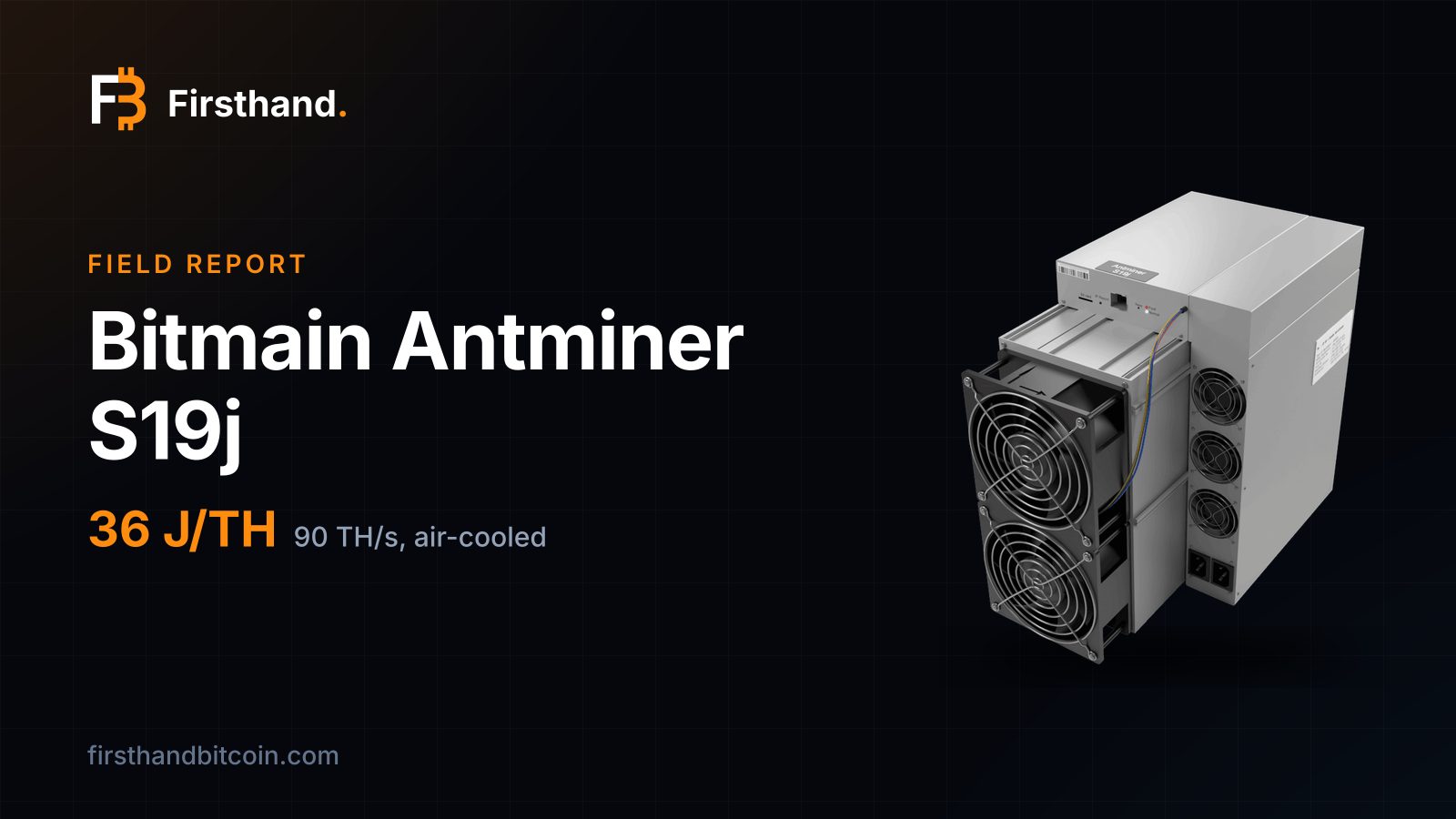
Bitmain Antminer S19j (90 TH/s)
A box bought for $7,947 has kept 0.3640 bitcoin
The Antminer S19j is a Bitmain air-cooled machine, the 90 TH/s model of the S19j line, announced in February 2021 in our record. Our store lists it at 90 TH/s from 3,250 W, 36 J/TH, in a 14.2 kg case 400 mm long, 195 mm wide and 290 mm tall, and the model is no longer in the store. We could not open Bitmain's own product page for it, so those figures are our store record and nothing more is claimed about the chassis.
Bought on 8 July 2021, the first date we hold a price for it, it cost $7,947. Landed at our Argentina site, the all-in cost was $10,484. In 1,769 days since it has mined and kept 0.3640 BTC, worth about $29,602 today, for $5,916 of electricity. That is $23,686 of cashflow, or 226% of its landed cost, with every coin kept: it has paid for its box 2.3× over.
It was bought when a petahash earned ten times what it does now
The box cost $7,947 on 8 July 2021, about $88 a terahash, with bitcoin at $34,037. A petahash earned $365.11 a day that day on our hashprice chart. On 23 October 2026 it earned $36.53, a tenth as much, and the machine has still covered its box more than twice.
The price of the box peaked in October 2021. Our price series has the same machine at about $9,555 then, 1.2× what was paid, with 0.0762 BTC already mined. That is the upside of a machine bought in a boom. The part that matters here is that the machine did not need it: the cashflow above is electricity against coins, and it never depended on the box being sold.
Argentina through the bull run and the bear market, then one crossing
At 36 J/TH a petahash uses 867 kWh a day. A machine's line is the hashprice at which it stops covering its own power: $52.00 at Argentina's 6¢ and $33.80 at Nigeria's 3.9¢. In the 1,018 days between the day it was bought and the April 2024 halving, hashprice never fell under the 6¢ line, and the machine ran every day.
It spent its first 703 days in Argentina, through the bull run and the year after it. It crossed to Nigeria on 11 June 2023, on a day hashprice was $65.87, still above its Argentine line. That is the rule in a machine crosses to cheap power once: the machine moves while it is still clearing, because a year of figures has made the cheaper site the better home, and it never comes back. It has run 1,066 days in Nigeria since.
Most of its coins came before the halving
The S19j was bought 33 months before the April 2024 halving. In the 1,017 days before it, it kept 0.3353 BTC, 92% of everything it has mined, in 57% of its life so far, and those coins are worth about $27,265 today. Its cash margin after electricity, at the prices of each day, was about $7.76 a day before the halving and about $0.88 a day after it.
After the halving it kept 0.0288 BTC in 752 days. A machine bought long before a halving is paid for in advance by the years before it, and this one was. The guide to the halving explains what it does to a machine's earnings.
Of everything the S19j has mined, nine coins in ten came before April 2024.
2026 is when hashprice came down to its line
Since the halving, hashprice has been under the S19j's Argentine line of $52.00 on 621 of 917 days, 297 of them in 2026, so at 6¢ the machine would have been losing money most days. Under Nigeria's $33.80 it has been on 143 days, and every one of them fell in 2026, between 4 February and 19 August.
The machine switched off on 19 February 2026, when hashprice was $32.55, and came back on 8 May at $38.18. It switched off again on 6 June, the day hashprice reached its lowest reading of the past year, $27.74, and restarted on 4 September at $40.40. Over its whole life it has stood switched off for 166 days, and it has run 51 days since the second restart. Hashprice was $36.53 on 23 October, $2.73 above the line.
What is left, and what the halving does to it
Today a coin costs it about $78,900 of electricity at Nigeria's 3.9¢, against a bitcoin price of $80,540: about what a coin sells for. At 6¢ the same coin would cost about $121,400, which is why the machine has one site left that pays.
The April 2028 halving halves the coins a petahash earns. At today's price and difficulty that puts hashprice near $18.26, well under even the Nigerian line of $33.80. At $124,493, the assumption behind every forward projection, a halved hashprice would be about $27.96, still $5.84 under the line. The forward figures to the halving add 0.016 BTC, worth about $2,015 at that price, and stop there because that date is known.
A machine that no site can pay for is switched off rather than mined at a loss, and it keeps every coin it has made.
What it says about the next machine you buy
Machines are the roof, not the building, as the roof guide puts it: the test is whether a machine earned enough to buy its replacement. The S19j has banked $23,686 after electricity against a $10,484 landed cost, so it has, and it did it from a box bought at a high price.
We found no operator survey of this machine to cite, so reliability is unknown rather than good. What exists is a repair shop's guide to the S19 family: D-Central's S19 maintenance guide lists chip faults, boost-circuit faults and ribbon-cable connections among the usual causes of a hashboard dropping out, says reseating the ribbon cable fixes a missing board in about 30% of cases, and puts fan life at 18 to 30 months. It is a troubleshooting reference and not a failure rate.
The arithmetic for its replacement is plain. A machine at 13.5 J/TH has a line of $19.44 at 6¢, within $1.20 of a halved hashprice, where the S19j is $15.54 under its line even at Nigeria's 3.9¢. The figure below ranks what we would put in its place today, on cost per coin and then year-one return.
- MicroBT Whatsminer M74S+ (332 TH/s) — 12 J/TH, In stock, $26,228 of electricity per bitcoin, 31% year one
- MicroBT Whatsminer M73S (560 TH/s) — 13 J/TH, In stock, $28,414 of electricity per bitcoin, 37% year one
- MicroBT Whatsminer M7DS (672 TH/s) — 13.5 J/TH, In stock, $29,507 of electricity per bitcoin, 40% year one
Sources and further reading
- Antminer S19 maintenance and repair guide — D-Central, Aug 2026
Which machines this covers
Disclosure
Firsthand Bitcoin sells and hosts mining hardware, including this machine. No manufacturer, distributor or affiliate programme paid for or reviewed this page and we take no commission on the links above. Historical figures are computed from daily bitcoin price and network hashprice, each day valued at its own prices. Nothing here is investment advice.