Home / Blog / MicroBT Whatsminer M60
Machine review · Oct 24, 2026 · 5 min read
Whatsminer M60 review: 19.9 J/TH in an air-cooled box, and Nigeria is where it pays
MicroBT's M60 is an air-cooled Whatsminer at 19.9 J/TH, the first step of a line that has since reached 15.5. It clears its power at 6¢ today and is a Nigeria machine after the halving, but the S21 XP and the M70S make a coin for about a third less.
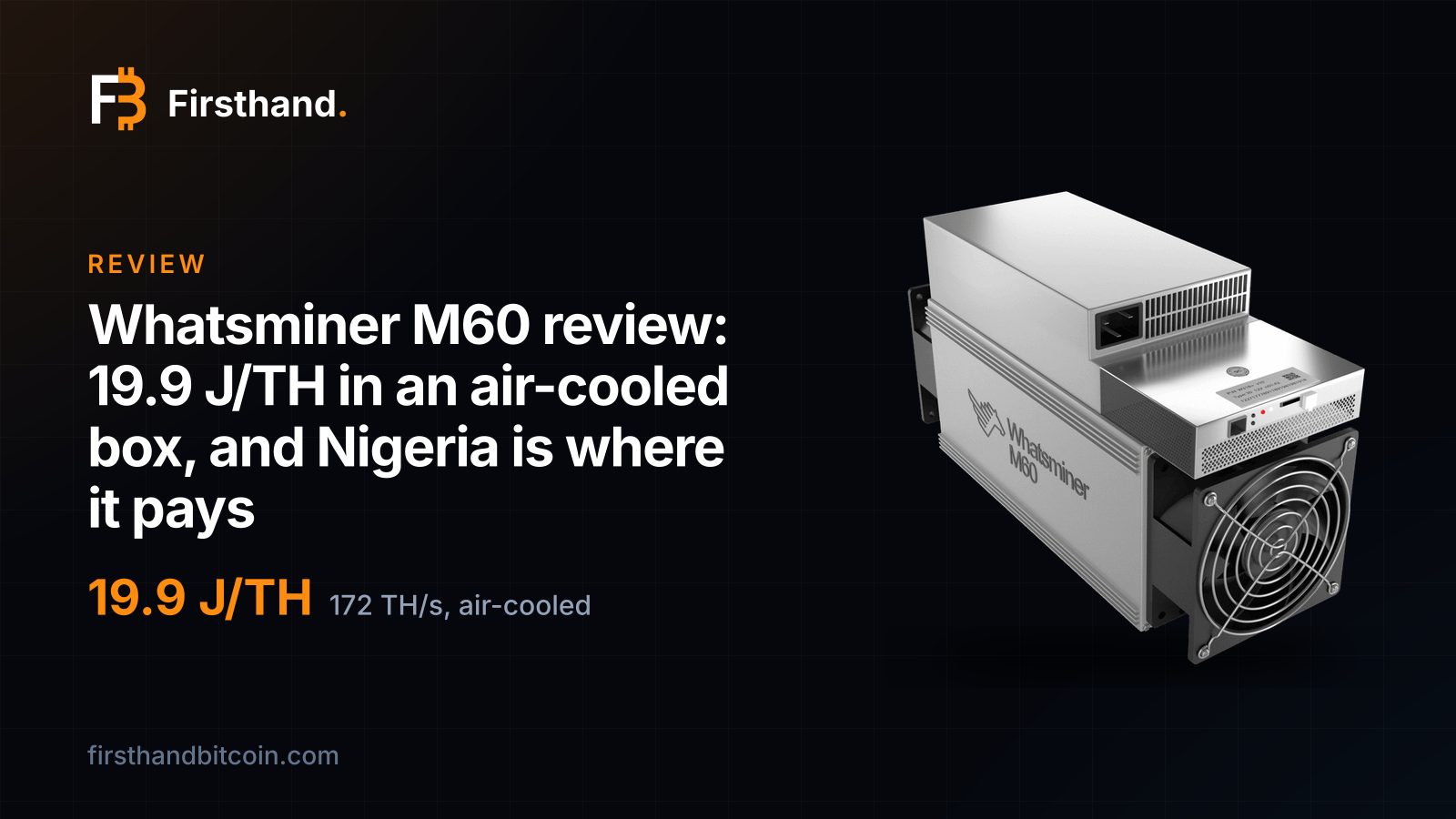
MicroBT Whatsminer M60 (172 TH/s)
The bottom line
The M60 is MicroBT's air-cooled Whatsminer from the start of its M60 line: 172 TH/s from 3,423 W in the bin we use here, 19.9 J/TH. At our Argentina site, at 6¢, it makes a bitcoin for about $66,900 of electricity and returns roughly 18% in its first year at today's price. At Nigeria's 3.9¢ the same coin costs about $43,500 and the first year returns about 37%.
Bought once its price settled, in June 2024, it has mined and kept 0.0772 BTC for $4,081 of power: $2,196 of cashflow against a $4,275 landed cost, 51% of the box in 871 days, and it crossed to Nigeria once, on 7 June 2026. Between now and the 2028 halving it has another 0.031 BTC in it, worth about $3,851 with bitcoin back at its previous high of $124,493: roughly 1.4× its hardware by the halving.
What you are buying is the lowest outlay per terahash of the M60 machines we stock, $5.67, from a case that fits a standard shelf. What you are not buying is an efficient coin: the S21 XP at 13.5 J/TH makes one in Argentina for about $45,400 and returns about 32% in year one, against this machine's $66,900 and 18%.
Scores
| Criterion | Score | Why |
|---|---|---|
| Cashflow | 5/10 | Makes a bitcoin for about $66,900 of electricity at 6¢ and about $43,500 at 3.9¢, and returns roughly 18% in year one in Argentina. It is on track for about 1.4× its hardware by the 2028 halving. The S21 XP returns about 32%. |
| Longevity | 3.5/10 | At 19.9 J/TH its line is $28.66 a petahash a day at 6¢ and $18.63 at 3.9¢. Hashprice halved, $18.26, is under both, so past April 2028 at today's conditions it leans on bitcoin recovering. |
| Efficiency | 3/10 | The start of the line: the M60S++ in the same case runs 15.5 J/TH and the S21 XP and the M70S run 13.5 in an air-cooled box. |
| Quality control | 5/10 | Scored as unknown rather than as good. We found no operator reports of the M60 in the field that we could cite, and a repair shop's guide is a troubleshooting reference, not a failure rate. |
| Serviceability | 6.5/10 | MicroBT lists a one-year warranty with repair services within its scope, and the M60 family has published repair guides. It is a 13.5 kg air-cooled unit. Hosted with us in Argentina, a fault is a parts bill and a line item. |
Cashflow and efficiency count most, because they decide how many halvings a machine clears. Reliability is scored as unknown, not as good, so it holds the total down.
Buy it if
- Your power is at or below 3.8¢ and you plan past the 2028 halving. Half of today's hashprice, $18.26, covers a 19.9 J/TH machine's line at 3.8¢; Nigeria's 3.9¢ sits 37 cents above it.
- Your power is between 3.8¢ and 7.6¢ and you are buying hashrate for the run to the April 2028 halving. At today's hashprice of $36.53 a petahash a day the machine clears its line at every rate up to 7.6¢.
- You want a low outlay: $975 for the 172 TH/s unit, $5.67 a terahash.
- You rack air-cooled hardware in a hall that stays under 35 °C, MicroBT's stated ceiling, and you add hashrate one unit at a time.
Walk away if
- You want the cheapest coin. The S21 XP makes one in Argentina for about $45,400 against this machine's $66,900, and returns 32% in year one against 18%.
- Your power is above 7.6¢. At today's hashprice the machine does not clear its line there.
- Your power is between 3.8¢ and 7.6¢ and you plan to run past April 2028 at today's conditions held flat. In that band it clears today and not after the halving.
- You want a public failure record before you buy. We found no operator reports of the M60 that we could cite, so we score reliability as unknown.
The air-cooled start of MicroBT's M60 line
MicroBT unveiled the M60 line at Blockchain Life 2023 in Dubai, Bitcoin Magazine reported on 24 October 2023: hydro, immersion and air-cooled machines, with the air-cooled M60 at 150 to 172 TH/s and 19.9 J/T, and the M60S at 170 to 186 TH/s and 18.5 J/T.
MicroBT's own shop page lists the M60 at 160 TH/s from 3,184 W at the wall, 19.9 J/TH, in a case 430 mm long, 155 mm wide and 226 mm tall that weighs 13.5 kg. It runs on 220 to 240 V through an IEC C19 cable rated for at least 16 A, works between -5 °C and 35 °C, and carries a one-year warranty with repair services within its scope. Our store lists bins from 152 to 178 TH/s, and the figures in this review are the 172 TH/s bin at 3,423 W, which is our store record.
It is the first step of a line. The M60 runs at 19.9 J/TH, the M60S at 18.5, the M60S+ at 17 and the M60S++ at 15.5, in the same case. The Whatsminer M60 had the worst timing of anything we bought follows one bought in 2024.
A coin costs it more than the S21s, and Nigeria is where the gap closes
In Argentina, at 6¢, the M60 makes a bitcoin for about $66,900 of electricity today, against a bitcoin price of $80,540. At Nigeria's 3.9¢ the same machine makes one for about $43,500, with Nigeria's lower uptime already counted. The S21 XP makes one in Argentina for about $45,400, the M70S for about $45,400, the S21 Pro for about $50,400 and the M60S++ for about $52,100.
In its first year the M60 returns about 18% in Argentina and 37% in Nigeria at today's price and difficulty. The S21 XP returns 32% in Argentina, the S21 Pro 34% and the M60S++ 29%. The M60 is at the bottom of that group, which is where 19.9 J/TH puts a machine beside the S21s.
The Nigerian figure is worth a second look: the M60's coin there, at about $43,500, costs about what an S21 XP's coin does in Argentina, $45,400. A machine starts at its home site and crosses once, when a year of figures says so; the one in our run crossed after 731 days, on 7 June 2026.
Over its run since June 2024, electricity has averaged about $52,900 a coin. That is a lifetime average over 871 days, mostly at 6¢ before the move; the figure to plan on is today's.
A very low entry price per terahash
The first price we hold for the 172 TH/s unit, on 20 May 2024, was $19.85 a terahash. A purchase once the price settled, in June 2024, cost $2,980. It is $975 today, $5.67 a terahash, for the same 172 TH/s at the same 19.9 J/TH, and the lowest price we have held for it is $5.36 a terahash, on 27 August 2026. The hashrate is the same as it was at launch, and this is within a few cents of the best entry price the machine has had.
Against the air-cooled machines we compare it with, it is the cheapest terahash by a distance and the most expensive coin. The S21 XP, at 13.5 J/TH, is $11.55 a terahash, the M70S $12.60, the S21 Pro at 15 J/TH $8.61, and the M60S++ at 15.5 J/TH $9.45. A machine's price per terahash settles to where its efficiency, its maker and its age put it, and the guide to what a miner costs all-in shows what sits on top of the box.
Where the halving puts it
A machine's line is the hashprice at which it stops covering its own power. At 19.9 J/TH a petahash uses 477.6 kWh a day: $28.66 at 6¢, and $18.63 at Nigeria's 3.9¢. On our hashprice chart, network hashprice was $36.53 a petahash a day on 23 October, so the M60 clears the 6¢ line with $7.87 to spare and Nigeria's with $17.90.
The 6¢ line has been crossed. Hashprice reached a low of $27.74 on 6 June 2026, and it sat under the M60's line on 14 days, between 23 February and 1 July, as we counted, and on no day before that. At Nigeria's 3.9¢ it has never been under.
The 2028 halving halves the coins a petahash earns. At today's price and difficulty that puts hashprice near $18.26, under the line at 6¢ and 37 cents under Nigeria's. That is today's conditions held flat, not a forecast: it is why every projection we publish assumes the old high returns, and the forward figures here do the same. The M60 is a machine for the run to April 2028 at Nigeria's rate or better, and after it a machine that leans on bitcoin recovering.
The guide to efficiency and halvings shows where the line sits at every J/TH. A 13.5 J/TH machine has a line of $19.44 at 6¢, within $1.20 of that halved level, which is the case for the S21 XP or the M70S if you plan to stay in Argentina.
What a fault costs you here
We looked for operator threads and repair write-ups on the M60 and found nothing specific to it that we could stand behind. What exists is a repair shop's guide: D-Central's page on Whatsminer errors 560 to 562 lists the M60 among the models where one hashboard can run slower than the others, and opens with a hard power cycle before anything else. We treat that as a troubleshooting reference and not as a failure rate, so the M60 is scored as unknown on quality control. MicroBT's own ceiling is 35 °C, which means an air-cooled machine wants a cool hall.
What a fault costs is the part that matters. MicroBT's shop page lists a one-year warranty with repair services within its scope. Hosted with us in Argentina, a repair is billed at the cost of the parts and nothing else, and it is a line item, not a catastrophe.
We found no operator reports of the M60 we could cite. We score that as unknown, not as good.
Our two cents
The M60 is a plain machine at a very low entry price. It clears its power at 6¢ today, it fits a standard shelf, and the one move it will make, to Nigeria, is where its figures improve most: a coin there costs about $43,500 to make, against $66,900 in Argentina.
If the aim is the cheapest coin, the S21 XP makes one in Argentina for about $45,400 and the M70S for about $45,400. If the aim is a low outlay at 15.5 J/TH, the M60S++ is the same case with a coin about $52,100. The figure below ranks what beats this machine on cost per coin and then on first-year return, in stock today. A coin that costs less to make is a coin you keep more of.
- MicroBT Whatsminer M74S+ (332 TH/s) — 12 J/TH, In stock, $40,351 of electricity per bitcoin, 31% year one
- MicroBT Whatsminer M73S (560 TH/s) — 13 J/TH, In stock, $43,714 of electricity per bitcoin, 35% year one
- MicroBT Whatsminer M7DS (672 TH/s) — 13.5 J/TH, In stock, $45,395 of electricity per bitcoin, 36% year one
Sources and further reading
- MicroBT Unveils Highly Anticipated WhatsMiner M60 Series At Blockchain Life 2023 In Dubai — Bitcoin Magazine, 24 Oct 2023
- WhatsMiner M60 — MicroBT shop, 2026
- Whatsminer Error 560-562 (hashboard loss of balance) — D-Central, 2026
Which machines this covers
- MicroBT Whatsminer M60 (172 TH/s)
- MicroBT Whatsminer M60 (174 TH/s)
- MicroBT Whatsminer M60 (164 TH/s)
- MicroBT Whatsminer M60 (162 TH/s)
- MicroBT Whatsminer M60 (160 TH/s)
- MicroBT Whatsminer M60 (158 TH/s)
- MicroBT Whatsminer M60 (156 TH/s)
- MicroBT Whatsminer M60 (154 TH/s)
- MicroBT Whatsminer M60 (152 TH/s)
- MicroBT Whatsminer M60 (170 TH/s)
- MicroBT Whatsminer M60 (176 TH/s)
Disclosure
Firsthand Bitcoin sells and hosts mining hardware, including this machine. No manufacturer, distributor or affiliate programme paid for or reviewed this page and we take no commission on the links above. Historical figures are computed from daily bitcoin price and network hashprice, each day valued at its own prices. Nothing here is investment advice.