Data insight · Oct 6, 2026 · 4 min read
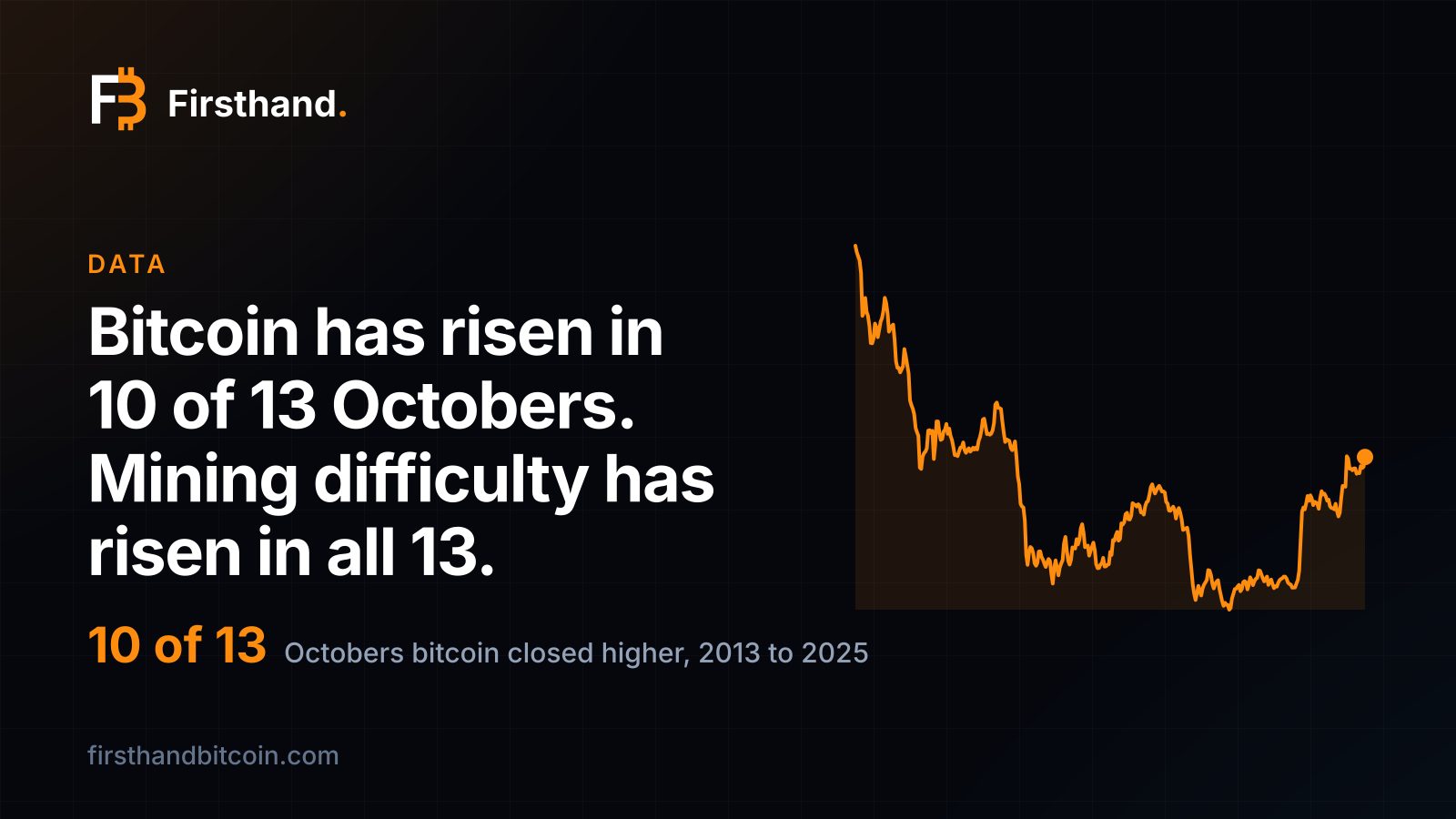
Bitcoin has risen in 10 of 13 Octobers. Mining difficulty has risen in all 13.
October has the best median return of any month in our price record, and it has never once ended with mining difficulty lower. The two arrive together: a good October lifts the price and the competition at the same time. Here is what 13 of them show, and what it means for the coins a machine keeps.
October is the strongest month by the middle of the record
Measured from the last close of September to the last close of October, bitcoin rose in 10 of the 13 Octobers from 2013 to 2025. The median October gained 15.4%, the highest median of any calendar month in our record. The next best are April at 11.6% and July at 10.0%.
The three losing Octobers were 2014 (−7.6%), 2018 (−4.5%) and 2025 (−3.7%). The winners include 2013 (+62.2%), 2017 (+50.2%) and 2021 (+41.3%). From 2019 to 2024 bitcoin closed October higher six years running, then 2025 broke the run.
Thirteen Octobers is a small sample, and the largest moves come from the early years when the market was a fraction of its size. The median is the fairer guide, and a month that rarely loses and sometimes gains a lot is the pattern behind its reputation. July has a slightly higher win rate, 11 of 14. October's edge is how much it has paid when it paid.
Ten Octobers up, three down, and the worst of the three lost 7.6%.
The gains come late in the month
Split each October at the 15th and the pattern sharpens. From the end of September to the 15th, bitcoin was higher in 8 of 13 years, with a median gain of 5.6%. From the 15th to the month-end it was higher in 11 of 13, with a median gain of 9.2%.
The two years that fell in the second half were 2014 and 2025. Nothing in the calendar causes that, and the record only says that a month that starts slowly has usually been rescued by its last two weeks. It has not always been rescued, and last year is the reminder.
Last October started at a record and ended lower
On 6 October 2025 bitcoin closed at $124,493, the highest close in our history. It ended the month at $109,610, down 3.7% from the end of September, when it stood at $113,774. A record high on the sixth day did not make the month.
This year the month has started more quietly. September closed at $83,629 after a gain of 6.8%, and the latest close, on 5 October, was $86,488, up 3.4% so far. Our September piece covers how a month that was supposed to be weak became one of the strongest.
Difficulty has never fallen in an October
The mining side of October is steadier than the price side. Difficulty, the setting that keeps blocks arriving every ten minutes, was higher at the end of October than at the end of September in all 13 years. The median rise was 8.2%. The smallest was 0.4% in 2018 and the largest was 162.7% in 2013, when the network was tiny.
Difficulty rises most months, 132 of 164 since 2013, so a rise is the default. What stands out is that October has no exceptions. February is the only other month that has never fallen. The last five Octobers added 14.0%, 17.5%, 9.4%, 8.2% and 9.6%.
This October has begun differently. The retarget on 3 October moved difficulty by 0.03%, the smallest since 2020, and difficulty is 0.03% below its 30 September level at the latest reading. The record says it has finished October higher every time. It has not said how far, and it has not said when.
In 13 Octobers, mining difficulty rose 13 times. Only February has a record that clean.
A good October lifts the price and the competition
Difficulty rises in October because more machines come online as the price improves. Mining capacity responds to what a petahash earns, and in a strong month that response is quick. Our guide to difficulty explains why more hashrate means each machine earns a smaller share.
The effect shows in coins per petahash. Our hashprice in sats series is measured, not estimated, from 2021. Between the end of September and the end of October a petahash earned fewer bitcoin in four of the five Octobers since: 6.9% fewer in 2021, 15.0% fewer in 2022, 9.5% fewer in 2023 and 8.8% fewer in 2025. Only 2024 earned more, up 2.8%.
The 2021 case is the clearest. Bitcoin rose 41.3% that October and a petahash earned 31.5% more dollars a day, yet it earned 6.9% fewer coins, because the network added hashrate faster than the price added value.
What it means for a miner
A miner who keeps the coins is paid in bitcoin, and October's record is a reminder of which number that depends on. The price can rise 40% in a month while a petahash earns fewer coins, because everyone else's machines arrive too. What does not move with the crowd is the cost of power behind each coin.
As of 6 October, the most efficient machine in stock, the Antminer S23 XP Hyd, on 3.9¢ power in Nigeria, costs about $17,900 of electricity to make a bitcoin, against a market price of about $85,800. That is roughly a fifth of the price, at today's hashprice and before the machine itself or the pool fee.
It is also why efficiency matters in a month like this: when difficulty climbs, each machine earns slightly less, and the one that makes a coin for the least power loses the least. The record says to expect more competition by the end of October. It does not say what the price will do, and the coins already mined are the same coins either way. Output is never guaranteed, and the charts above are live on the Data section.
A strong month for the price is also a strong month for the competition. The coins a machine keeps come from how cheaply it makes them.
Sources and further reading
- Bitcoin heads into historically bullish October after third-best September on record — CoinDesk, 1 Oct 2025
Disclosure
Firsthand Bitcoin sells and hosts mining hardware, including this machine. No manufacturer, distributor or affiliate programme paid for or reviewed this page and we take no commission on the links above. Historical figures are computed from daily bitcoin price and network hashprice, each day valued at its own prices. Nothing here is investment advice.