Home / Blog / Bitmain Antminer S19 Pro Hyd
Field report · Oct 6, 2026 · 4 min read
The S19 Pro Hyd switched off for two months and still paid for its box
The least efficient water-cooled machine we bought sat out the summer of 2024 and kept every coin it had mined. Three years on, the numbers say what 29.5 J/TH on cheap power is worth.
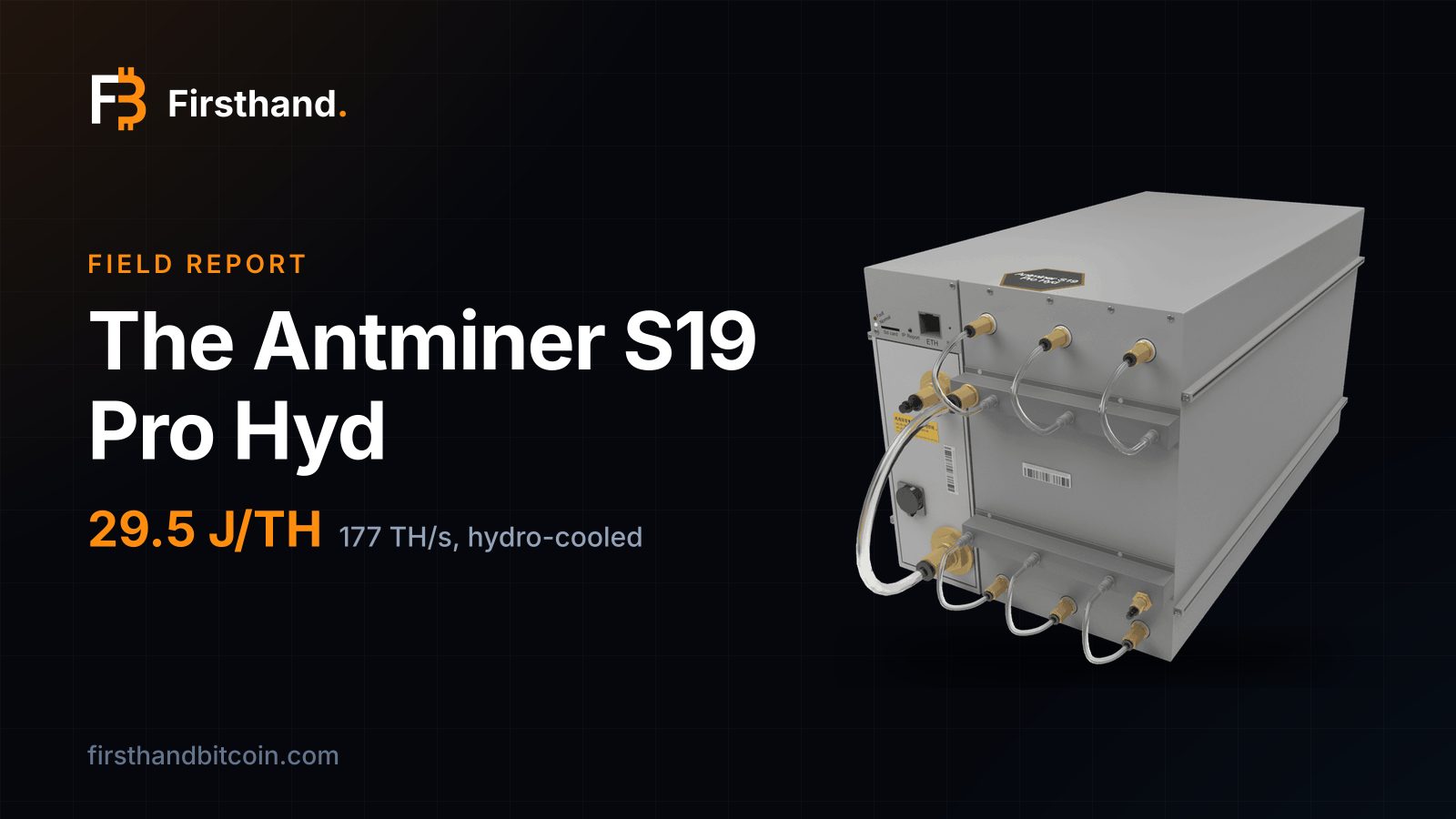
Bitmain Antminer S19 Pro Hyd (177 TH/s)
The efficiency complaint was there on day one
Bitmain announced its water-cooled S19 line in January 2022, the top bin at 198 TH/s and 27.5 J/TH, and the first reaction on Bitcointalk was about efficiency. As one poster put it, "The S19 XP is a lot more efficient with 21w/th vs the hydro with 27.5w/th". The S19 Pro Hyd we bought is the lower bin of the same family: 177 TH/s from 5,221 W, or 29.5 J/TH, with the water loop in place of fans.
That puts it behind the S19 XP Hyd we bought a month earlier, which uses about 30% less power per terahash. We bought it anyway, in November 2023, at $1,505 once its price had settled, and landed it in the UAE for $2,806. Hydro machines start there: the water plant is on site and the manufacturer's warranty centre is a short drive away.
The calendar did the rest. Bitcoin was near $37,000 on 16 November 2023, and the network was paying about $90 per petahash of hashrate per day, the figure our hashprice chart tracks. The halving was five months away.
At 29.5 J/TH it was never the best machine in the room. It did not need to be.
Five months at the old subsidy
It started hashing 156 days before the 20 April 2024 halving, while every block still paid 6.25 bitcoin. In that stretch it mined 0.0520 BTC, 44% of everything it has mined to date, from 16% of its working life so far. It was clearing about $8.46 a day over its electricity.
After the halving that fell to about $1.71 a day. Nothing about the machine had changed; the line it had to clear had moved. That is what efficiency decides, and a 29.5 J/TH machine feels it before a 16 J/TH one does.
Its first 156 days mined 44% of every coin it has ever mined.
Off for the summer of 2024, every coin kept
Through the summer the network's hashprice slid. It touched $37.70 per petahash a day on 5 August 2024, and averaged about $44 across the weeks that followed, against $90 when we bought. At the UAE's 6¢ a machine at 29.5 J/TH had stopped paying its way, and from 17 August 2024 it was switched off for about two months.
A machine that no site can pay for is switched off rather than mined at a loss, and switched back on when the trailing month pays again. The coins it had already mined stayed where they were. By October it was hashing again, with bitcoin back above $68,000 and hashprice near $48.
Nigeria, once, in December 2024
On 19 December 2024, with bitcoin past $100,000, it crossed to Nigeria. A machine moves once, and only to cheaper power, when a trailing year of its own figures says the move pays decisively. For a 29.5 J/TH machine that point came early: 3.9¢ is worth more to it than almost anything.
It has been there for 656 days since. The proof is the low. On 6 June 2026 hashprice fell to $27.74 per petahash a day, the lowest of the 1,000 days we hold since this machine was bought, and a machine at 3.9¢ was still hashing through it.
The tally
Over 990 days it has mined and kept 0.1178 BTC for $5,291 of electricity, $44,898 a coin averaged over its life so far. The lifetime figure is flattered by the months before the halving; today's is the one to plan on. At 3.9¢ in Nigeria a coin now costs about $63,100 in electricity, against bitcoin at $86,055.
Valued at today's price, those coins less every dollar of power come to $4,901 of cashflow on a $2,806 landed cost: 1.7× its box, from the coins alone. Between now and the April 2028 halving it has about 0.035 BTC still in it at today's difficulty, worth roughly $4,339 with bitcoin back at its previous high, which would bring it to about 3.3× its hardware by then, still running.
What an old hydro machine tells a buyer
The lesson is not that a 29.5 J/TH machine is the one to buy now. At 6¢ a coin from the same machine would cost about $97,200, which is exactly why a machine of this efficiency has one home on cheap power and not two. The lesson is that a proven hydro machine bought at a settled price, kept through a halving, switched off when nothing paid and sent to Nigeria once, still covered its box.
A buyer today has far better water-cooled machines to choose from, and they make a coin for far less power. Efficiency decides how many halvings a machine survives, so the figures below rank what the same money buys now by what a coin costs to make.
- Bitmain Antminer S23 Hyd (563 TH/s) — 9.5 J/TH, In stock, $20,322 of electricity per bitcoin, 25% year one
- Bitmain Antminer S21j XP Hyd (495 TH/s) — 12 J/TH, In stock, $25,575 of electricity per bitcoin, 42% year one
- Bitdeer SealMiner A3 Pro Hyd (666 TH/s) — 12.5 J/TH, In stock, $26,392 of electricity per bitcoin, 34% year one
What people are saying online
The S19 XP is a lot more efficient with 21w/th vs the hydro with 27.5w/th
The efficiency gap to the air-cooled XP was noticed the day the hydro line was announced.
Sources and further reading
- Bitmain's new Antminer S19 Pro with cooling technology... — Bitcointalk, January 2022
Which machines this covers
Disclosure
Firsthand Bitcoin sells and hosts mining hardware, including this machine. No manufacturer, distributor or affiliate programme paid for or reviewed this page and we take no commission on the links above. Historical figures are computed from daily bitcoin price and network hashprice, each day valued at its own prices. Nothing here is investment advice.