Data insight · Nov 20, 2026 · 4 min read
Bitcoin's Wikipedia readers are at an eleven-year low. A petahash earns 13% more BTC
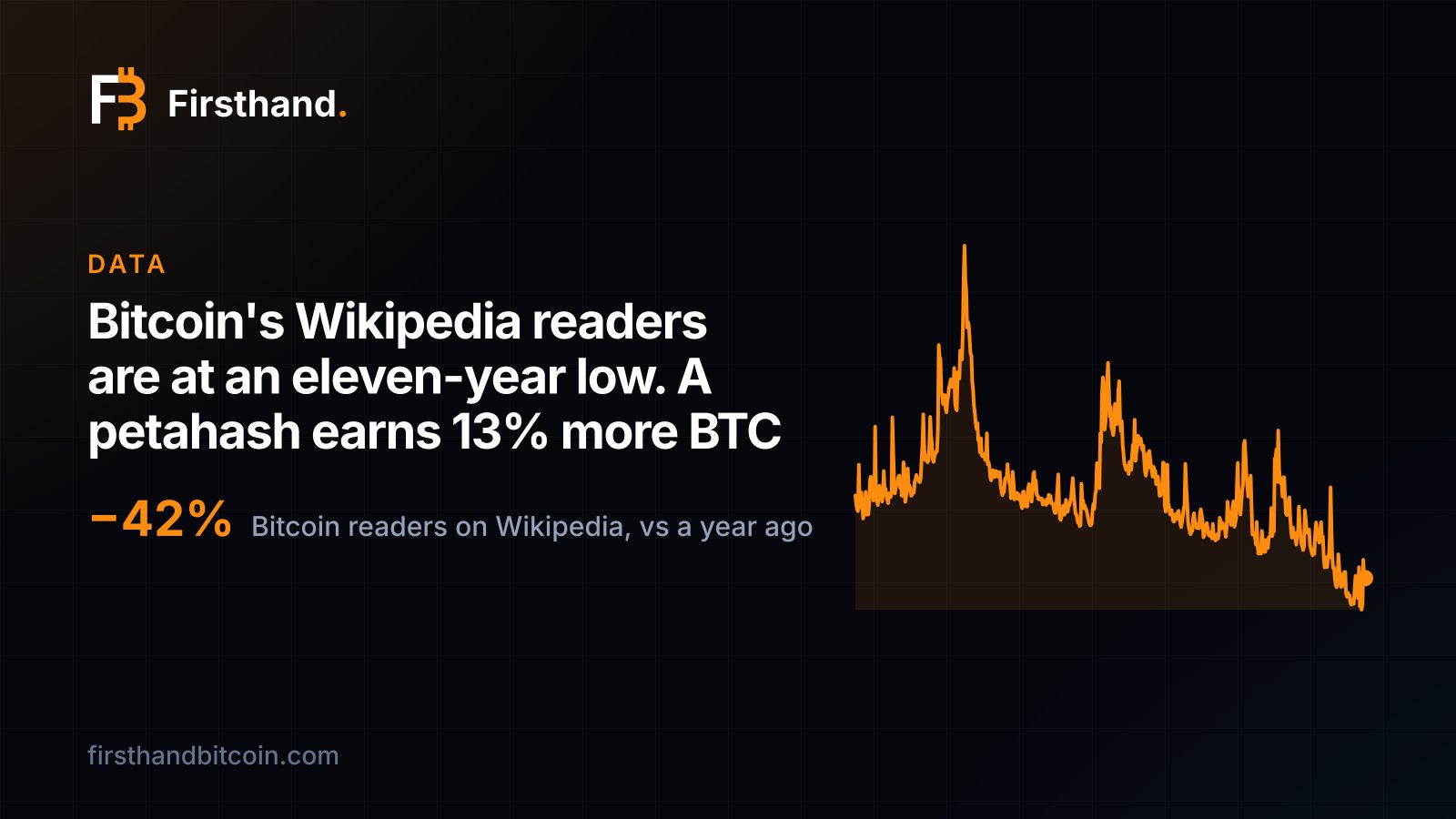
Readers of the Bitcoin article on Wikipedia averaged 5,499 a day over the last 30 days, 42% fewer than a year ago, and all 100 of the quietest days since 2015 fell in 2026. The bitcoin a machine earns never depended on the audience: a petahash makes 13% more BTC a day than it did a year ago.
TL;DR
- Readers of the Bitcoin article on Wikipedia averaged 5,499 a day in the 30 days to 19 November 2026, against 9,480 a year earlier: 42% fewer.
- The 100 quietest days since our readings began in July 2015 all fell in 2026. The quietest was 17 October, with 3,323 readers.
- Each cycle's record high drew fewer readers than the last: 265,860 on 19 December 2017, 39,267 on 9 November 2021, 11,864 on 6 October 2025.
- A petahash earns 0.000470 BTC a day at today's difficulty, 13% more than the 0.000416 it earned a year ago.
The quietest year for bitcoin on Wikipedia since 2015
Our public interest chart counts the daily readers of the Bitcoin article on Wikipedia, across twelve language editions, with automated traffic removed. In the 30 days to 19 November 2026 it averaged 5,499 readers a day. In the same 30 days of 2025 it averaged 9,480: 42% fewer people are looking bitcoin up than a year ago.
A Wikipedia read is a plain measure of curiosity: someone heard the word and wanted to know what it is. Unlike search interest it is published as real counts, back to 2015, and anyone can check it against Wikimedia's own figures.
Over a full year the drop is larger. The 365 days to 19 November averaged 6,023 readers a day, against 12,613 in the 365 days before: 52% fewer. 2026 has averaged 5,748 a day so far, where no full year since 2016 averaged fewer than 10,735.
The low readings are not one bad week. Our record starts on 1 July 2015, and the 100 quietest days in it all fell in 2026. The quietest was 17 October, with 3,323 readers, when bitcoin closed at $81,502. Before this year the quietest day was 21 December 2025, with 5,503; 190 of 2026's 323 days so far have come in below it.
Wikipedia lost readers too, but not at this pace
Some of the fall belongs to Wikipedia itself. The Wikimedia Foundation reported in October 2025 that human pageviews across Wikipedia had fallen by roughly 8% compared with the same months of 2024, and TechCrunch reported that the Foundation tied it to AI search summaries and social video.
The Bitcoin article fell faster than that. Its readers averaged 10,294 a day from March to August 2025, against 13,303 over the same months of 2024: 22.6% fewer, nearly three times the drop Wikipedia reported for itself. And the last year took away another half. People are reading less Wikipedia, and less still about bitcoin.
Wikipedia as a whole lost about 8% of its human readers. The Bitcoin article lost 22% over the same months.
Each record high drew fewer readers than the last
Attention on this chart has always arrived with the price. The busiest day in our record is 7 December 2017, with 534,938 readers, twelve days before bitcoin's highest close of that cycle, $18,911.79 on 19 December. The day of that close itself drew 265,860.
The last big day came on 5 December 2024, when bitcoin closed above $100,000 for the first time, at $101,163.18. That day 86,470 people read the article, still the busiest day of the past four years.
The next cycle's highest close, $67,534.17 on 9 November 2021, drew 39,267 readers. The highest close of all, $124,493.40 on 6 October 2025, drew 11,864. A price nearly seven times the 2017 high brought in one reader for every 22 who came that December.
The busiest single day since then was not a high at all. On 6 February 2026 bitcoin closed at $67,090.88, down from $75,022.93 two days earlier, and 28,963 people opened the article, the most of any day this year. The Fear & Greed Index read 9 that day.
November's sell-off barely moved the count
Futures exchanges force-closed $1.32 billion of bitcoin longs on 13 and 14 November, and bitcoin went from $73,931 on 12 November to $64,119 on 15 November, as our liquidations piece set out. Readers rose from 4,891 on 13 November to 6,941 on 14 November, and were back to 5,835 by 19 November.
In earlier bear markets the article was busier at the bottom than it is now. December 2018 averaged 17,742 readers a day and November 2022, the month the FTX exchange failed, averaged 17,598, with 26,835 on 10 November 2022 alone. November 2026 has averaged 5,627 so far. Wikipedia's own decline accounts for part of that gap, which is why our chart page advises comparing peaks within a cycle rather than across them; the size of the gap is still the story of this cycle.
What it means for a miner
A mining machine is paid by the network, not by the crowd. What it earns in bitcoin depends on the block reward, fees and how much hashrate it competes with, and none of those reads Wikipedia. A petahash earns 0.000470 BTC a day at today's difficulty on our hashprice in bitcoin chart, 13% more than the 0.000416 it earned on 20 November 2025, because difficulty is 11% lower than it was then.
Our next adjustment page estimates a rise of about 9% at the coming retarget, which would take back most of that gain. A petahash would still earn more BTC a day than it did a year ago, in a year when half the readers left.
On the most efficient machine in stock, the Antminer S23 XP Hyd at 8.9 J/TH on Nigeria's 3.9 cents, one BTC costs about $17,700 of electricity at today's hashprice, against $61,733 to buy this morning: 29% of the price. A miner who keeps what the machine makes, as our guide to holding the BTC sets out, is stacking them at that cost while the crowd is elsewhere.
Output is not guaranteed, and these figures hold today's conditions flat. They depend on bitcoin's price, network difficulty and the machine's uptime.
A machine is paid by the network, not by the audience.
Sources and further reading
- New User Trends on Wikipedia — Wikimedia Foundation (Diff), 17 Oct 2025
- Wikipedia says traffic is falling due to AI search summaries and social video — TechCrunch, 18 Oct 2025
- Public interest in bitcoin — Firsthand Bitcoin data, 19 Nov 2026
- Hashprice in bitcoin — Firsthand Bitcoin data, 20 Nov 2026
Disclosure
Firsthand Bitcoin sells and hosts mining hardware, including this machine. No manufacturer, distributor or affiliate programme paid for or reviewed this page and we take no commission on the links above. Historical figures are computed from daily bitcoin price and network hashprice, each day valued at its own prices. Nothing here is investment advice.