Data insight · Nov 21, 2026 · 5 min read
A petahash earns 3% more BTC than at June's low, as dollar hashprice sets a record
Bitcoin's fall to $57,744 took dollar hashprice to $27.14 a petahash on 21 November, under June's $27.74 and the lowest in our record. In bitcoin the day went the other way: a petahash earns 3% more BTC than at June's low, and the best machine makes one for $17,725 of power.
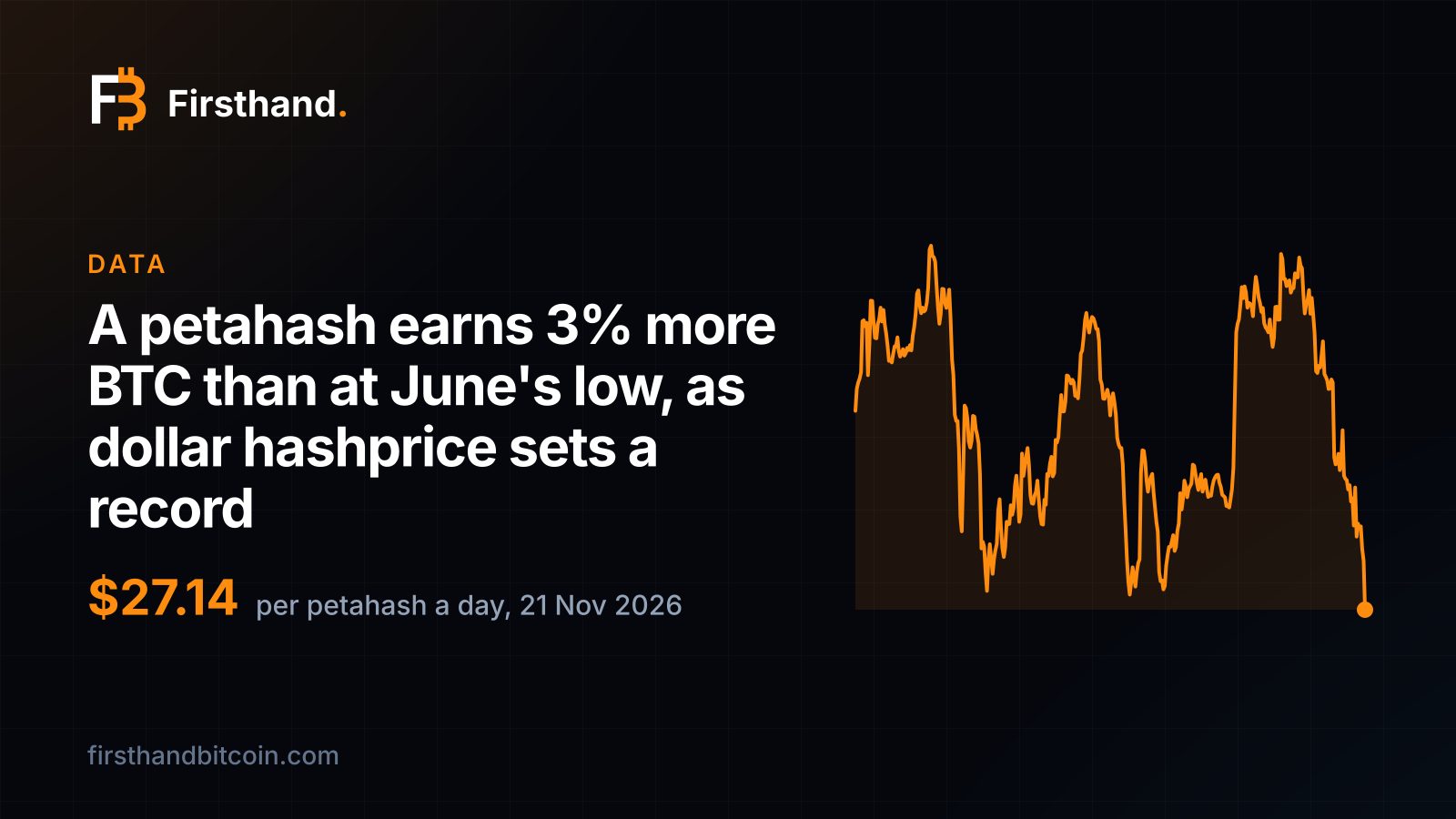
$27.14 a petahash, the lowest reading in our record
On the morning of 21 November, with bitcoin at $57,744, one petahash of mining power earned about $27.14 a day. That is the lowest dollar hashprice in our hashprice series, which runs back to 2013. The previous low was $27.74, on 6 June 2026, and before that $27.89 on 24 February. If the term is new, start with our guide to hashprice.
It came down in steps. Hashprice was $37.29 on 21 October, $30.49 on 13 November, $29.57 on 19 November and $29.09 at the close of 20 November. Only four days since the April 2024 halving have read under $28, and three of them are in 2026's earlier troughs.
The reason is the price, and only the price. Difficulty has not changed since the 9.13% cut of 14 November, and fees are a rounding error: they were 0.4% of what miners were paid on 15 November, as our piece on that day's record found. So the BTC side of a petahash's day has held still while the dollar value of each BTC fell.
In bitcoin, a petahash earns more than it did at June's low
Measured in what a miner keeps, the day looks different. A petahash earns 0.000470 BTC a day at today's difficulty on our hashprice in bitcoin chart. On 6 June, the day of the last dollar low, it earned 0.000456 BTC. The same machine and the same power bill now bring in 3.0% more BTC than they did then.
The dollar figure is lower because bitcoin itself is: $57,744 this morning against $60,771 on 6 June, 5.0% less. The two moves together leave dollar hashprice 2.2% under June's reading. For a miner who holds what the machine makes, the 3% is the part that stays.
It is also 10% more BTC than a petahash earned on 13 November, the day before the last difficulty cut, when the figure was 0.000427. Our piece on that cut sets out where it sits in the record.
Bitcoin is 5% cheaper than at June's low. A petahash earns 3% more of it.
Every machine at 18.5 J/TH or better still clears 6 cents
A machine's power bill per petahash is a fixed line: its J/TH times 24 hours, times the power rate. At $27.14, hashprice is above that line at 6 cents for any machine at 18.8 J/TH or better, at Argentina's 5.75 cents for any machine up to 19.6 J/TH, and at Nigeria's 3.9 cents for any machine up to 29 J/TH. Our break-even electricity chart draws the same lines as a price per kilowatt-hour.
The efficient end of the store is far from any of them. The Antminer S23 XP Hyd at 8.9 J/TH has a line of $12.82 at 6 cents and $8.33 at 3.9 cents. The Antminer S21 XP at 13.5 J/TH sits at $18.63 in Argentina. Machines at 17 J/TH, like the Whatsminer M63S+, have a 6-cent line of $24.48. None of these has had a day under its line since the April 2024 halving, at any of our three rates.
The margin narrows as the J/TH rises. At 18.5 J/TH, the efficiency of the Whatsminer M63S and M61S, the 6-cent line is $26.64, 50 cents under this morning's reading.
| Machine efficiency | Line at 6¢ | Days under it | Line at 5.75¢ | Days under it | Line at 3.9¢ | Days under it |
|---|---|---|---|---|---|---|
| 8.9 J/TH | $12.82 | 0 | $12.28 | 0 | $8.33 | 0 |
| 13.5 J/TH | $19.44 | 0 | $18.63 | 0 | $12.64 | 0 |
| 17 J/TH | $24.48 | 0 | $23.46 | 0 | $15.91 | 0 |
| 18.5 J/TH | $26.64 | 0 | $25.53 | 0 | $17.32 | 0 |
| 19.9 J/TH | $28.66 | 15 | $27.46 | 1 | $18.63 | 0 |
| 21.5 J/TH | $30.96 | 63 | $29.67 | 36 | $20.12 | 0 |
| 22 J/TH | $31.68 | 86 | $30.36 | 45 | $20.59 | 0 |
The 19.9 J/TH line was crossed in Argentina for the first time
A month ago we counted the days since the halving on which hashprice had dipped under each machine's line, in hashprice has never fallen under the power cost of a 19 J/TH machine. The lowest reading then was June's $27.74, which put the dividing line at about 19.3 J/TH at 6 cents. This morning's reading moves it to 18.8.
At Argentina's 5.75 cents, a 19.9 J/TH machine such as the Whatsminer M60 has a line of $27.46. Today is the first day since the halving on which hashprice has been under it. At 6 cents the same machine has now had 15 such days, all in 2026. The 21.5 and 22 J/TH machines, the S19j XP and S19e XP Hyd, have had 63 and 86 days under their 6-cent lines, and 8 and 10 of them this November.
At Nigeria's 3.9 cents, every hosting machine in our store, the least efficient of them at 22 J/TH, is still clear of its line, and none has had a day under it since the halving. That is the rate older machines cross to, once, when its cheaper power has paid them better over a trailing year, as our guide to the crossing explains.
One BTC costs $17,725 of electricity on the best machine
Because the BTC a petahash earns has not fallen, neither has the cost of making one. On the most efficient machine in stock, the S23 XP Hyd at 8.9 J/TH on Nigeria's 3.9 cents, one BTC costs $17,725 of electricity at today's difficulty. That is electricity only, before the machine and the pool's fee, and it is 31% of the $57,744 a BTC cost to buy this morning.
On 6 June the same machine on the same power would have spent about $18,250 of electricity on each BTC. Making one is 3% cheaper than at the last low; buying one is 5% cheaper. Our cost-to-mine chart carries the same comparison every day for a 13.5 J/TH machine at our rates.
About $17,700 of power to make a BTC that costs $57,744 to buy.
The next difficulty reset is estimated as a rise
Difficulty resets every 2,016 blocks. With 887 blocks to go this morning, mempool.space estimated the next one, due around 26 November, at +10.0%, and our next difficulty adjustment page showed the same. Hashrate has recovered since the 14 November cut, and blocks have been arriving every 9.1 minutes on average.
An estimate with five days to run moves a lot. Five days before the last reset, ours stood at −6.3%; the cut landed at −9.13%. If a rise of that size did arrive, it would take back the BTC the November cut added, at the same price and fees. We forecast neither the price nor the reset.
What it means for a miner
A record low in dollar hashprice is a record low in the price of bitcoin as seen through a petahash. It says nothing new about the machine: the BTC it makes each day is higher than at June's low, and the electricity behind each BTC is lower.
What decides whether that day is worth running is the line, and the line is set when the machine is bought. At 8.9 to 17 J/TH it sits between $8 and $25 a petahash at our rates, well under this morning's $27.14. The guide to efficiency and halvings shows why the same gap decides how long a machine stays on.
A miner who keeps what the machine makes is accumulating BTC at about a third of the market price on the best machine. Every figure here is a snapshot of 21 November 2026, held flat, and a machine's output is not guaranteed: hashprice moves with the price of bitcoin and with difficulty.
Sources and further reading
- Hashprice, daily, since 2013 — Firsthand Bitcoin data, 21 Nov 2026
- Hashprice in bitcoin, per petahash per day — Firsthand Bitcoin data, 21 Nov 2026
- Cost to mine one bitcoin — Firsthand Bitcoin data, 21 Nov 2026
- Difficulty adjustment estimate (mining API) — mempool.space, 21 Nov 2026
Disclosure
Firsthand Bitcoin sells and hosts mining hardware, including this machine. No manufacturer, distributor or affiliate programme paid for or reviewed this page and we take no commission on the links above. Historical figures are computed from daily bitcoin price and network hashprice, each day valued at its own prices. Nothing here is investment advice.