Data insight · Nov 13, 2026 · 6 min read
Hashrate fell 14% in 17 days, the third time in 2026, and a petahash will earn 9% more BTC
The network's seven-day hashrate has dropped from 1,081 EH/s on 27 October to 930 EH/s this morning. Falls of that size have now happened three times in 2026, as often as in the four years before it, and each one ended the same way: a difficulty cut that paid the machines still running more bitcoin. The next lands today, at about 8%.
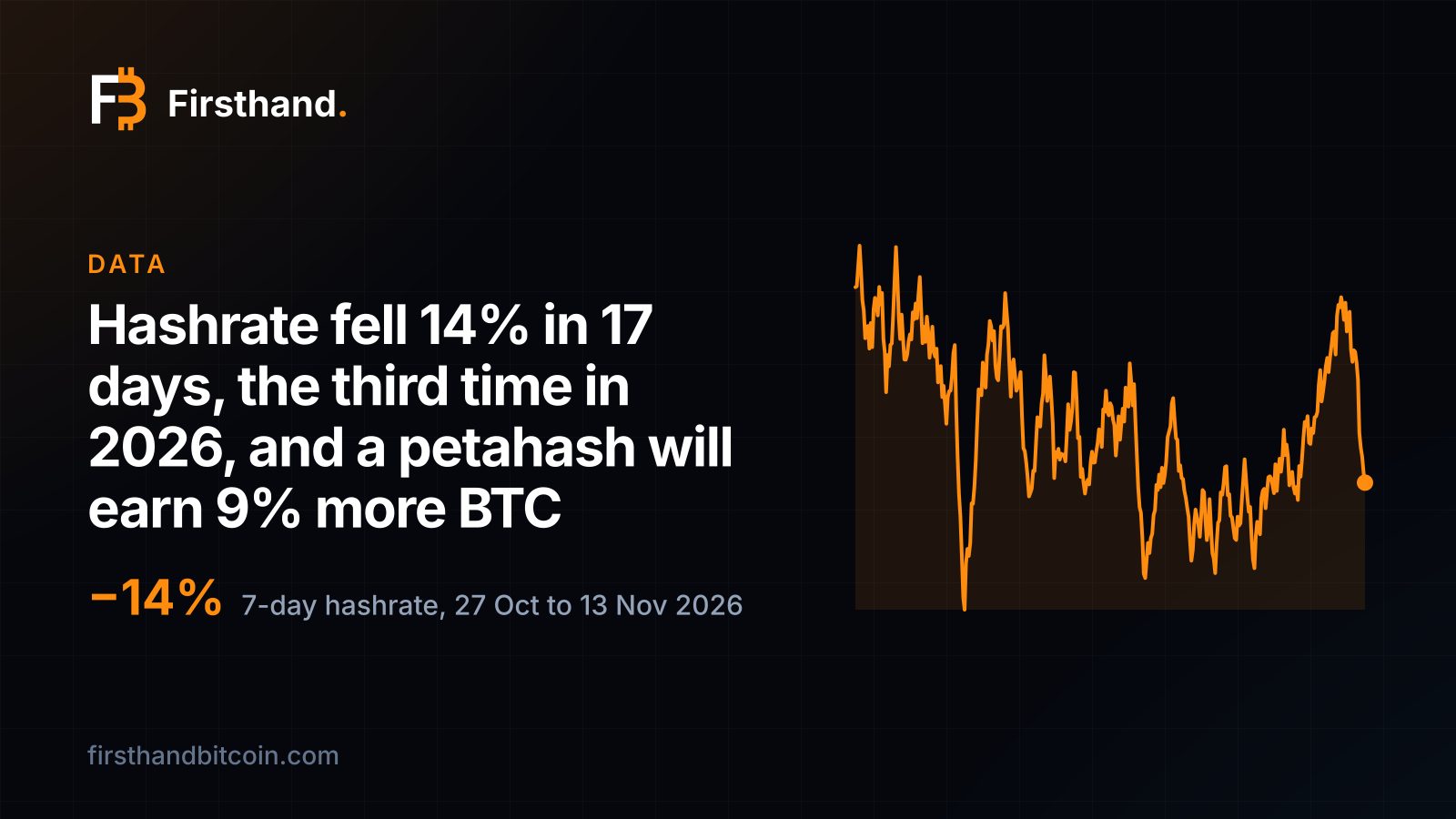
A seventh of the network has gone quiet since 27 October
The seven-day average of bitcoin's network hashrate on our hashrate chart stood at 1,081 EH/s on 27 October, with bitcoin at $80,000. By this morning, 13 November, it was 930 EH/s, with bitcoin at $68,631. That is a fall of 14% in seventeen days, and the average is now at its lowest since 26 September.
Falls of that size are rare in the record since the 2021 China ban, which took 36% of the network out in a fortnight. Between August 2021 and the end of 2025 the seven-day average fell 13% or more inside fourteen days on three occasions: twice in November and December 2022 and once in June 2025. In 2026 it has done so three times in ten months. The first ran from 16 to 30 January, 1,009 to 837 EH/s, a fall of 17%, while bitcoin went from $95,345 to $82,998. The second ran from 26 May to 9 June, 1,007 to 852 EH/s, a fall of 15%, while bitcoin went from $76,524 to $62,356. The third is the one we are in.
Each of the three had a price fall in front of it. Hashrate does not fall because machines break. It falls because somebody, somewhere, has decided that a machine no longer covers its electricity at the price of the day, and has switched it off.
Three times in ten months, the network has lost 13% or more of its hashrate inside two weeks.
The machines that stopped are the ones at the line
What a petahash earns in dollars, hashprice, was $36.27 per petahash per day on 25 October. On 12 November it was $31.58, and with bitcoin under $69,000 this morning it is about $29.32. That is above June's low of $27.74, but it is low enough to put the oldest machines on ordinary power under water.
The arithmetic is plain for a machine in our own catalogue. The air-cooled Antminer S19 XP runs at 21.35 J/TH, so a petahash of it uses 512 kWh a day. At 6 cents that is $30.74 of electricity against $29.32 of revenue: a loss of about $1.40 a day for every petahash left on. At Nigeria's 3.9 cents the same petahash costs $19.98 to run and clears about $9 a day. A 20 J/TH machine on 6-cent power sits almost exactly on the line.
That is the margin the network has been shedding. When the price fell through the mid-seventies and then the low seventies, the 20-plus J/TH machines on 6-cent and dearer power stopped covering themselves, and their owners did what the owners of the same machines did in January and June. Nothing about an 8.9 or 13.5 J/TH machine changed in those seventeen days; a petahash of the most efficient machine in stock costs about $8 a day to run at 3.9 cents, a little over a quarter of what it earns.
The difficulty cut lands today, at about 8%
Difficulty resets every 2,016 blocks to what the hashrate of the previous fortnight produced. With the network a seventh smaller, blocks have been slow: our estimate for the reset on the difficulty adjustments chart has moved from a 6.5% cut on 9 November to 8.4% this morning, with 105 blocks to go, so it lands later today. On Monday we expected 6%; the week since has made it bigger.
An 8.4% cut would be the third-largest since the 2021 China ban, behind only the two that followed this year's earlier hashrate falls: 11.2% on 7 February and 10.1% on 14 June. The cut after the 2022 episodes was 7.3%, on 6 December 2022, and the one after June 2025 was 7.5%. Three falls of a seventh of the network in one year, three cuts of 8% or more, is not a pattern the record held before 2026.
For a machine that stayed on, a cut is a rise in pay. On 12 November a petahash earned 0.000427 BTC a day on our hashprice in bitcoin chart, the lowest of the year on 1 November at 0.000426. After an 8.4% cut the same petahash earns about 0.000467 BTC a day, 9.2% more, from the moment the new difficulty takes effect. In bitcoin terms a petahash will earn more from tonight than it has at any point since the June cut.
Every machine still running is about to earn 9% more bitcoin for the same electricity.
What happened after January and June
The two earlier episodes ended differently. After the January fall the seven-day average was back above its 16 January level within a fortnight, on 13 February, six days after the 11.2% cut: the machines that had gone quiet came back as soon as the difficulty paid them to. After the June fall it took until 11 October for the average to climb back above its 26 May level, four months in which bitcoin went from $62,000 back to over $80,000.
The difference was the price. In February bitcoin was still above $80,000 and a lower difficulty was enough to make the marginal machines pay again. In June it was in the low sixties, and a 10% cut did not bring a 22 J/TH machine on 6-cent power back over its line; those machines waited for the price. Which way this third episode goes depends on the same two numbers, and we do not forecast either of them.
What the record does say is that the network has never stayed smaller for long. The seven-day average is 19% below its record of 1,153 EH/s, set on 19 October 2025. Both earlier 2026 falls were fully reversed; the June one simply took longer.
What it means for a miner
A falling price and a rising share of the network are the two things a miner who keeps the bitcoin wants to happen at once, and they are happening at once. Each petahash earns 9% more BTC from tonight, and the BTC it earns are being mined at a price a third below October's.
On the most efficient machine in stock, the Antminer S23 XP Hyd at 8.9 J/TH, a bitcoin costs about $19,500 of electricity to make at our Nigeria site at today's hashprice, against about $68,600 to buy one this morning. That is 28% of the price, and after today's cut it falls again. The machines that caused the cut by switching off were the 20-plus J/TH machines on 6-cent and dearer power, which is the whole argument for buying efficiency and hosting it on cheap power: those machines never came near the line.
Earnings are not guaranteed, and every figure here holds today's conditions flat. But the moments when a seventh of the network switches off are the moments an efficient machine on cheap power stacks the most bitcoin per dollar of electricity, and the record now holds three of them in one year.
Sources and further reading
- Network hashrate — Firsthand Bitcoin data, 13 Nov 2026
- Difficulty adjustments — Firsthand Bitcoin data, 13 Nov 2026
- Live updates: Bitcoin slumps below $72,000 as Nvidia's Huang resigns, interest rates surge — CoinDesk, 12 Nov 2026
Disclosure
Firsthand Bitcoin sells and hosts mining hardware, including this machine. No manufacturer, distributor or affiliate programme paid for or reviewed this page and we take no commission on the links above. Historical figures are computed from daily bitcoin price and network hashprice, each day valued at its own prices. Nothing here is investment advice.