Data insight · Nov 2, 2026 · 3 min read
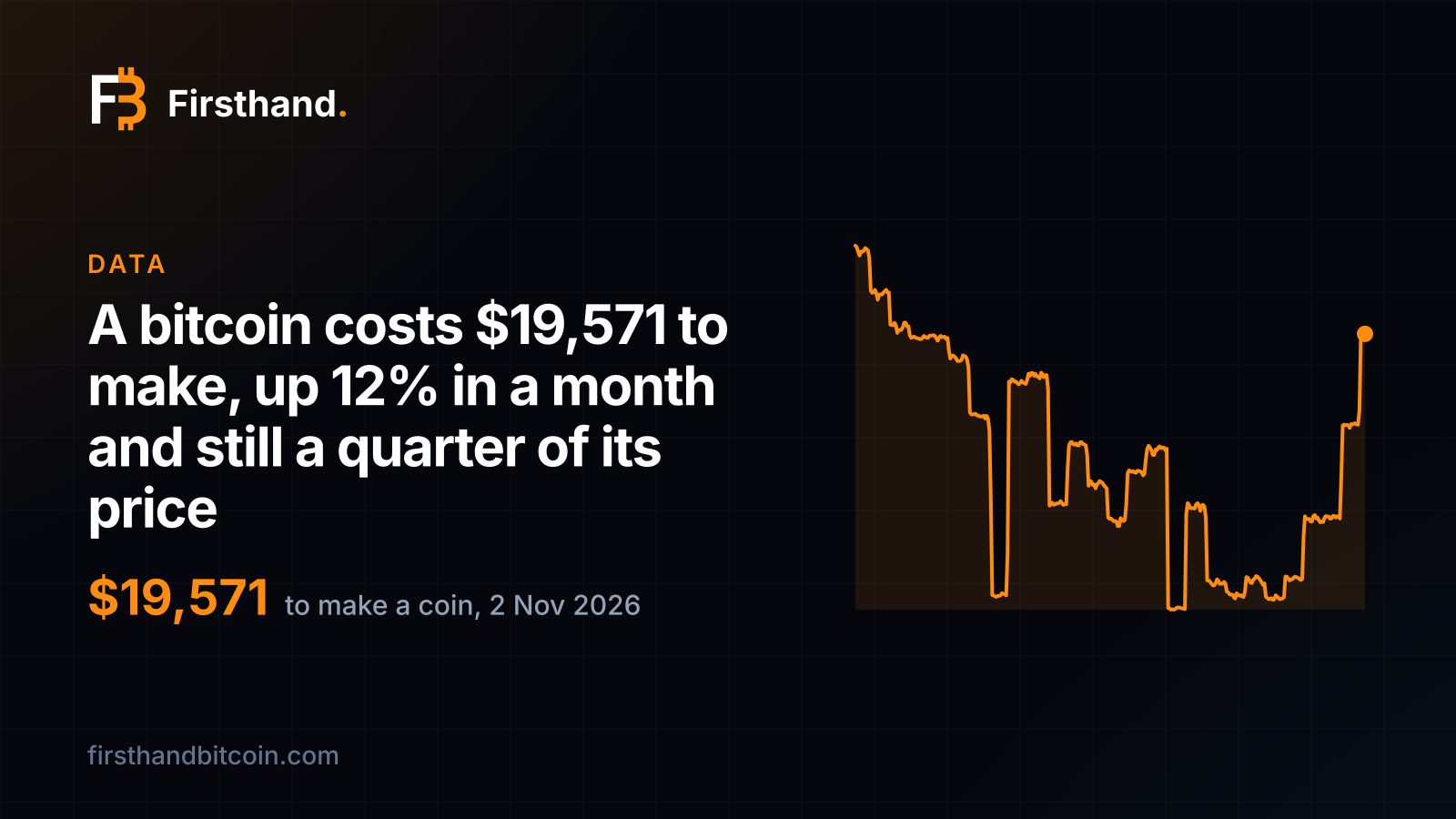
A bitcoin costs $19,571 to make, up 12% in a month and still a quarter of its price
Two difficulty rises in 13 days, 5.9% and 5.5%, gave each petahash fewer coins than at any point since December, and the best machine's cost of making a coin went from $17,431 to $19,571. Bitcoin's price slipped 7.6% over the same month. The coin still costs about a quarter of what it sells for.
Two retargets in 13 days lifted difficulty 11.8%
Bitcoin's mining difficulty rose 5.92% on 16 October to 140.58 trillion, then another 5.54% on 29 October to 148.36 trillion, according to mempool.space's record of every retarget. The previous retarget, on 3 October, had left it at 132.72 trillion, so the month's two steps add up to 11.8%. KuCoin's write-up of the second one puts it at the same 148.36 trillion.
That is 4.9% under the record of 155.97 trillion set on 29 October 2025. Our earlier piece on difficulty winning back half of its fall put the 29 October estimate at +4.85% on 25 October; the retarget landed at +5.54%. Difficulty is the network's count of how much machinery is competing for each block, and it follows the machines: our 30-day average hashrate went from 948 exahashes a second on 3 October to 1,039 on 2 November.
Back-to-back rises of 5% or more have happened only three times since 2021
Our table of every retarget since January 2021 holds 154 of them. In only three stretches did two or more in a row each add 5% or more: July and August 2021 (6.03%, 7.31% and 13.24%), February 2024 (7.33% and 8.24%), and these two weeks. The three steps of 2021 added up to a rise of 28.8%.
October's 11.8% is the smallest of the three. The largest two-step rise in the table, 21.5%, came on 13 and 25 August 2021. The point is not that the network has done something unusual. A run of increases is what a growing network looks like, and the cost of making a coin follows it up the same way each time.
A petahash earns fewer coins than at any point since 10 December
The network pays out about 450 new bitcoin a day in block rewards, 3.125 on each of roughly 144 blocks. When difficulty rises, that sum is divided among more machines and each petahash gets a smaller share. On 3 October a petahash earned 0.000478 bitcoin a day. On 1 November it earned 0.000426, the lowest reading since 10 December 2025 and the lowest of 2026, on our hashprice in bitcoin chart.
In dollars the picture is milder, because the coin itself was worth more for most of the month. Hashprice was $40.38 per petahash per day on 3 October and $33.24 on 2 November. The close of $32.93 on 31 October was the lowest since 19 August. Hashprice is calculated from an estimated hashrate, so compare weeks rather than single days.
More machines on the network means the same 450 new bitcoin a day is shared more thinly.
The cost of a coin rose 12% and the price fell 7.6%
Our most efficient machine in stock is the Bitmain Antminer S23 XP Hyd, at 8.9 J/TH. On Nigeria's 3.9¢ power a petahash of it burns $8.33 of electricity a day, and what that buys is set by hashprice. On 3 October that made a bitcoin for $17,431 of electricity. On 2 November it was $19,571, up 12.3%. That counts electricity only, at the day's hashprice, and leaves out the machine and the pool fee.
Over the same month bitcoin's price went from $84,503 to $78,095, down 7.6%. A coin sold for 4.85 times its cost to make on 3 October and 3.99 times on 2 November. A dearer coin to make and a cheaper coin to sell narrowed the gap, and it is still about four to one: the electricity bill is a quarter of the coin's price.
The next retarget is about ten days away and starts below zero
The new epoch began at block 973,728. At block 974,227 on 2 November, 1,517 blocks remained, roughly ten days at the recent pace. The estimate on our difficulty adjustments chart is -1.67%, which would give some of the coins back.
It is early in the epoch and the estimate swings with every block: it read +6.33% on 20 October and +4.85% on 25 October before the last retarget landed at +5.54%. A single day's hashrate reading can be off by more than 10%, so the estimate firms up only as blocks are found. Getting back to the record from today's level would take a rise of 5.1%.
What it means for a miner
A rise in difficulty is a cost that lands on every machine at once, and efficiency decides how heavily. At 8.9 J/TH on 3.9¢ power, a petahash costs $8.33 a day to run: 25% of the $33.24 it earned on 2 November, up from 21% on 3 October. At 19 J/TH on the same power it costs $17.78 a day, 54% of today's pay, up from 44%. Our piece on hashprice against the power cost of a 19 J/TH machine sets out where that line sits.
The coins mined at a higher difficulty are still coins kept. A machine that makes a bitcoin for about $19,600 while the market pays about $78,100 is producing the asset at a quarter of the price of buying it, and the efficient machines on cheap power are the ones that keep that margin when the network adds more machinery. Output is not guaranteed and moves with difficulty and price every fortnight. What the last month shows is the size of that movement: a coin got 12% dearer to make in four weeks and the margin to its price stayed above three times.
The machine that makes a coin for a quarter of its price is the one that stays on through a month like this.
Sources and further reading
- Bitcoin mining difficulty adjustments (every retarget, to block 973,728) — mempool.space, 2 Nov 2026
- Bitcoin Mining Difficulty Rises 5.54% in October: What It Means for Miner Profitability — KuCoin, 30 Oct 2026
Disclosure
Firsthand Bitcoin sells and hosts mining hardware, including this machine. No manufacturer, distributor or affiliate programme paid for or reviewed this page and we take no commission on the links above. Historical figures are computed from daily bitcoin price and network hashprice, each day valued at its own prices. Nothing here is investment advice.