Home / Blog / How to think about mining
Guide · Nov 7, 2026 · 5 min read
Cloud mining sells you a promise; a hosted miner is a machine you own
Cloud mining and hosting both let someone else run the hardware, and they are easy to confuse. One gives you a contract that expires. The other gives you a machine with your name on it, and five questions show which you are being offered.
TL;DR
- Cloud mining is a contract for a share of output. A hosted miner is a machine you own.
- Ask for a serial number, your own pool account, your own wallet and the right to leave.
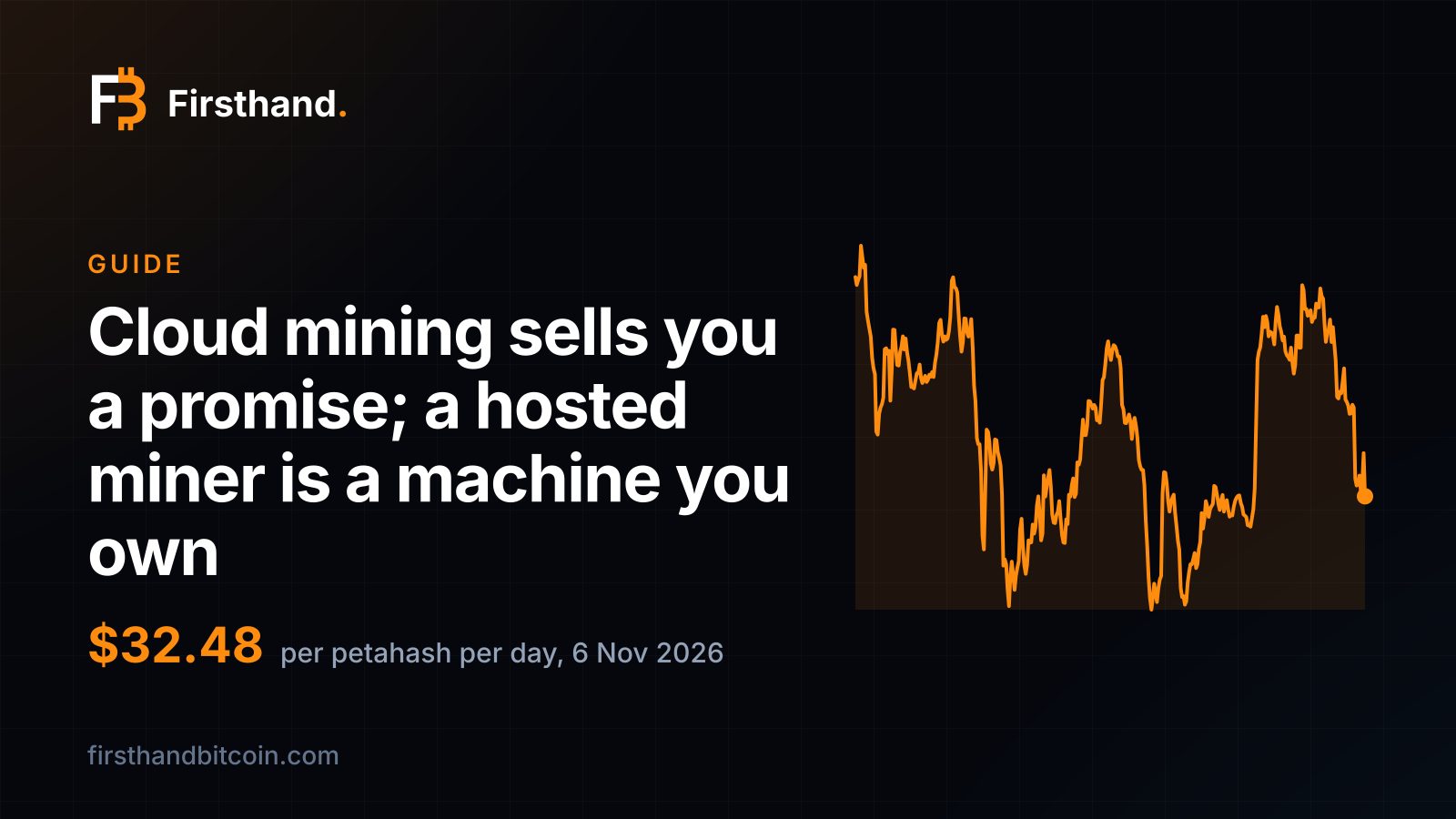
- No contract can pay more than the network does: about $32 per petahash a day on 6 November 2026.
Cloud mining is a contract, not a machine
Cloud mining is the name for paying a company up front in return for a share of its mining output over a set period, often a year or two. You are not buying a miner. You are buying a contract that says the company will send you a portion of what some of its machines produce.
Owning a hosted miner is a different thing with a similar sound. You buy one specific machine, with its own serial number, and it is racked at a site that supplies power, cooling and staff. The machine is yours. The site is a landlord. If you want the full picture of how that works, start with how hosting a bitcoin miner works, step by step.
The first question for any mining offer is simple: what exactly will I own tomorrow?
What you hold in each case
The clearest way to tell them apart is to ask what you could pick up, show or move. Put the two side by side and the difference is the whole story.
| Question | Cloud mining contract | Hosted miner you own |
|---|---|---|
| What you own | A promise of a share | A specific machine |
| Paperwork | The contract | An invoice with the model and serial number |
| Who picks the pool | The company | You |
| Where the coins go | Through the company, then to you | Pool to your own wallet |
| If you want to leave | Wait for the term to end | Ship the machine, move it or sell it |
| What is left after the term | Nothing to hold | The machine, still hashing |
A promise is hard to check
With a machine you can check everything yourself. The pool shows the hashrate your machine delivers, and the coins arrive in a wallet whose address you control. With a contract you see only what the company's dashboard chooses to show you.
There is one check anyone can do in a minute. Hashprice is what one petahash of hashrate earns in a day, before any power bill. On 6 November 2026 it was $32.48 per petahash per day, which is about 3 cents for each terahash. A contract that promises 10 cents per terahash per day is promising three times what the whole network pays today, with no electricity taken off.
Nobody can pay out more than the network produces. A promise above the line has to be funded some other way, and the usual way is with the money of the next buyer.
Follow the money in each case
With a contract, you pay a lump sum at the start. After that, payments are meant to arrive from the company every day or every month until the term ends. Your money has gone into the company's accounts, and everything after that depends on the company continuing to do what it said.
With a hosted miner, your money buys a machine, delivers it to a site and, in a hosting quote like ours, pays a deposit towards the first months of electricity. After that you pay the power bill for your own machine, and the coins it mines go to your own wallet. The price you pay for the machine is the price of an object. If you ever stop liking the arrangement, the object is still there.
Our guide on the price of a miner is not the price of the box lists what sits inside an all-in price, so you can compare like with like.
What happens if the company stops
Every business can fail, so it is worth asking what a failure would do to you. If a contract company stops, your promise stops with it. There is no machine to collect and no wallet of yours holding the coins, because the company was the one holding them.
If a host stops, a machine you own is a physical thing with a serial number. You can have it shipped to another host, and the coins already mined are in your own wallet, out of the host's reach. A host's failure can interrupt your mining for a while. It cannot take the bitcoin you have already received.
A hosted miner still needs a good host
Owning the machine is the start of the checking, not the end of it. A host runs the site, so ask the practical questions as well: what the power rate is, how often the site is online, who repairs a fault and what that costs. The guide to what uptime means shows how to read the second one.
The difference is that with a machine you can compare hosts, move between them and see every number for yourself. With a contract there is only one counterpart, and you take its word.
Five questions that tell them apart
Before paying anyone for mining, ask these five. A hosted-miner seller answers all of them in writing. A seller who cannot has told you what you are buying.
Which machine is mine? You should get a model and a serial number on an invoice in your name, and a photo or video of that unit in the building.
Whose pool account does it mine into? It should be yours, or one you choose and control. Our guide to changing a pool or payout wallet shows what that control looks like.
Where do the coins land? Ideally straight from the pool to a wallet address that only you hold keys for, so the company never holds your bitcoin.
Can I leave with the machine? You should be able to have it shipped to you, moved to another host or sold on.
What does the quote say a terahash earns? Set it against hashprice, as above. A real machine earns what the network pays and no more.
Some contracts are honest, and still leave you with nothing to hold
This is not a claim that every contract is a fraud. An honest company can run a contract well and send what it promised. At the end of the term you still have a record of payments and nothing else: no machine to keep hashing, nothing to sell, nothing to take elsewhere.
Contracts also tend to be sold on a headline number and bundled with maintenance fees, so the figure to compare is what lands in your hands after every deduction, over the whole term, set against what you paid at the start. Write that sum down before you pay. If the seller will not give you the pieces to work it out, the missing pieces are the answer.
A machine works the other way. It keeps producing after it has paid for itself, and its coins are in your wallet from the first day. Our guide on how long a miner takes to pay for itself walks through the timing.
What it means for a miner
The point of mining is to end up holding bitcoin that cost less to make than to buy. On 7 November 2026 the best machine we sell, the S23 XP Hyd at our Nigeria site, made a coin for about $19,487 of electricity against a market price of $76,016. That gap is only yours if the machine and the coins are.
Nothing here asks you to pick a side before you have the facts. It asks you to find out, in writing and before paying, which of the two things is being sold, and to buy the one you can see, hold and move.
A contract hands the gap to whoever owns the machines. A hosted miner keeps it with you. Mining output is never guaranteed, so judge any offer by what you hold on the day the first payment arrives, and read what to check before you buy your first miner before you pay anyone.
Own the machine and the coins it mines, and you can check both yourself.
Disclosure
Firsthand Bitcoin sells and hosts mining hardware, including this machine. No manufacturer, distributor or affiliate programme paid for or reviewed this page and we take no commission on the links above. Historical figures are computed from daily bitcoin price and network hashprice, each day valued at its own prices. Nothing here is investment advice.