Home / Blog / How mining works
Guide · Nov 3, 2026 · 6 min read
What share of the bitcoin network does one miner own, and what does that share earn a day?
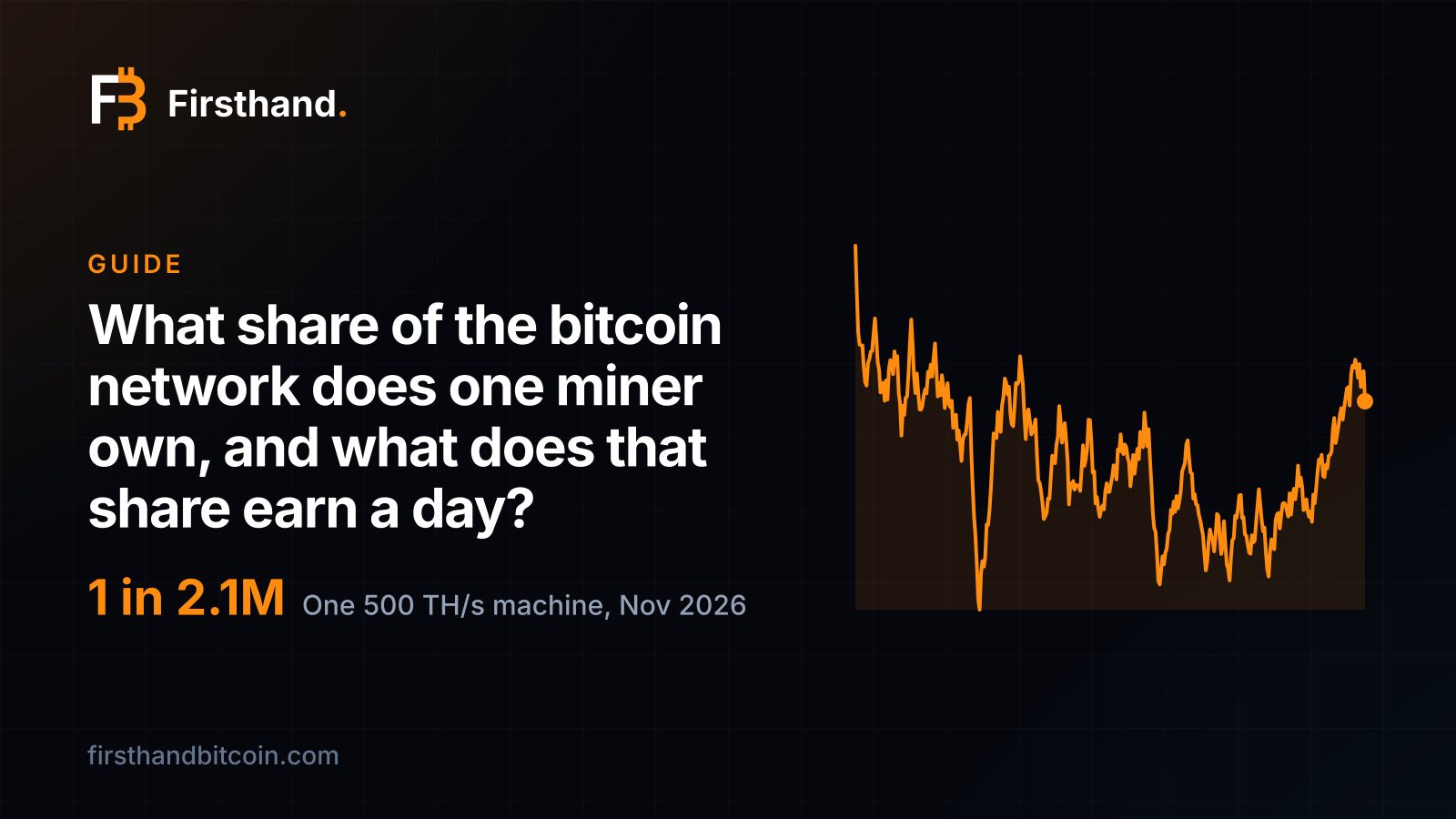
A 500 TH/s machine owns about one two-millionth of bitcoin's mining power, and that sliver earns about 21,300 satoshis a day. Here is how the share is worked out, why it earns a little less each time difficulty rises, and what it means when you pick a machine.
TL;DR
- A machine's income is its share of the network's mining power times the network's daily pay.
- A 500 TH/s machine owns about 1 in 2.1 million of the network and earned about 21,300 satoshis a day on 2 November 2026.
- A rise in difficulty shrinks every share by about the same percentage, with no change to the machine.
A miner earns a share, so start with the share
Every day the whole bitcoin network earns the same pot of new coins, and every machine on it earns a slice of that pot. The size of the slice depends on one thing: how much of the network's total mining power the machine supplies. Work out the share and the rest of mining income is arithmetic.
Mining power is measured in hashes per second. If you want the plain-words version of what a hash is, our guide to the TH/s on a spec sheet covers it. Here all you need is that a machine's rating is a number of terahashes per second, and the network's total is a number of exahashes per second. One exahash is a million terahashes.
Think of the day's pay as one pie cut in proportion to the power each machine supplies. A machine with twice the power takes twice the slice, and a network twice the size halves every slice. Those two ideas explain nearly everything that follows.
The network is about a billion times larger than one machine
Our hashrate chart put the network at an average of 1,039 exahashes per second over the 30 days to 2 November 2026. That is 1,039,000,000 terahashes per second.
Take a machine rated at 500 TH/s. Divide 500 by 1,039,000,000 and you get 0.00000048, or about 1 in 2.1 million. That is the machine's whole share of bitcoin mining: one part in two million.
We use a 30-day average because a single day's reading is a rough estimate. Over the last year the daily readings in our data ran from 706 to 1,245 exahashes per second, so one day is a poor guide to the size of the network. An average is steadier, and it is what a machine's income actually follows.
A 500 TH/s machine owns about 1 in 2.1 million of bitcoin's mining power.
What a share of one in two million earns
The cleanest way to turn a share into coins is hashprice: what one petahash per second earns in a day. A petahash is 1,000 terahashes, so a 500 TH/s machine is half a petahash. Our hashprice chart read 0.000426 bitcoin per petahash per day on 2 November 2026. Half of that is 0.000213 bitcoin, which is 21,300 satoshis a day.
A satoshi is one hundred-millionth of a bitcoin, and if the unit is new to you our guide to satoshis shows how to read amounts this small. At the 2 November close of $78,269 that day's coins were worth about $16.70, and a 30-day month came to about 0.0064 bitcoin, 639,000 satoshis.
These are the machine's gross coins, before the power it burned and any pool fee. What the power costs is a separate sum, and it is where one machine ends up better than another. Our guide to electricity and profit does that half.
Why the same machine earns a little less when difficulty rises
Nothing about your machine changes when the network grows. Its rating stays at 500 TH/s. But its share is a fraction, and when the bottom of the fraction gets bigger the share gets smaller.
Difficulty is the setting that keeps blocks arriving about every ten minutes as machines are added. When it was raised by 5.54% on 29 October, the coins per petahash fell from 0.000449 bitcoin on 28 October to 0.000427 on 30 October, a drop of 5.0%. The same machine went from about 22,500 satoshis a day to about 21,300, and it had not done anything differently. Our difficulty guide explains the setting itself.
The reverse also holds. When difficulty falls, every share grows by the same proportion. That is why a machine's coins per day are best read as a range that moves in steps every two weeks or so, not as a fixed number.
Why one machine never finds a block by itself
A share of 1 in 2.1 million also explains why machines join pools. The network finds about 144 blocks a day, and each block goes to one miner. A machine with one two-millionth of the power would expect to find a block about once every 40 years, with no guarantee of when. Our solo mining guide walks through those odds.
A pool adds the shares of many machines together and pays each its slice of the day's blocks. That turns a rare jackpot into a steady stream: your machine earns what its share says it should, every day. How the pool counts and pays that slice is covered in our guide to pool payouts.
The same sum for any machine, in four steps
You can run this for any machine in under a minute. First, read its rating from the spec sheet, in terahashes per second. Second, divide by 1,000 to get petahashes. Third, open the hashprice chart and read the latest value. Fourth, multiply the two.
A 200 TH/s machine is 0.2 petahash, so 0.2 times 0.000426096 bitcoin is about 8,520 satoshis a day on 2 November 2026. A 1,000 TH/s machine is one petahash and earned about 42,610. Double the rating and you double the coins, because you doubled the share.
Those are coins before power and pool fees, at one day's hashprice. Read them as the size of the machine's slice, and use the hashprice chart to see how that slice has moved.
What the share does not tell you
The share is the machine's rating divided by the network, which assumes the machine is hashing at its rating all day. A machine that reads lower than its spec sheet earns less than its share, and our guide to why a hashrate reads lower than the spec sheet covers the usual reasons.
It also assumes the machine is running. Every hour offline is an hour with no share at all, which is why uptime is one of the first things to ask a host about. The share tells you what a machine could earn; the rating, the uptime and the power bill decide what it keeps.
What it means when you pick a machine
The machine's income is its share of the network times the network's daily pay. The first part you buy: a bigger rating is a bigger share. The second part you do not control: it moves with the number of machines competing and with the bitcoin price.
Two machines with the same rating own the same share and earn the same coins before power. What separates them is what they burn to do it, which is the efficiency number on the spec sheet, and the price per kilowatt-hour at the site they run in. That is why a miner who keeps the coins looks at the cost to make each one, and at the machine's efficiency, before the hashrate headline.
Ten of these machines would own 1 in 208,000. A hundred would own 1 in 21,000. Even a large fleet is a small part of the whole network, and it earns in direct proportion to that part, which is why the daily arithmetic never needs more than a rating, a hashprice and a power bill.
Disclosure
Firsthand Bitcoin sells and hosts mining hardware, including this machine. No manufacturer, distributor or affiliate programme paid for or reviewed this page and we take no commission on the links above. Historical figures are computed from daily bitcoin price and network hashprice, each day valued at its own prices. Nothing here is investment advice.