Data insight · Oct 25, 2026 · 6 min read
Bitcoin's difficulty has won back half of its fall from the record
Mining difficulty peaked at 155.97 trillion a year ago, fell to 124.93 trillion in June and stands at 140.58 trillion: halfway back. The whole round trip is worth about $4,100 on a coin that costs about $18,500 to make and sells for more than four times that.
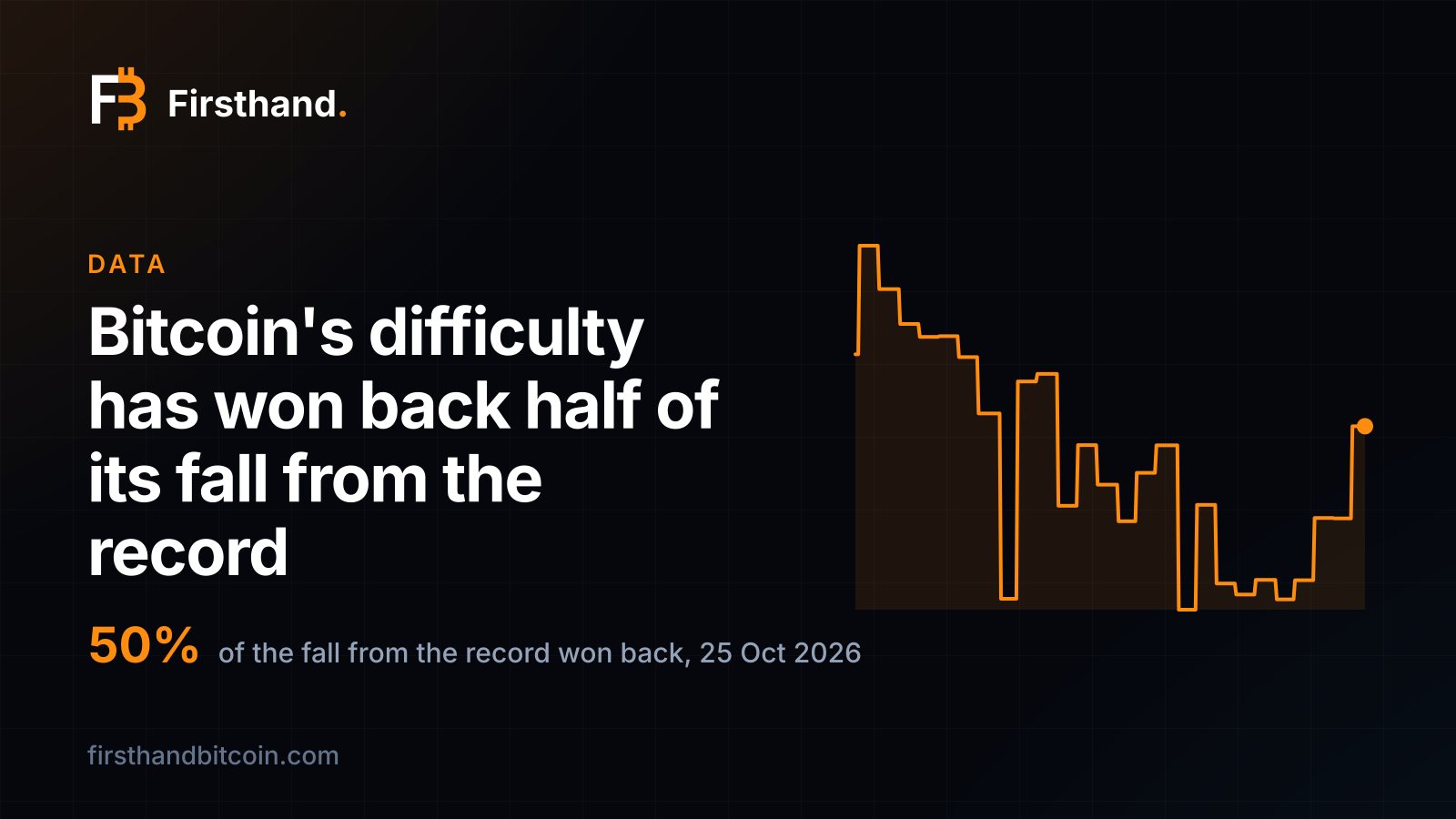
Difficulty is halfway from its June low back to the record
Bitcoin's mining difficulty reached its highest level ever, 155.97 trillion, on 29 October 2025. After the retarget on 16 October 2026 it stands at 140.58 trillion, 9.9% below that record and 12.5% above the 124.93 trillion it fell to on 14 June. Of the 31.04 trillion it lost between the peak and the low, it has won back 15.65 trillion, or 50.4%. It is the highest since 19 March.
Difficulty is the network's own count of how much machinery is competing for each block. When it rises, the same 450 new bitcoin a day is shared among more machines and each petahash earns fewer coins. In September it was 15% below the peak. It has closed about a third of that gap in a month.
February's cut reversed in twelve days. June's has taken four months to half-repair
Difficulty has fallen by more than 10% twice this year, and the two cuts had different causes. On 7 February it dropped 11.16% to 125.86 trillion after Winter Storm Fern shut down mining in Texas and other US regions, according to KuCoin's report. Twelve days later, on 19 February, it rose 14.73% to 144.40 trillion as the machines came back. That was a pause.
The cut on 14 June was 10.09%, from 138.96 trillion to 124.93 trillion. It followed a price slide of about 15% that squeezed margins and took computing power off the network, as CoinMarketCap reported from Galaxy Research's account. Both cuts are among the ten largest in our record, which starts in 2013. A machine switched off by margins comes back when the margin does, and 133 days on, difficulty has won back half.
The first attempt faded. Difficulty rose 7.15% on 27 June to 133.87 trillion, then gave back 5.00% on 11 July and 0.74% on 25 July, and on 23 August it was 125.81 trillion, within 0.7% of the low. Since the low there have been nine retargets, five up and four down, for a net rise of 12.5%. The run that counts began on 5 September: +1.31%, +4.16% on 19 September, then +5.92% on 16 October.
A machine switched off by a storm comes back with the weather. One switched off by margins comes back with the margin.
Hashrate has come back a little faster than difficulty, and the price a good deal slower
Difficulty follows hashrate, so the machines tell the same story. A single day's hashrate reading is an estimate that can be off by more than 10%, so compare 30-day averages. That average peaked at 1,110 exahashes a second on 12 November 2025, sank to 897 on 29 July 2026 and was 1,012 on 25 October. That is 54% of the distance from the low back to the peak.
The price has recovered less. Bitcoin's record close in our series is $124,493 on 6 October 2025, its lowest close since is $59,014 on 30 June 2026, and it was $80,520 on 25 October: 33% of the way back. The network has won back more of its machinery than the market has of its price, which is why a petahash earned 0.0004493 bitcoin on 25 October against 0.0004165 on the day difficulty peaked, 7.9% more.
The whole round trip in difficulty is worth about $4,100 on a coin
What the climb means for a machine is arithmetic. A bitcoin made by the most efficient machine we stock, the Bitmain Antminer S23 XP Hyd at 8.9 J/TH on Nigeria's 3.9¢ power, cost about $18,541 in electricity on 25 October, against a market price of $80,520. That counts electricity only, at today's hashprice, and leaves out the machine and the pool fee.
The cost of a coin moves one-for-one with difficulty when fees and the pace of blocks stay where they are. Scale today's figure to the record and the same machine would make a coin for about $20,572. Scale it to the June low and it would be about $16,478. The distance between the two is about $4,100, on a coin that sells for almost four times the dearer figure.
The price has moved far more. Bitcoin fell $65,000 from its record close to its June low and has won back $21,500 since. Difficulty set the cost of making a coin inside a band a few thousand dollars wide, and the price decided the margin around it.
The price moved $65,000 down and $21,500 back. Difficulty moved the cost of a coin by about $4,100.
The next retarget is estimated at +4.8%, and the estimate moves with every block
The estimate on our difficulty adjustments chart was +4.85% on 25 October, with 692 blocks left in the current epoch. The retarget happens at block 973,728, a little under five days away at the recent pace. If it landed at that estimate, difficulty would be 147.39 trillion, 72% of the way back from the low and 5.5% under the record.
The estimate was +6.33% on 20 October, +5.94% on 23 October and +5.20% on 24 October, so it settles only when the last block of the epoch is found. From today's level, getting back to the record would take a rise of 10.95%.
What it means for a miner
Each step up in difficulty hands a little less of the day's 450 bitcoin to each petahash, and each step down hands a little more. That is the network's side, and it moves about every two weeks. A machine's side is its efficiency. At 8.9 J/TH on 3.9¢ power, a petahash costs $8.33 a day to run, 23% of the $36.18 it earned on 25 October. At the record's difficulty, with today's price, the same petahash would earn about $32.61 and power would take 26% of it.
An older machine feels the same swing harder. At 19 J/TH on the same power a petahash costs $17.78 a day, 49% of today's pay and 55% at the record's difficulty. Our earlier piece on hashprice against the power cost of a 19 J/TH machine has the history behind that comparison.
Output depends on difficulty and on the price, and it is never guaranteed. What a retarget cannot do is change the electricity bill, so the machine that makes a coin for the least gets the most coins out of either direction.
A retarget changes what a petahash earns. It does not change what the electricity costs.
Sources and further reading
- BTC Mining Difficulty Drops 10% in 2nd Biggest Fall of 2026 — CoinMarketCap, Jun 2026
- Bitcoin mining difficulty adjusts twice in 2026 with double-digit changes — KuCoin, 25 Jul 2026
Disclosure
Firsthand Bitcoin sells and hosts mining hardware, including this machine. No manufacturer, distributor or affiliate programme paid for or reviewed this page and we take no commission on the links above. Historical figures are computed from daily bitcoin price and network hashprice, each day valued at its own prices. Nothing here is investment advice.