Home / Blog / Bitmain Antminer S19 Pro
Field report · Oct 2, 2026 · 3 min read
Most of the Antminer S19 Pro's coins came before the 2024 halving. Cheap power keeps it on
Bought in August 2020 and run for six years, the S19 Pro has paid for its hardware many times over, rode the 2021 peak, was switched off once, and has spent its late years in Nigeria. Its forward figures show exactly what a 29.55 J/TH machine has left.
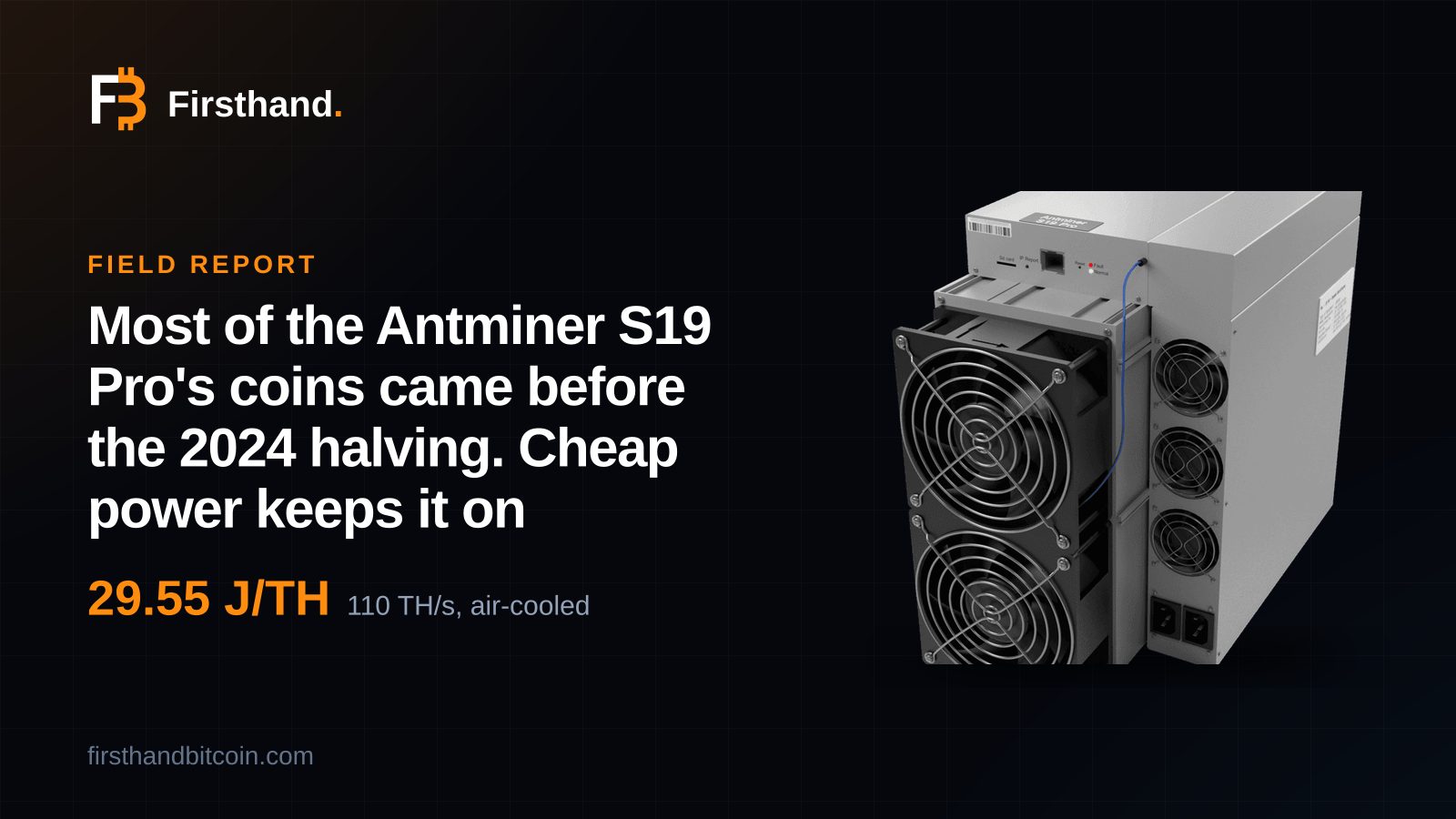
Bitmain Antminer S19 Pro (110 TH/s)
Bought in August 2020, racked in Argentina at 6¢
The Antminer S19 Pro launched in May 2020 at 110 TH/s and 29.55 J/TH, and it was the flagship air-cooled machine of its year. Bought the week we first held a price for it, on 5 August 2020, it cost $2,900. Landed at our Argentina site, with freight, duty, setup and its place in a rack, the all-in cost was $4,470.
In 2,202 days since it has mined and kept 0.7175 BTC, worth about $60,888 today, for $9,093 of electricity. That is $51,795 of cashflow, or 11.6× its landed cost, and an average of about $12,700 of power per coin over the whole run. Not one coin was sold. The original S19 look-back tells the same story for the machine below it.
The 2021 peak: the box was worth 4.5× what we paid
By March 2021 the machine had mined 0.1671 BTC, worth $14,180 at today's price. On our market index a unit of this class was priced at $13,118 that month, 4.5× what we paid for it. Mine through the bull run and the box and the coins together came to $27,298, 6.1× the landed cost, about seven months after it was racked.
That is the one resale story we tell, and it is the upside: a machine that earns for years can also be sold at the top of a cycle for a large multiple, or sold to buy the next generation. We kept ours running. The point of the number is what a cycle top does to a machine's whole life, not what we did with it.
Seven months in, the machine and its coins were worth 6.1× what it cost to land.
94% of its coins came in the first 61% of its life
From the day we bought it to the April 2024 halving the machine ran 1,354 days and put 0.6751 BTC in the wallet, clearing about $12.11 a day after electricity. That is about $4,421 a year on a machine that cost $4,470.
On 20 April 2024 the block subsidy halved, and every machine on the network began producing half as many coins for the same electricity. The 848 days since have produced 0.0424 BTC at about $1.13 a day after power. Same machine, same site rate, a far smaller day.
Network hashprice, what a petahash earns per day, was $98.01 on 5 August 2020, when we bought it, and $39.95 on 1 October 2026, on our hashprice chart. The coins did not stop: the cost of making them stopped being small.
Switched off for 49 days, then one move to Nigeria
The engine had the machine switched off for 49 days from 26 August 2024, the house rule for a machine whose trailing month no longer pays at its site. It came back on in October 2024 and has not stopped since.
On 7 January 2025 it made its one move, to Nigeria, where it has run 635 days at 3.9¢. A crossing is freight, customs and downtime at both ends, so a machine makes it once and does not shuttle, which is the rule in a machine crosses to cheap power once. It had spent 1,483 days in Argentina first, every month of the 2021 run and the halving included.
Where it stands at a 29.55 J/TH line
A machine's line is the hashprice at which it stops covering its own power. At 29.55 J/TH a petahash uses 709 kWh a day. That is $42.55 at 6¢ and $27.66 at Nigeria's 3.9¢.
Hashprice was $39.95 on 1 October. That is below the line at 6¢ and above it at 3.9¢, which is why today's cost per coin is $93,500 at 6¢ and $60,800 in Nigeria, and why one bought at today's price returns 20% in a year in Nigeria and less than its power costs in Argentina.
The April 2028 halving cuts the coins a petahash earns in half at an unchanged price and difficulty, which would put hashprice near $19.97, below the line at both rates. The forward figures to that date add 0.022 BTC, $2,720 at the previous high, and then this is a machine for as long as hashprice stays above its line. That is today's conditions held flat, not a forecast.
At 29.55 J/TH the line is $42.55 at 6¢ and $27.66 in Nigeria. Hashprice was $39.95 on 1 October.
What it says about the next machine you buy
Nothing about this machine failed. It mined every day it was on, it kept every coin, and it covered its landed cost 11.6×. What changed is how much of each coin a joule is worth, and that is set at purchase by J/TH. The guide to efficiency and halvings is the long version of this section.
Compare the machine that came after it. The Antminer S19 XP runs at 21.5 J/TH and mined through the whole 2024 halving at 6¢ before it left Argentina. Efficiency is the one number that separates a machine that crosses once and keeps going from one that needs the cheapest power on earth. The figure below ranks what is in stock today.
- MicroBT Whatsminer M74S+ (332 TH/s) — 12 J/TH, In stock, $24,696 of electricity per bitcoin, 34% year one
- MicroBT Whatsminer M73S (560 TH/s) — 13 J/TH, In stock, $26,754 of electricity per bitcoin, 42% year one
- MicroBT Whatsminer M7DS (672 TH/s) — 13.5 J/TH, In stock, $27,783 of electricity per bitcoin, 45% year one
Which machines this covers
Disclosure
Firsthand Bitcoin sells and hosts mining hardware, including this machine. No manufacturer, distributor or affiliate programme paid for or reviewed this page and we take no commission on the links above. Historical figures are computed from daily bitcoin price and network hashprice, each day valued at its own prices. Nothing here is investment advice.