Home / Blog / 14 November 2026
News · Nov 14, 2026 · 4 min read
Bitcoin today: difficulty cut 9.1%, the largest since June, as bitcoin slips under $67,000
The network cut its difficulty by 9.13% this morning, so every petahash still running earns about 10% more bitcoin from today. Bitcoin slipped under $67,000 overnight, its lowest since August, after $692 million of longs were force-closed on Friday. In dollars, the cut outweighed the fall.
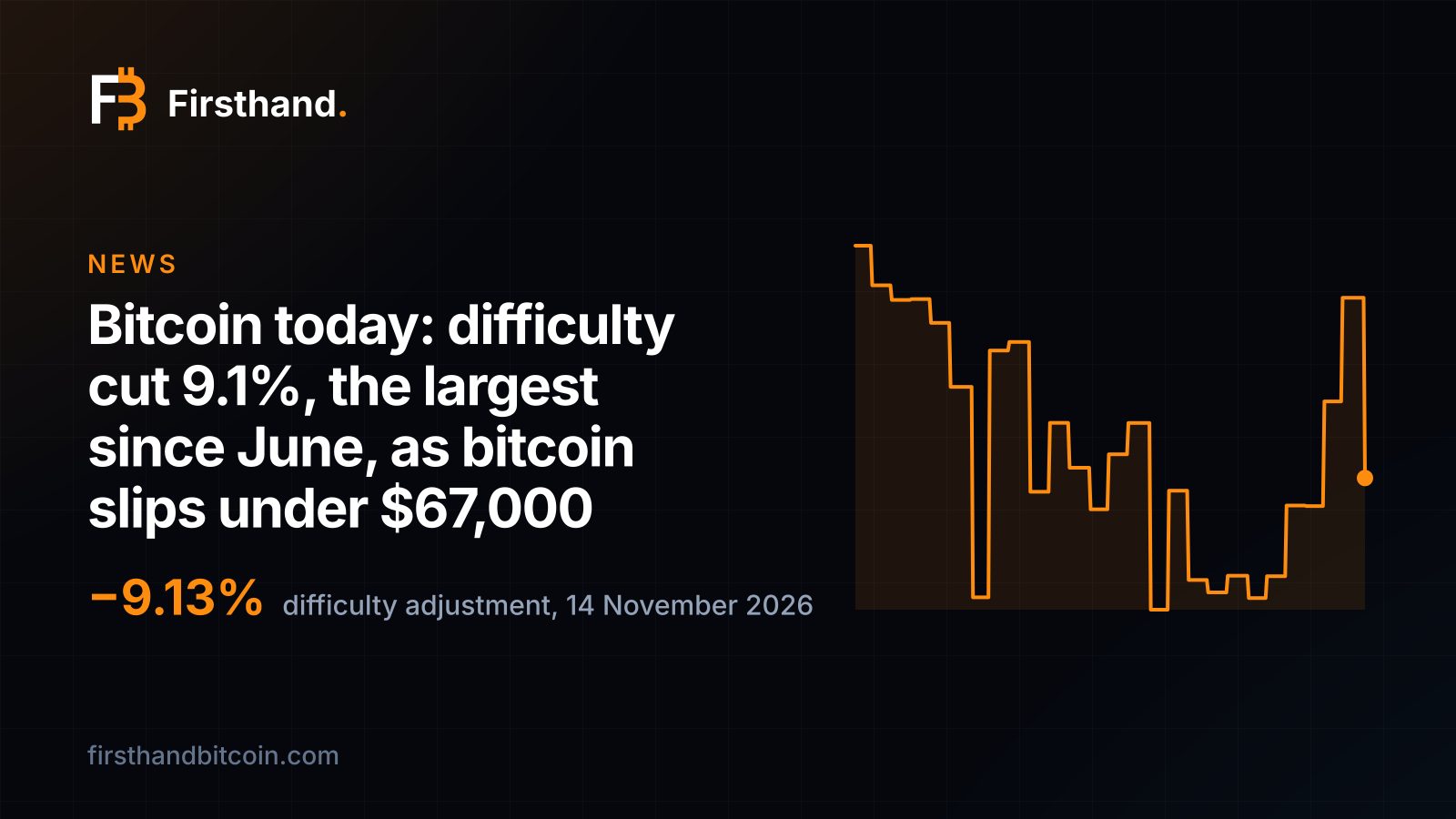
Difficulty fell 9.13% at 05:02 UTC, and a petahash now earns 10% more bitcoin
Bitcoin's difficulty reset at block 975,744 at 05:02 UTC on Saturday, from 148.36 trillion to 134.82 trillion: a cut of 9.13% on our difficulty adjustments chart, matched by mempool.space's record. It is the largest cut since the 10.09% of 14 June and the third of more than 9% this year, after February's 11.16%. Since the 28% cut that followed China's mining ban in July 2021, only those two have been larger.
The network was catching up with machines that had already left. The period's 2,016 blocks took 15 days and 10 hours instead of 14 days, an average of 11 minutes each, while the seven-day average on our hashrate chart fell from 1,081 EH/s on 27 October to 930 EH/s on 13 November. The estimate grew all week: 6% in Monday's piece, 7.4% in Thursday's recap, 8.4% on Friday, when our data piece set out the year's three hashrate falls.
In bitcoin, a petahash earned 0.000427 BTC a day on 13 November on our hashprice in bitcoin chart. At the new difficulty the same petahash earns about 0.000470 BTC a day, 10% more, for the same electricity.
The machines that switched off handed their share of every block to the ones still running.
Bitcoin slipped under $67,000 overnight, its lowest since 19 August
Bitcoin was at $67,175 this morning on our price chart, after closing at $71,366 on Friday and $73,931 on Thursday. It is the lowest reading since the $66,036 close of 19 August and 22% below the $86,488 close of 5 October. CNBC put Friday's low at $67,632.68, with bitcoin on pace for a sixth straight weekly decline; CryptoTicker reports a low of $66,789 on Coinbase in the early hours of Saturday.
The stock market did not follow. The Nasdaq Composite fell 0.91% on Friday and the S&P 500 0.4%, with Nvidia down another 2% after its founder's resignation, yet all three US indexes had their best week since early August, CNBC reports. The Fear & Greed Index reads 13 this morning, down from 20 on Friday and the lowest since 1 July.
Friday closed $692 million of bitcoin longs, the second-largest day we hold
Futures exchanges force-closed $692 million of bitcoin long positions on 13 November on our liquidations chart, against $64 million of shorts. In the series, which starts on 28 March, only 2 June was larger, at $802 million. From Monday to Friday $1.2 billion of longs were closed, and $167 million more so far today.
Tim Sun, senior analyst at Hashkey, told Decrypt the fall was "directly triggered by a concentrated liquidation of leveraged long positions", and called weakening demand the deeper issue. The funds show it. The US spot bitcoin ETFs lost $299.8 million on 11 November and $47.7 million on 12 November on our flows chart: six outflows in a row, nine in the ten trading days since 30 October, $2.57 billion net.
Producer prices are up 6.5% in a year, the most since 2022
US producer prices for final demand rose 0.3% in October after 1.4% in September, the Bureau of Labor Statistics said on Friday, and 6.5% over 12 months, the largest 12-month rise since November 2022. Excluding food, energy and trade services they rose 0.5% on the month and 4.9% on the year.
The monthly figure was below the 0.4% economists expected, and stocks rallied on it at first, CNBC reports. It did not change the rate picture. CME futures put a quarter-point rise at the Federal Reserve's 9 December meeting at about 87% and a half-point rise at 13%, the 10-year Treasury yield ended near 5.13%, and the dollar index reached its highest since April 2025. Our Treasury yields chart has the 10-year at 5.10% on 12 November, up from 4.84% on 5 November.
The Fed's market contacts named AI the top risk to financial stability
The Federal Reserve published its November Financial Stability Report on Friday. In its survey of 23 market contacts, taken in September and October, artificial intelligence was the most-cited risk, ahead of a correction in risk assets and higher long-term rates. In the spring survey it was third, behind geopolitical risks and an oil shock. The report presents these as the contacts' views, not the Fed's.
Respondents pointed to stretched valuations in AI shares and heavy debt funding of the AI buildout, with the potential for "a deterioration in broader risk assets". On digital assets the report says only that stablecoins stayed at about $310 billion over the past year "amid lower crypto-asset prices".
What it means for miners
From this morning every petahash earns about 10% more bitcoin: 0.000470 BTC a day against 0.000427. Even in dollars the cut outweighed the night's fall. A petahash earned $30.49 at Friday's close of $71,366, and earns about $31.60 at this morning's $67,175 on the new difficulty.
On the most efficient machine in stock, the Antminer S23 XP Hyd at 8.9 J/TH, a bitcoin cost about $19,500 of electricity to make at our Nigeria site at the hashprice before the cut, against about $67,100 to buy one this morning: 29% of the price. The cut takes about 9% off that cost.
Hashrate leaves from the bottom: the first machines off are the ones that burn the most electricity per terahash, which is why efficiency decides how many of these a machine survives. A price a fifth below October's with 10% more bitcoin per petahash is when efficient machines on cheap power stack the most BTC. Output is not guaranteed, and these figures hold today's conditions flat.
A petahash earned $30.49 at Friday's close and about $31.60 this morning, with bitcoin $4,200 lower.
Sources and further reading
- Difficulty adjustments (block 975,744) — mempool.space, 14 Nov 2026
- Nasdaq falls on Friday as Nvidia sells off, but index notches best week since August: Live updates — CNBC, 13 Nov 2026
- Bitcoin price at lowest since August: levels to watch — CryptoTicker, 14 Nov 2026
- Bitcoin Drops to $69K On 'Concentrated Liquidation' and 'Weakening' Demand — Decrypt, 13 Nov 2026
- Producer Price Indexes – October 2026 — Bureau of Labor Statistics, 13 Nov 2026
- Financial Stability Report, November 2026 — Board of Governors of the Federal Reserve System, 13 Nov 2026
- Difficulty adjustments — Firsthand Bitcoin data, 14 Nov 2026
Disclosure
Firsthand Bitcoin sells and hosts mining hardware, including this machine. No manufacturer, distributor or affiliate programme paid for or reviewed this page and we take no commission on the links above. Historical figures are computed from daily bitcoin price and network hashprice, each day valued at its own prices. Nothing here is investment advice.