Data insight · Nov 14, 2026 · 5 min read
A petahash earns 10% more BTC after difficulty's fifth big cut of 2026, a record year
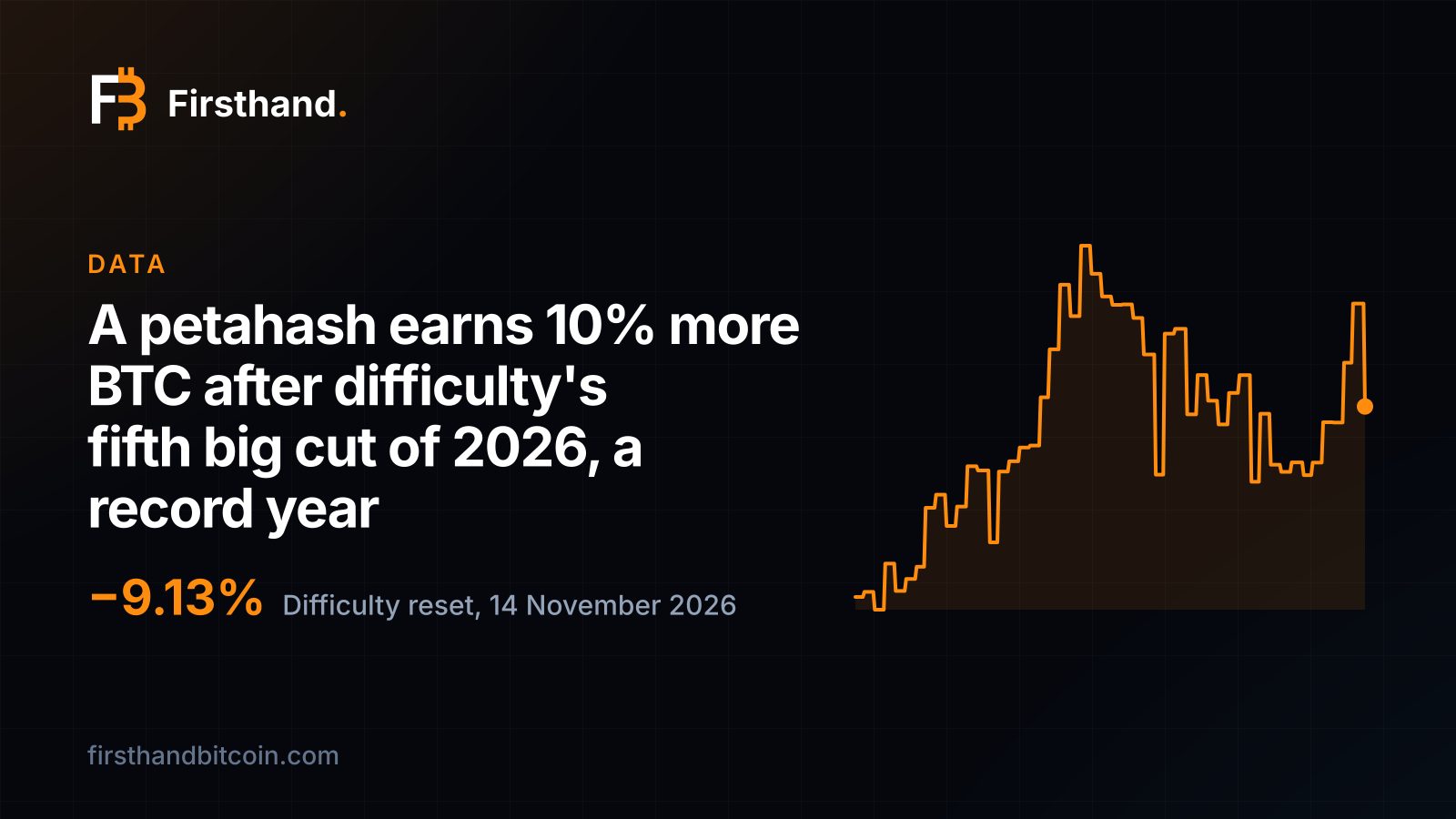
Difficulty fell 9.13% on 14 November, more than either estimate we published in the days before. It is the fifth cut of 5% or more in 2026, which no year in the record has had, and it leaves difficulty 9% lower than on 1 January. Every petahash still running earns about a tenth more BTC for the same electricity.
The cut landed at 9.13%, deeper than either estimate
At 05:02 UTC on 14 November, at block 975,744, bitcoin's difficulty reset from 148.36 trillion to 134.82 trillion, a fall of 9.13%. The 2,016 blocks before it took 15 days and 10 hours instead of 14 days, an average of 11 minutes a block. mempool.space records the same height and the same change.
We followed it on the way in. On 9 November the estimate was −6.3%. On 13 November, in a piece on why a seventh of the network's hashrate had gone quiet, it was −8.4% with 105 blocks to go. The last blocks were slower still. With the cut complete, two things can be measured: where it sits in the record, and what it does to the BTC a petahash earns and to the cost of making one. The mechanics are in our guide to difficulty.
It is the largest cut since 14 June and the third largest since the China mining ban of 2021, whose deepest reset was −27.94% on 3 July that year. The two larger ones since then are also from 2026: −11.16% on 7 February and −10.09% on 14 June.
Five cuts of 5% or more in one year is a record
Our difficulty adjustments record holds all 469 resets since the first, on 30 December 2009. A cut of 5% or more is rare in it: there are 32.
Five of the 32 are in 2026: 7 February (−11.16%), 20 March (−7.76%), 14 June (−10.09%), 11 July (−5.00%) and 14 November (−9.13%). The most any earlier year had was four, in 2011, 2020 and 2021, the last of them the year of the China ban.
2026 is also the first year in which falls outnumber rises. Of its 23 resets so far, 12 lowered difficulty and 11 raised it. No completed year has had more falls than rises; the closest was 2020, with 11 falls in 27 resets.
No year in the record has had five cuts this deep. 2026 still has almost seven weeks to run.
| Year | Resets | Falls | Cuts of 5% or more | Difficulty over the year |
|---|---|---|---|---|
| 2011 | 30 | 9 | 4 | +7,908% |
| 2018 | 28 | 5 | 3 | +200% |
| 2020 | 27 | 11 | 4 | +44% |
| 2021 | 26 | 7 | 4 | +31% |
| 2022 | 26 | 10 | 2 | +46% |
| 2025 | 26 | 9 | 1 | +35% |
| 2026 | 23 | 12 | 5 | −9.1% |
Difficulty is 9% lower than on 1 January, which no year has ended on
Difficulty began 2026 at 148.26 trillion. After 23 resets it is 134.82 trillion, 9.1% lower. In every year from 2010 to 2025 it ended higher than it began, and the smallest rise was 31%, in 2021.
Against the same day a year earlier the gap is wider. Difficulty was 152.27 trillion on 14 November 2025, so today's is 11.5% lower. Before 2026 it had stood below its level of twelve months earlier at only five resets, all between July and September 2021. This year it has been below at every reset since 8 August.
For 2026 to end level, the resets still due before 31 December, about three, would have to add 10.0% between them. The all-time high is still the 155.97 trillion of 29 October 2025, and today's level is 13.6% under it. We set out why this year broke the pattern in miners were paid below their yearly average for 310 days.
A petahash earns 10% more BTC than yesterday, and than on New Year's Day
Difficulty divides each day's block rewards among all the hash power, so a cut is a pay rise in bitcoin for every machine still on. On 13 November a petahash earned 0.000427 BTC a day on our hashprice in bitcoin chart. At the new difficulty the same rewards work out at about 0.000470 BTC a day, 10.0% more. If the term is new, start with our guide to hashprice.
That is close to where it stood before October's two rises, 0.000477 on 15 October. It is 10% more than the 0.000427 of 1 January 2026, and 13% more than the 0.000416 of 14 November 2025. In every year from 2014 to 2025 a petahash ended the year earning fewer BTC than it began with; the gentlest was 2021, with 13% fewer. This year it is earning 10% more.
It is still short of the year's best. A petahash earned 0.000507 BTC a day on 16 June, two days after the June cut.
The same machine and the same power bill, for a tenth more BTC.
The cut cancelled two days of falling price
In dollars the cut did something simpler. Bitcoin was $73,931 on 12 November and $67,141 on the morning of 14 November, 9.2% lower. At the old difficulty a petahash would have earned $28.68 a day at this morning's price. At the new one it earns about $31.57, almost exactly the $31.58 of 12 November on our hashprice chart.
A 9% fall in the price and a 9% cut in difficulty arrived within two days of each other and left a petahash's day in dollars where it was. In bitcoin there was nothing to cancel: the price plays no part in how many BTC a petahash earns.
The last two cuts this deep were partly handed back at the next reset
A cut makes a switched-off machine worth switching on again, and 2026 shows how quickly that can happen. The 11.16% cut of 7 February was followed twelve days later by a rise of 14.73%, which left difficulty higher than before the cut. The 10.09% cut of 14 June was followed on 27 June by a rise of 7.15%, which took back about two thirds of it, and then by a further 5.00% cut on 11 July.
So the 10% is today's figure, held flat. What the next reset does depends on how many machines come back, and that depends on the price. We forecast neither.
One BTC now costs about $17,700 of electricity on the best machine
The power a machine draws does not change with difficulty, so the electricity behind each BTC falls by the same 9.13%. On the most efficient machine in stock, the Antminer S23 XP Hyd at 8.9 J/TH on Nigeria's 3.9 cents a kilowatt-hour, one BTC cost $19,499 of electricity at the last reading before the cut. After it that is about $17,700, against $67,141 to buy one this morning: 26% of the price.
Every line on our cost-to-mine chart steps down with a cut in the same way, whatever the machine and whatever the power price.
What it means for a miner
Difficulty fell because machines that could not cover their power were switched off. The ones still running did nothing different and are paid a tenth more BTC for it. In a year with five such cuts that has been the pattern: each one moved BTC from the machines at the line to the machines well under it.
An efficient machine on cheap power is on the receiving side of every one of those resets. At about $17,700 of electricity for a BTC that costs $67,141 to buy, it is nowhere near the line the switched-off machines crossed, and its owner keeps the BTC it makes.
Output is not guaranteed, and the next reset can go either way, as February and June showed. So far 2026 is a year in which bitcoin has become easier to mine, not harder, which no completed year has been, and the miners who gained from it are the ones who stayed on.
Sources and further reading
- Difficulty adjustments: every reset since 2009 — Firsthand Bitcoin data, 14 Nov 2026
- Hashprice in bitcoin, per petahash per day — Firsthand Bitcoin data, 14 Nov 2026
- Mining difficulty — Firsthand Bitcoin data, 14 Nov 2026
- Difficulty adjustments, last month (mining API) — mempool.space, 14 Nov 2026
Disclosure
Firsthand Bitcoin sells and hosts mining hardware, including this machine. No manufacturer, distributor or affiliate programme paid for or reviewed this page and we take no commission on the links above. Historical figures are computed from daily bitcoin price and network hashprice, each day valued at its own prices. Nothing here is investment advice.