Home / Blog / Bitmain Antminer S17+
Field report · Oct 30, 2026 · 6 min read
Bought before the 2020 halving, the Antminer S17+ mined most of its coins in 977 days
The Antminer S17+ was racked in April 2020 and has paid for its box several times over. More than four of every five coins it has mined came in its first 977 days in Argentina. It is switched off today because hashprice sits under what Nigeria's power costs it, and every coin it made is still held.
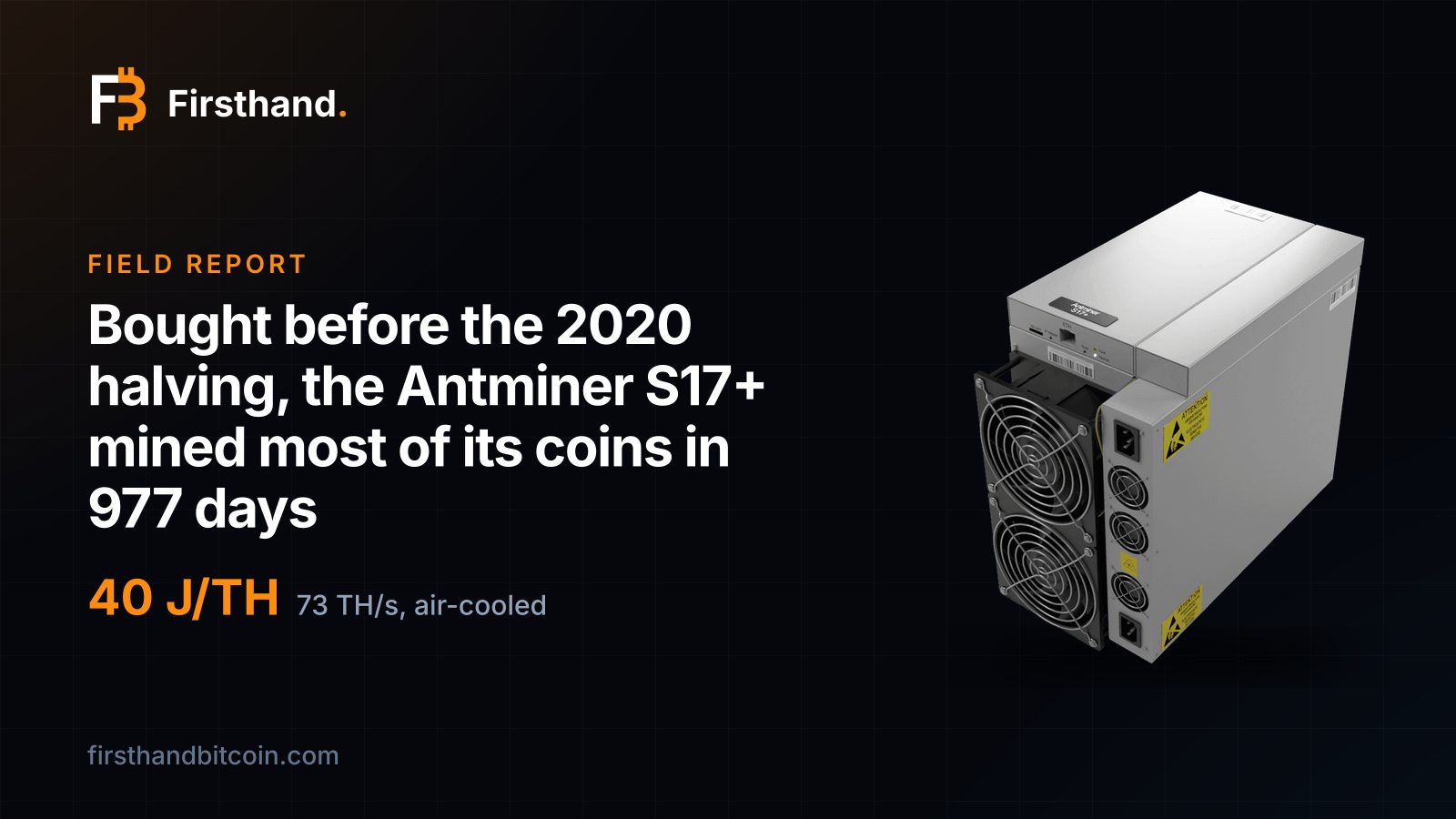
Bitmain Antminer S17+ (73 TH/s)
A 2019 machine at a spring 2020 price
Bitmain unveiled the S17+ on 9 October 2019 at the World Digital Mining Summit in Frankfurt. The announcement gave 73 TH/s at 40 J/TH plus a 10% tolerance, sales from 11 October and delivery from 1 to 10 December. Ours draws 2,920 W. It is air-cooled, with three hashboards and 195 chips according to one repair shop's spec sheet.
The first price we hold for it is from 1 April 2020: $1,280 for the unit, $2,150 landed in Argentina with freight, duty and setup. It predates our own price feed, so that figure is an estimate from our market index of what a machine in its class cost that week. Hashprice that day was $123.08 a petahash a day on our hashprice chart, and the machine needs $57.60 of it to cover power at Argentina's 6¢. It started with room to spare.
Air-cooled machines start in Argentina, and this one did. It stayed there for 977 days.
It was the machine the halving was going to test, and it had 40 days of the old reward to bank first.
Forty days of the old reward
The halving came 40 days after the machine started. Block 630,000 was mined at 19:23 UTC on 11 May 2020, and the subsidy fell from 12.5 bitcoin a block to 6.25. Hashprice was $169.75 on 10 May and $86.91 on 12 May: the reward halved and the line the machine had to clear did not move.
Those first 40 days mined 0.0480 BTC, 9% of everything the machine has ever mined, worth $3,734 at today's price. A small share, and not the point. The point is that the halving did not stop it. At 40 J/TH a petahash uses 960 kWh a day, which is $57.60 at 6¢, and hashprice stayed above that for the next two and a half years bar three days in November 2022. Efficiency decides how many halvings a machine survives; this one cleared the third halving with room to spare, and the fourth was four years off.
The bull run did the work
Hashprice peaked at $412.85 on 20 October 2021, 7.2 times what the machine needs to cover power at 6¢. The network ran about 110 EH/s when it was switched on and more than 230 EH/s by the end of 2022; the machine kept earning anyway, because the price of a coin did the rest.
Over 977 days in Argentina it mined more than four of every five coins it has ever produced and kept them. That is the pattern of an efficient-for-its-day machine bought just ahead of a cycle. The older Antminer S17 crossed the same way.
A machine like this earns twice in a cycle. Our market index puts the S17+ at $7,039 in March 2021, 5.5× what we paid. The coins it had mined by then came to 0.2097 BTC, worth $16,317 at today's price. Mined and kept, then the box sold at the top, would have made $23,356, 10.9× the landed cost. Nobody has to sell. It is the option a miner holds for as long as the machine runs.
More than four of every five coins this machine has mined came in its first 977 days.
In November 2022 hashprice dipped $1.74 under the line
The nearest it came was 21 November 2022. Hashprice fell to $55.86 that day against the 6¢ line of $57.60, and was under it on three days that month. Bitcoin was near $16,000 and the network at about 270 EH/s.
The machine ran until 3 December 2022, was off for about two weeks, and came back on 16 December for another 127 days. That is what a trailing-month rule does: it waits for a month to say the machine is not covering its power rather than reacting to a bad week. Every coin it had mined was still in the wallet.
Crossed to Nigeria on 22 April 2023
By April 2023 a full year of figures said Nigeria's 3.9¢ was decisively the better home for a 40 J/TH machine. Hashprice was $72.34 that day, comfortable, which is the point: a machine crosses to cheap power once, and it crosses while the current site still pays, not after.
At Nigeria's rate the line drops from $57.60 to $37.44. In the 1,016 days since the crossing it has mined far fewer coins than it did in Argentina, because the reward had halved again and the network grew from about 350 EH/s to about 960. It covered its power for 956 consecutive days at the cheaper rate, which is what the crossing was for.
Since the April 2024 halving, hashprice has been under the 6¢ line on 808 of 924 days to 30 October 2026. It has been under Nigeria's line on 219 of them, none before 21 November 2025.
Why it is switched off today
Hashprice was $34.73 on 30 October 2026, under Nigeria's $37.44 line, and was under it on 29 and 28 October too. Its last day running was 28 October 2026. It has been off for 285 days since it was bought, in stretches, as hashprice has crossed back and forth over the line.
That is a statement about electricity and the network, not about the machine, whose rated output has not changed. It switches on again when a trailing month says it pays, and the coins it holds do not move in the meantime. A machine's cost per coin is electricity only, and at 3.9¢ this one's is about $90,200 today. The coins it made when they were cheap to make are the ones in the wallet.
That is the 2026 story for any 40 J/TH machine. It is also why the next generation matters: a petahash on a 12 J/TH machine uses 288 kWh a day, $11.23 at Nigeria's rate, a line hashprice has not been near.
What owning one was like
The S17 generation has a reputation. D-Central, a repair shop, calls the line "famously fault-prone as it ages" and says "hashboards and the dsPIC-based DC-DC converters are the usual failure points". It is a repair business and it says so; we treat the page as a reference, not as a failure rate. We found no operator thread on the S17+ that we could open and quote, so we give no failure rate of our own.
What a fault costs is the useful part. In Argentina we repair on site and bill the cost of the parts only, and the same page says a replacement hashboard "is often cheaper than a whole unit". A failed board on a machine like this is a line item, not a catastrophe, and a machine that has covered its box many times over has a lot of room for a line item.
The tally
In 2,120 days the S17+ has mined and kept 0.5520 BTC for $6,957 of electricity: $12,602 a coin averaged over its life. That average is flattered by 2020 and 2021 and it is not the number to plan on. Today's is about $90,200 at the cheapest site.
Valued at today's price, the coins less every dollar of power come to $35,991 of cashflow on a $2,150 landed cost: 16.7× its box, from the coins alone.
It was switched off on 29 October 2026. A machine is only ever retired when it is off today, and its coins never are.
What we would tell ourselves
Bought into a halving with room to spare, kept through a bull run at 6¢, sent once to 3.9¢ before the current site stopped paying: this machine did everything the model asks and paid for itself 16.7× over. Its box was the cheapest part of the story.
The lesson for a buyer is where the line sits. At 40 J/TH it is $37.44 at Nigeria's rate. The S21 XP at 13.5 J/TH makes a coin for $30,500 in Nigeria, and the M74S+ at 12 J/TH for $27,100. Against $90,200 for the S17+, those are the machines to look at, and the S17+ is the record of why.
Buy the efficiency, buy the cycle, and let the box be the cheap part.
- MicroBT Whatsminer M74S+ (332 TH/s) — 12 J/TH, In stock, $27,069 of electricity per bitcoin, 28% year one
- MicroBT Whatsminer M73S (560 TH/s) — 13 J/TH, In stock, $29,324 of electricity per bitcoin, 33% year one
- MicroBT Whatsminer M7DS (672 TH/s) — 13.5 J/TH, In stock, $30,452 of electricity per bitcoin, 36% year one
Sources and further reading
- Bitmain announces two new Antminer 17 series miners at World Digital Mining Summit — Bitmain (PR Newswire), 9 Oct 2019
- Bitcoin block 630,000 — Blockchain.com Explorer, 11 May 2020
- Antminer S17 review: a comprehensive analysis — D-Central, 2026
Which machines this covers
Disclosure
Firsthand Bitcoin sells and hosts mining hardware, including this machine. No manufacturer, distributor or affiliate programme paid for or reviewed this page and we take no commission on the links above. Historical figures are computed from daily bitcoin price and network hashprice, each day valued at its own prices. Nothing here is investment advice.