Data insight · Nov 24, 2026 · 6 min read
The dollar is at its strongest since April 2025, and a petahash earns as much BTC as in October
The Federal Reserve’s broad dollar index closed at 123.60 on 20 November, its highest since April 2025, as markets priced a December rate rise. Bitcoin, priced in dollars, is 30% under its October high. The BTC a petahash earns is back where it was in October.
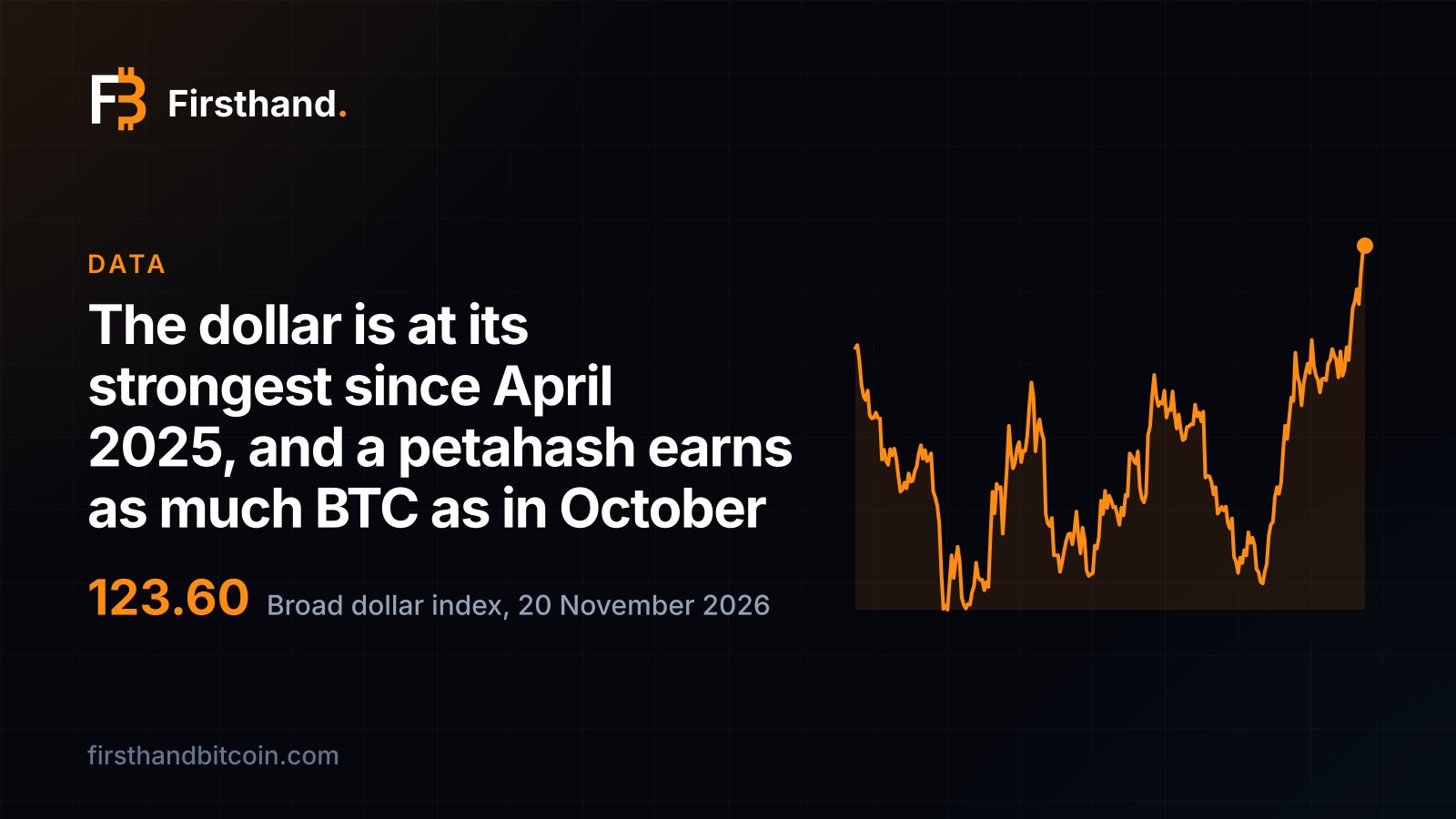
The dollar is at its highest since April 2025
The Federal Reserve’s broad dollar index, which weighs the dollar against the currencies of the countries the US trades with, closed at 123.60 on 20 November, the latest reading on FRED. The last time it stood higher was 15 April 2025, at 123.78.
The low of the second half of the year was 117.88 on 9 September, so the dollar has gained 4.9% against that basket since. Most of the move came in November: the index was 121.37 on 2 November and rose on 10 of the 13 trading days that followed. The narrower index traders quote reached its highest since April 2025 on 11 November, Reuters reported.
Markets expect the Fed to raise rates again in December
The reason is the Federal Reserve. On 11 November traders put the odds of a quarter-point rise at the Fed’s December meeting at 87%, up from about 70% a month earlier, after consumer prices rose more than expected for a third month running, according to the same Reuters report. Goldman Sachs and Deutsche Bank both moved to expect a rise in December.
The Fed’s own record points the same way. The minutes of its 27–28 October meeting, released on 18 November, show that almost all participants expected further rises in the policy rate to be needed to bring inflation back to 2%, and a couple said that “an increase of more than 25 basis points could warrant consideration at the next meeting” if inflation data came in high.
Higher US rates pull money towards the dollar, because a dollar deposit or Treasury bill pays more than its equivalent in most other currencies. The minutes say as much of the weeks before the meeting, comparing US rates with those of the other advanced economies: “The widening of interest rate differentials between the AFEs and the U.S. helped drive the appreciation of the U.S. dollar.”
A dollar that pays more to hold is a dollar more people want to hold.
Bitcoin fell 30% while the dollar rose 2%
Bitcoin closed at $85,944 on 5 October and has not closed higher since. On 20 November it closed at $60,757 on our price chart, 29.3% lower. Over the same seven weeks the dollar index rose from 121.27 to 123.60, a gain of 1.9%.
A 2% move in the dollar does not take 30% off anything by arithmetic. The two are reading the same thing: how tight money is going to be. When markets expect higher rates, money leaves assets that pay no income and goes where the rate is, and the dollar is where the rate is. Bitcoin pays no coupon, so it sits on the other side of that trade.
The pattern holds across the year. Of the 222 trading days of 2026 so far, bitcoin and the dollar index moved in opposite directions on 127 and the same direction on 95.
In 2022 the same two lines ran further
The last time rate rises drove the dollar this hard was 2022. The broad index went from 115.41 on 3 January to 128.45 on 26 September, its high for the year. Bitcoin went from $46,820 to $19,017 over the same months. That year the two moved in opposite directions on 157 trading days and together on 92, the widest split in our series.
This year’s dollar is still 3.8% under that 2022 high, and the October 2026 high in bitcoin was more than four times the September 2022 close. We looked at the other half of the rate story, the ten-year Treasury yield, in our piece on yields and bitcoin.
A petahash earns as much BTC as in October
A strong dollar changes the price of bitcoin. It does not change how many BTC a machine produces. That is set by the network: how much hashrate is competing for each block and what the blocks pay.
On 24 November one petahash per second earned 0.000469 BTC a day on our hashprice in bitcoin chart. On 5 October, the day of bitcoin’s October high, it earned 0.000464 BTC. On 10 November, before difficulty fell 9.1% on 14 November, it earned 0.000427 BTC. A machine running today makes 9.8% more BTC a day than it did two weeks ago, and 0.9% more than at the October high.
Hashrate has come back since the cut, and the next adjustment, about 420 blocks away, is running at plus 9.9% on our difficulty chart. If it lands near there, most of the November gain in BTC per petahash is given back. Output per petahash is set block by block and is never guaranteed.
The dollar decides what a BTC costs to buy. It does not decide how many BTC a machine makes.
What it means for a miner
Electricity is billed in dollars, and the electricity behind one BTC depends on how many BTC a petahash earns, not on the bitcoin price. When the BTC earned per petahash goes up, the dollar cost of each BTC goes down, whatever the dollar is doing.
On 24 November the most efficient machine we stock, the Antminer S23 XP Hyd at 8.9 J/TH, made a bitcoin for about $17,779 of electricity on our 3.9¢ Nigerian power, against a market price of $60,372 on our cost-to-mine chart. Making a bitcoin cost 29% of buying one.
A rising dollar and a falling bitcoin make bitcoin cheaper to buy in dollars. Whether it gets cheaper to make depends only on the BTC the network pays per petahash, and in November that rose. For a miner who keeps what the machines produce, the dollar index is the weather. The BTC in the wallet are the harvest.
Sources and further reading
- Nominal Broad U.S. Dollar Index (DTWEXBGS) — FRED, Federal Reserve Bank of St. Louis, 20 Nov 2026
- Dollar climbs as traders raise December Fed hike bets — Reuters, via Kitco News, 11 Nov 2026
- Minutes of the Federal Open Market Committee, October 27–28, 2026 — Federal Reserve, 18 Nov 2026
Disclosure
Firsthand Bitcoin sells and hosts mining hardware, including this machine. No manufacturer, distributor or affiliate programme paid for or reviewed this page and we take no commission on the links above. Historical figures are computed from daily bitcoin price and network hashprice, each day valued at its own prices. Nothing here is investment advice.