Home / Blog / MicroBT Whatsminer M10S
Field report · Nov 24, 2026 · 5 min read
Bought near the 2018 low, the Whatsminer M10S mined most of its BTC before the 2020 halving
MicroBT's 55 TH/s machine of 2018 was racked in Argentina in February 2019, with bitcoin under $3,700. Its first fifteen months did most of the work. It crossed to Nigeria before the 2021 bull run, mined until a month after the 2024 halving, and every BTC it made is still held.
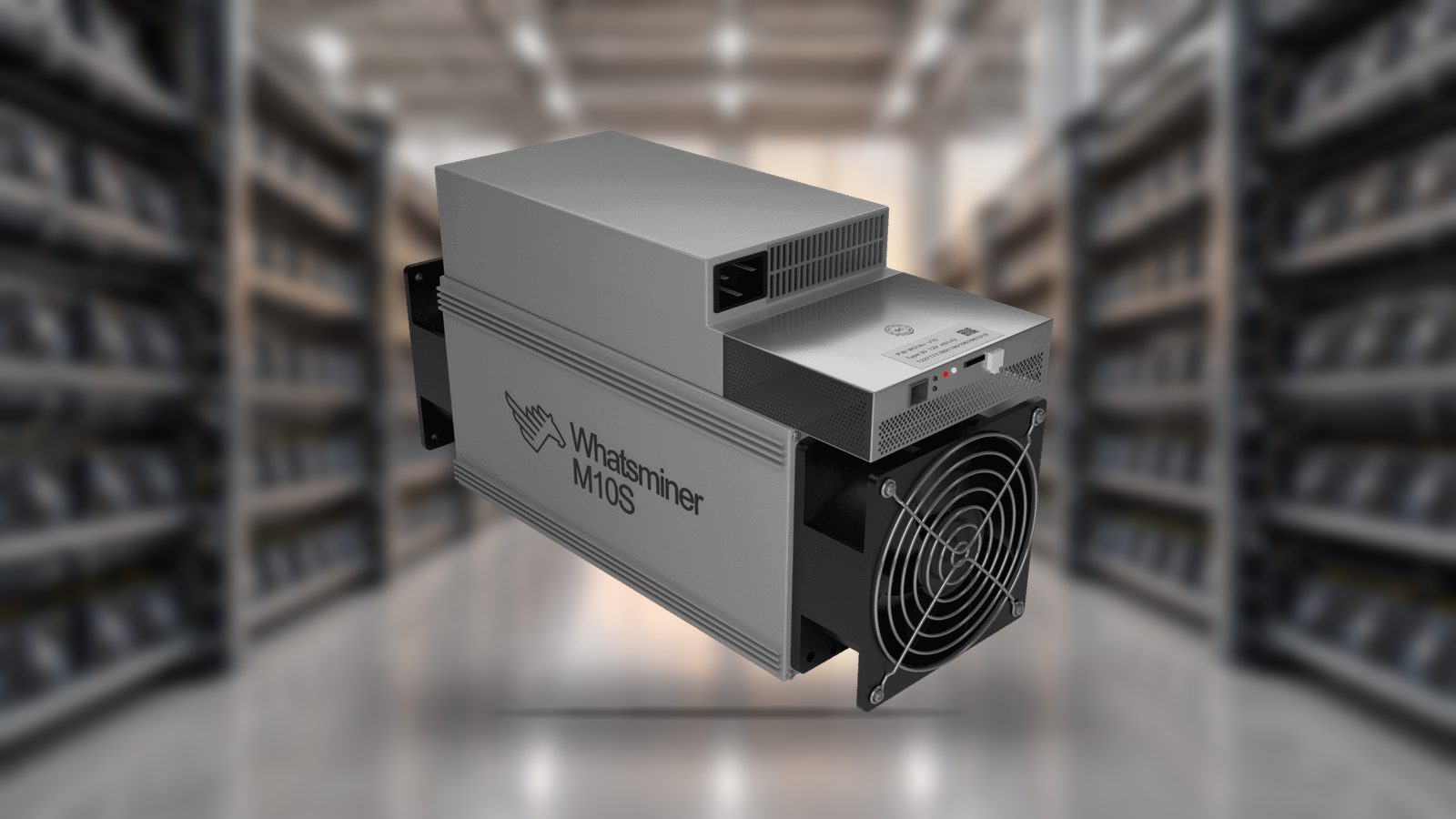
MicroBT Whatsminer M10s (55 TH/s)
February 2019: nine weeks after the low
MicroBT's M10 series arrived in 2018. The first M10 made 33 TH/s from 2,145 W, and by November that year the M10S was announced at 55 TH/s. It draws 3,500 W, which is 63.64 J/TH. It is air-cooled, a long aluminium case with a fan at each end.
The first price we hold for an M10S is from 17 February 2019: $1,989 for the 55 TH/s unit, $3,036 landed in Argentina with freight, duty and setup. Bitcoin closed that day at $3,687.78, nine weeks after the bear market's low of $3,308.11 on 14 December 2018.
At 63.64 J/TH a petahash of M10S burns 1,527 kWh a day: $87.82 of power at Argentina's 5.75¢ and $59.57 at Nigeria's 3.9¢. That is its line, the hashprice it needs just to cover its own electricity. On the day it was racked, a petahash earned $157.91, 1.8 times the line. The guide to efficiency and halvings explains why a line that high sets the length of a machine's life.
Fifteen months of 12.5 BTC blocks did most of the work
The bear market was already ending. By 10 July 2019 bitcoin had reached $12,586.78 and a petahash earned $405.13 a day, 4.6 times what the M10S's power cost in Argentina.
Every block still paid 12.5 bitcoin. Between 17 February 2019 and the halving, a petahash earned on average 0.0259 BTC a day. In those first 449 days the M10S mined 0.6308 BTC: 71% of everything it would mine in its life.
Its first 449 days made 71% of every BTC it would ever mine.
The 2020 halving brought hashprice down to its line
Block 630,000 cut the subsidy from 12.5 to 6.25 BTC on 11 May 2020. That day a petahash earned $86.35, a dollar and a half under the M10S's Argentine line.
It ran another four weeks and stopped on 8 June 2020, after 478 days in Argentina. Off costs nothing: the machine draws no power, and nothing it has mined is sold. It came back on 25 August 2020 for 24 more days as hashprice climbed to $99.60.
It crossed to Nigeria on 18 September 2020, before the bull run
On 18 September 2020 the M10S crossed to Nigeria, once a full year of figures said 3.9¢ was decisively the better home for a 63.64 J/TH machine. That is the one crossing a machine makes, and the line fell from $87.82 to $59.57.
It then ran 802 days in Nigeria without a stop, through the whole of the 2021 bull run and most of 2022's fall. Hashprice peaked at $412.85 on 20 October 2021, almost seven times its Nigerian line.
The BTC came slower than in 2019. Over those 802 days a petahash earned on average 0.0064 BTC a day, a quarter of its pre-halving rate, because the subsidy had halved and the network had grown. Each of those BTC was still made at a fraction of what it cost to buy.
The box was worth more too. By March 2021 the market price for a machine of its class had reached $5,304, 2.7× what we paid. An owner could have mined for two years and still sold near the top, or swapped it for a newer generation, the move our guide on machines as the roof describes.
On 20 October 2021 a petahash earned $412.85 a day. In Nigeria, the M10S's power cost $59.57.
Stopping and starting, then the 2024 halving
The 2022 low came close. On 28 November 2022 hashprice fell to $56.40, under the Nigerian line, and the M10S stood off until 14 January 2023. It ran again until September, was off for six weeks, and was back on 26 October 2023.
Block 840,000 halved the subsidy again on 20 April 2024, to 3.125 BTC. The M10S ran 28 more days. Its last day was 17 May 2024, and it was retired on 18 May 2024, five years and three months after it was racked.
A machine is retired when it is off today. Its BTC never are: 100% of what it mined came before that last halving, and all of it is still held.
What owning one was like
The M10 family was built around big heatsinks and fast fans. In a hands-on review of the M10, Bitcointalk member HagssFIN called it very loud, said the cooling design was good, and found it performed just as advertised; MicroBT's warranty then ran 180 days from shipment. A long-time operator later wrote that Whatsminers of that era were less forgiving of a hot room than Bitmain's machines.
That is a reason to run one in a hall built for air. At our Argentina site a fault on a machine like this is a parts bill: repairs there are billed at the cost of the parts and nothing else.
What it banked
Over 1,751 running days the M10S mined and kept 0.8840 BTC for $5,675 of electricity, about $6,400 a BTC averaged over its life. At today's price those BTC are worth $53,995, which is $48,320 of cashflow after every dollar of power: 15.9× the $3,036 it cost to land.
None of it was sold to pay the power bill. The cheap BTC of 2019 were made when one cost a few thousand dollars of electricity, and they are valued at today's price, which is why a machine retired two and a half years ago still carries its whole record.
It covered its box 15.9× over from the BTC alone.
What we would tell ourselves
Buy when the gap between hashprice and the machine's line is wide, and keep what it makes. The M10S earned 1.8 times its line on the day it was racked and four and a half times it that summer, and the BTC it banked then carried the next five years.
Today's machines start much further under the market. The air-cooled Whatsminer M74S+ at 12.5 J/TH makes a BTC for about $37,100 of electricity in Argentina, and the hydro Antminer S23 XP Hyd at 8.9 J/TH makes one for about $19,400 in Nigeria, against $59,617 to buy one. The M10S did its work with a line five times higher; the lesson it leaves is to start where it started, far under the market, with a machine that can stay there through the next halving.
- MicroBT Whatsminer M74S+ (332 TH/s) — 12 J/TH, In stock, $25,161 of electricity per bitcoin, 20% year one
- MicroBT Whatsminer M73S (560 TH/s) — 13 J/TH, In stock, $27,257 of electricity per bitcoin, 24% year one
- MicroBT Whatsminer M70S (250 TH/s) — 13.5 J/TH, In stock, $28,306 of electricity per bitcoin, 20% year one
What people are saying online
This machine performed just as advertised and a little better
A hands-on review of the M10, the M10S's 33 TH/s sibling: loud, well cooled, as advertised.
Sources and further reading
- (Review/Guide) WhatsMiner M10 33.0 Th/s, 2145W Bitcoin (SHA-256) ASIC miner — Bitcointalk, September 2018
- (Review/Guide) WhatsMiner M20S 68.0 Th/s, 3260 W Bitcoin (SHA-256) ASIC miner — Bitcointalk, June 2019
- Bitcoin records its third-ever block reward halving — The Block, May 2020
- Bitcoin blockchain has fourth halving in 15-year history — CoinDesk, April 2024
Which machines this covers
Disclosure
Firsthand Bitcoin sells and hosts mining hardware, including this machine. No manufacturer, distributor or affiliate programme paid for or reviewed this page and we take no commission on the links above. Historical figures are computed from daily bitcoin price and network hashprice, each day valued at its own prices. Nothing here is investment advice.