Guide · Nov 24, 2026 · 6 min read
What records to keep for your first bitcoin miner: six things to write down from day one
A mining machine pays you in small amounts every day for years, and in three years you will want to know exactly what it mined and what it cost. Six records, started on the first day and kept in one sheet, answer every question an owner, a buyer or a tax office will ask.
The short answer: six records, kept from the first day
Keep six things: the purchase papers, where the machine lives and when it started, every payout, the price of bitcoin on each payout day, every electricity bill, and every repair. Put them in one spreadsheet and spend ten minutes on it once a month.
That sounds like paperwork, and it is a small amount of it. The reason to start on day one is that a miner earns in small slices, every day, for years. A record that is a week behind takes a minute to catch up. A record that is two years behind can take a weekend, and some of what you need may no longer be easy to find.
Every step below is something you can do yourself, with nothing more than the papers you were sent, your pool dashboard and a free block explorer.
Step 1: keep the purchase papers and the serial number
Save the invoice for the machine, and with it the breakdown of what you paid: the machine, freight, import duty, setup and any hosting deposit. Those lines together are the real price of a miner, as our guide to the price of a miner explains, and the total is the number you will later compare the machine's earnings against.
Write down the exact model and its hashrate, because one model is often sold in several speeds. Our guide to why the same miner comes in different hashrates shows how much those speeds can differ. A note that says only "S23" will not tell you, three years from now, which one you bought.
Then record the serial number. Every machine carries one on a label on its case, and it is the number a warranty claim or a repair ticket will ask for. Our guide to what a warranty covers explains why a warranty claim starts with it. Keep a copy of the hosting agreement in the same folder.
Step 2: write down where it lives and the day it started
Note the site, the country and the date the machine first started hashing. That date is not the day you paid: a machine has to travel, clear customs and be installed first, and the first payout comes after it starts, not after you buy.
If the machine ever moves to another site, write down the date it left, the date it started again and the new power price. Most machines move at most once in their working life, as our guide to why a machine crosses to cheap power once sets out, so this is usually one line in the whole record.
With those dates you can always answer the two questions a buyer asks first about any machine: how long has it been running, and where.
The day a machine starts hashing is the day its record starts. Write it down that day.
Step 3: log every payout in bitcoin, with its transaction id
Each time the pool pays you, write down four things: the date, the amount in BTC, the wallet address it went to and the transaction id. The transaction id is a long string of letters and numbers that identifies that one payment on the bitcoin network. Our guide to checking a payout on a block explorer shows where to find it and how to confirm the payment really arrived.
Record the amount in bitcoin, not in dollars. The bitcoin amount is what the machine produced, and it never changes after the fact. A dollar figure depends on the day you look.
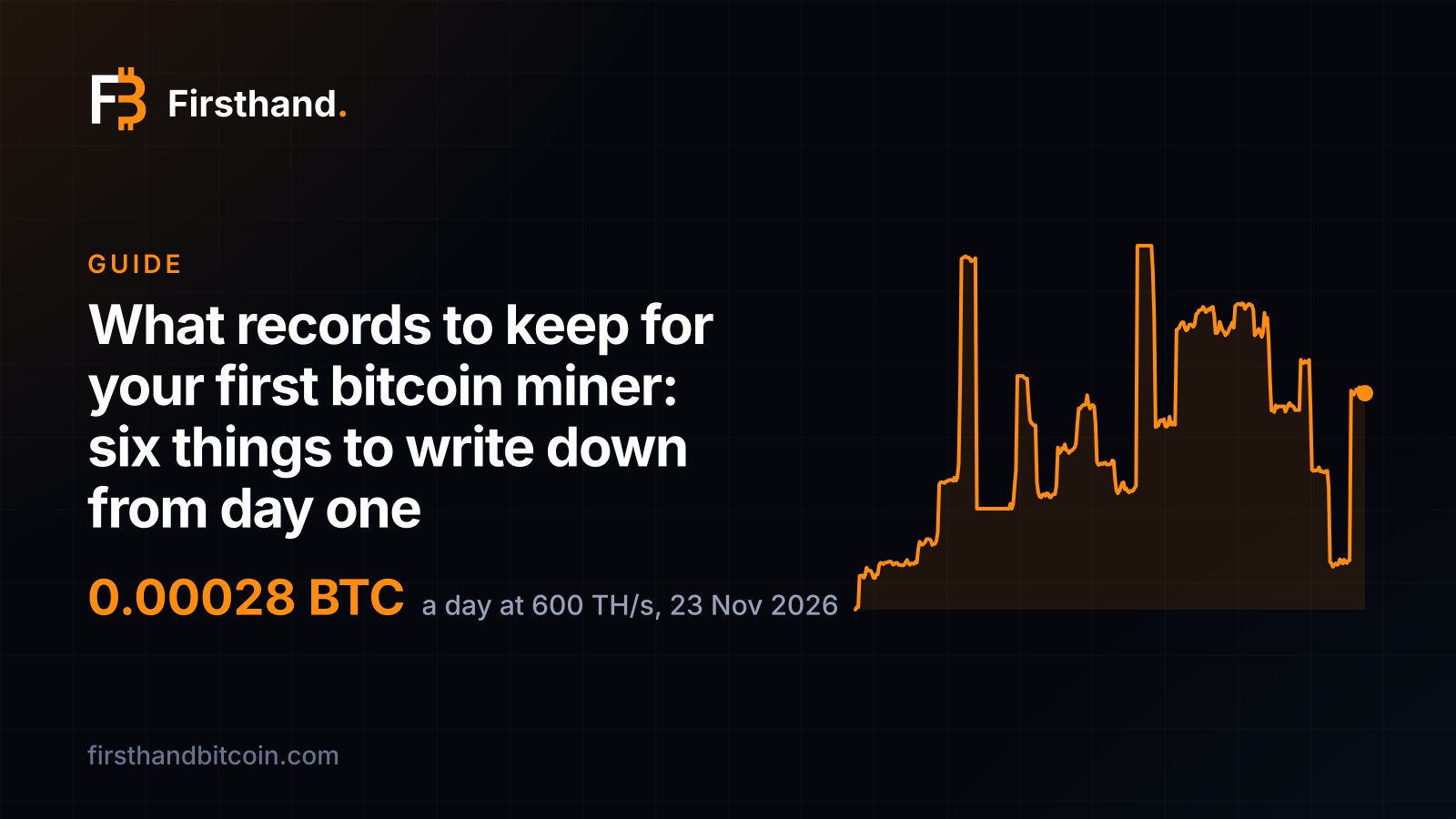
To see what to expect, take the most efficient machine in stock, the Antminer S23 XP Hyd at 600 TH/s. On 23 November 2026 one petahash of hashing earned 0.000469 BTC for the day, so the machine's 0.6 petahash earned about 0.00028 BTC, before the pool's fee. Over a 30-day month that is about 0.0084 BTC.
You will usually have fewer payout rows than days. Many pools pay once your balance passes a minimum, as our guide to how pools pay you explains, so one row may hold several days of mining. That is normal; write down each payment as it lands.
Step 4: note the price of bitcoin on each payout day
Next to each payout, write the price of bitcoin on that day. It does not change how much bitcoin you own, and for a miner who keeps the BTC the only price that matters is today's, as our guide to why nobody sells the BTC to pay the power bill explains.
The reason to write it down anyway is that a tax office may ask for it. In the United States, for example, the IRS answered the question directly in Notice 2014-21: "when a taxpayer successfully “mines” virtual currency, the fair market value of the virtual currency as of the date of receipt is includible in gross income."
The IRS also tells holders to keep records that document "receipts, sales, exchanges, or other dispositions", in its frequently asked questions on virtual currency. The rules differ from country to country. An accountant where you live decides what you owe; your part is to hand them a complete list, and a price column filled in as you go saves looking up hundreds of old prices later.
Step 5: keep every electricity bill, and how you paid it
Electricity is the one regular bill a hosted machine has. Keep each one, and write down three things from it: the period it covers, the amount in dollars, and how you paid it, whether from income, from the deposit you paid in advance, or another way.
With the payouts from step 3 and the bills from this step, you can work out the most useful number a miner has: what each bitcoin cost you to make. Add up the electricity, divide by the BTC mined, and that is your cost per bitcoin.
For the best machine in stock at the cheapest site that can run it, the S23 XP Hyd in Nigeria at 3.9¢ a kilowatt-hour, that came to about $17,800 of electricity per bitcoin on 24 November 2026, when buying one cost $60,372. Your own record will tell you your own number, month by month, from your own bills.
BTC mined, electricity paid, and what the BTC are worth today. Every other number comes from those three.
Step 6: write down every repair and every day off
Every machine has faults over its life. When one happens, note the date it went down, the date it came back, what failed and what the repair cost. Our guide to what a failed hashboard means explains why a fault is a line in the budget rather than a disaster, and this is where that line is written.
Days off show up in your payout log too, as smaller payouts. Our guide to what uptime means explains how to read them. A repair note next to the dates turns a puzzling dip into a known event.
One sheet, ten minutes a month
A simple spreadsheet with two tabs is enough. The first holds the facts that rarely change: the model, hashrate, serial number, purchase total, site, start date and any move. The second holds one row per event: payouts, electricity bills and repairs.
Once a month, open your pool dashboard and your inbox, add the new rows and save a copy of the month's bills in the same folder. Keep the folder somewhere you will not lose it, and keep a second copy. Never put your wallet's seed phrase in it; our guide to keeping a seed phrase safe explains why that lives on paper, apart from everything else.
| Date | What | BTC | Dollars | Note |
|---|---|---|---|---|
| Payout date | Pool payout | Amount received | Price of bitcoin that day | Transaction id |
| Bill date | Electricity bill | Amount paid | Period covered, how it was paid | |
| Repair date | Repair | Parts cost | What failed, days off |
What it means for a miner
A miner who keeps these six records can answer the only three questions that describe the business at any moment: how many BTC the machine has mined, what the electricity cost in dollars, and what those BTC are worth today.
Those three numbers give you your own cost per bitcoin to set against the price of buying one, and the multiple your machine has covered its own purchase price. They are the numbers that tell you whether to add a second machine, and the numbers a buyer or an accountant will ask to see.
Choose an efficient machine, put it on cheap power, keep the BTC, and write it all down from the first day. Mining output is never guaranteed, but a complete record means you always know exactly where you stand.
Sources and further reading
- Notice 2014-21 — Internal Revenue Service, 25 Mar 2014
- Frequently asked questions on virtual currency transactions — Internal Revenue Service, 30 Jun 2026
Disclosure
Firsthand Bitcoin sells and hosts mining hardware, including this machine. No manufacturer, distributor or affiliate programme paid for or reviewed this page and we take no commission on the links above. Historical figures are computed from daily bitcoin price and network hashprice, each day valued at its own prices. Nothing here is investment advice.