Guide · Oct 9, 2026 · 6 min read
What a bitcoin miner is, and what it actually does all day
A bitcoin miner is a computer built to do one job: guess numbers until one passes a test, which earns bitcoin from the network. This guide explains the job, the three numbers on the box, and what a machine earns in a day, in plain words, step by step.
TL;DR
- A miner is a one-job computer. It makes trillions of guesses a second and checks each against a test. Nothing else.
- The network pays for the winning guess. One block roughly every ten minutes, 3.125 new bitcoin each, plus fees.
- Three numbers describe a machine. Hashrate is its guesses per second, power is its electricity draw, and efficiency is power per unit of hashrate.
- One machine rarely wins alone. It joins a pool and is paid a steady share. A machine's day is hashrate times hashprice, less electricity.
A miner is a computer that does one thing
A bitcoin miner looks like a heavy metal box with fans or water pipes on it. Inside is not a general-purpose computer but a set of chips built for a single task. They are called ASICs, short for application-specific integrated circuits, and a laptop or a phone cannot do their job at any useful speed.
The task is simple to describe. The network gives the machine a bundle of recent transactions and a target number. The machine adds a number of its own, runs the lot through a fixed scrambling function, and looks at what comes out. If the result is below the target, the guess wins. If it is not, the machine changes its number by one and tries again. Bitcoin's developer guide puts it this way: "The mining hardware iterates through every possible value for the block header nonce and generates the corresponding hash."
There is no skill in any single guess. The scrambling cannot be run backwards, so the only method is to try. Winning is a matter of how many guesses you can make, which is why the chips are built to do nothing else.
All that guessing turns electricity into heat, and the heat is the practical problem. It is why the box has fans or water pipes, and why a mining site is built around moving heat out as much as around power. Our guide to air, hydro and immersion cooling explains the three ways of doing it and why it decides where a machine can live.
There is no skill in any single guess. Winning is a matter of how many guesses a machine can make.
What it is trying to win: a block, about every ten minutes
Every winning guess adds a block of transactions to bitcoin's record. The network is tuned so that this happens about every ten minutes. It checks itself every 2,016 blocks, which should take two weeks, and if blocks came too quickly it makes the test harder, and if too slowly, easier. The same guide describes the two-week period. Our guide to mining difficulty covers what that does to a machine's earnings.
The prize for each block is the block reward: new bitcoin that did not exist before, plus the fees users paid to get their transactions in. On our series the new bitcoin per block is 3.125, and 139 blocks were found on 8 October, which is about 434 new bitcoin that day. Fees added another 3.0 bitcoin across all of them, a small share. The 3.125 halves again in April 2028, which our guide to the halving explains.
That is the whole business. Machines all over the world make guesses, one of them wins about every ten minutes, and the winner is paid in bitcoin.
Why one machine rarely wins a block by itself
The network's total guessing power was about 1,000 exahashes a second in early October on our hashrate chart. One exahash is a million trillion guesses. A good modern machine, the Antminer S21 XP, makes 270 terahashes a second, which is 270 trillion. Its share of the network is about one in 3.7 million.
At that share a machine would win a block about once every 70 years. That is not a business. So miners join a pool: thousands of machines guess together, the pool collects each win, and it shares the reward out in proportion to the guesses each machine contributed. The machine is paid a small, steady amount every day instead of a rare jackpot. Our guide to what a mining pool is shows how that works and where the money lands.
This is also why the payout is a steady daily figure and not a lottery. The pool smooths the luck out.
The three numbers on the box
Every machine has a spec sheet, and three numbers on it describe the job. The first is hashrate: how many guesses a second it makes, measured in terahashes per second (TH/s). More guesses means a bigger share of the pool's rewards.
The second is power, in watts: how much electricity the machine draws from the wall. The S21 XP draws 3,645 watts, about what two large space heaters use, and it runs all day. The third is efficiency, in joules per terahash (J/TH): power divided by hashrate. The S21 XP's is 13.5, which means each terahash of guessing costs it 13.5 joules. A lower number is better, and it is the number that decides how long a machine stays worth running. Our guide to reading a spec sheet goes through all five numbers that matter.
Notice what is not on the spec sheet: the price of bitcoin. A machine's guesses per second and its watts do not change when the price moves. What changes is what a day of guessing is worth.
What a machine earns in a day, with real numbers
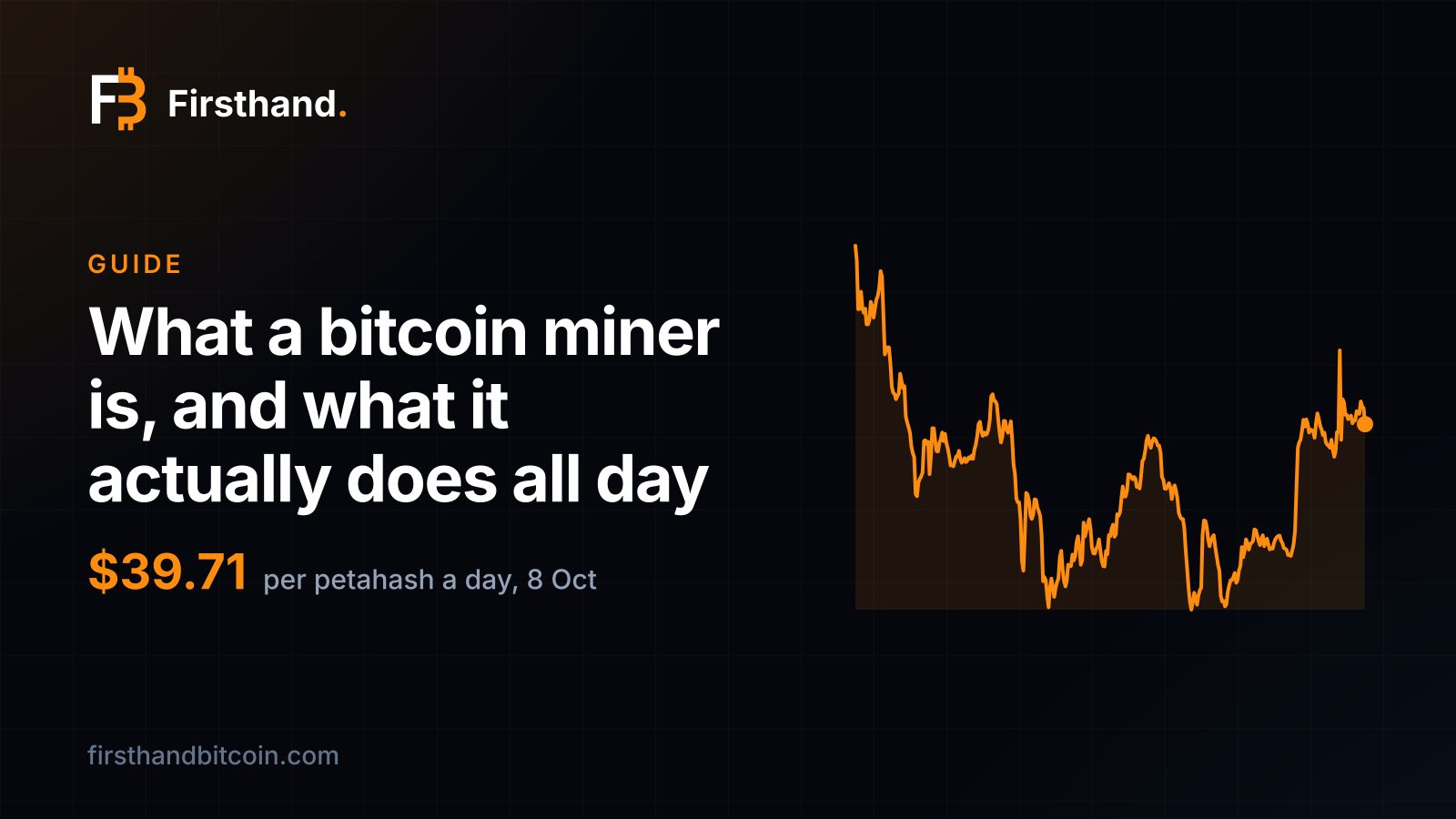
The industry's measure of daily earnings is hashprice: what one petahash of guessing power, which is a thousand terahashes, earned in a day. On our hashprice chart it was $39.71 on 8 October, which is 0.000477 bitcoin at that day's price.
A 270 TH/s machine is 0.27 petahash, so it earned about $10.72 that day, or 0.00013 bitcoin, before any fees and downtime. To run for a day it drew 87.5 kilowatt-hours. At 6¢ a kilowatt-hour that is $5.25 of electricity. At 3.9¢ it is $3.41. The difference between what a day earns and what a day costs in power is the cashflow, and it is positive today at both rates. How the power price decides it is a guide of its own.
None of these figures is guaranteed. Hashprice moves with the bitcoin price and with how many other machines are guessing. They show how a day is made up, not what the next one will pay.
What it means before you buy one
A miner is a machine that turns electricity into bitcoin, so the three questions that matter are the same three that decide any machine's usefulness: how many guesses it makes, what it costs to run, and how long it stays efficient enough to be worth running. Newer machines make more guesses for the same electricity, which is why an older machine eventually costs more to run than it earns. Plan on about four years of working life.
For a buyer who wants to keep the coins, the number to hold in mind is what a coin costs to make against what it costs to buy. For the most efficient machine in stock, the Bitmain Antminer S23 XP Hyd at 8.9 J/TH, on our cheapest power in Nigeria at 3.9¢ a kilowatt-hour, that is about $17,900 of electricity against $81,673 for a bitcoin today. That is a best case, not an average, and it leaves out the machine's price. A more typical machine at a dearer site costs more per coin.
If you do not want to run a machine yourself, a host does it for you: your machine in a building with power and cooling, the coins paid to your own wallet. Our guide to how hosting works takes it from checkout to first payout. Output is never guaranteed.
Sources and further reading
- Mining, Bitcoin developer guide — Bitcoin.org developer documentation, 2026
- Block chain, Bitcoin developer guide — Bitcoin.org developer documentation, 2026
Disclosure
Firsthand Bitcoin sells and hosts mining hardware, including this machine. No manufacturer, distributor or affiliate programme paid for or reviewed this page and we take no commission on the links above. Historical figures are computed from daily bitcoin price and network hashprice, each day valued at its own prices. Nothing here is investment advice.