Home / Blog / Bitmain Antminer S21e Hyd
Machine review · Oct 8, 2026 · 6 min read
Antminer S21e Hyd review: a low price per terahash, and a power bill that decides it
Bitmain's 17 J/TH water-cooled machine is among the lowest-priced per terahash of the water-cooled machines we list at that efficiency or better. It needs more electricity per coin than the 13 J/TH S21e XP Hyd, so its case rests on a low entry price and cheap power, and fades after the 2028 halving at 6¢.
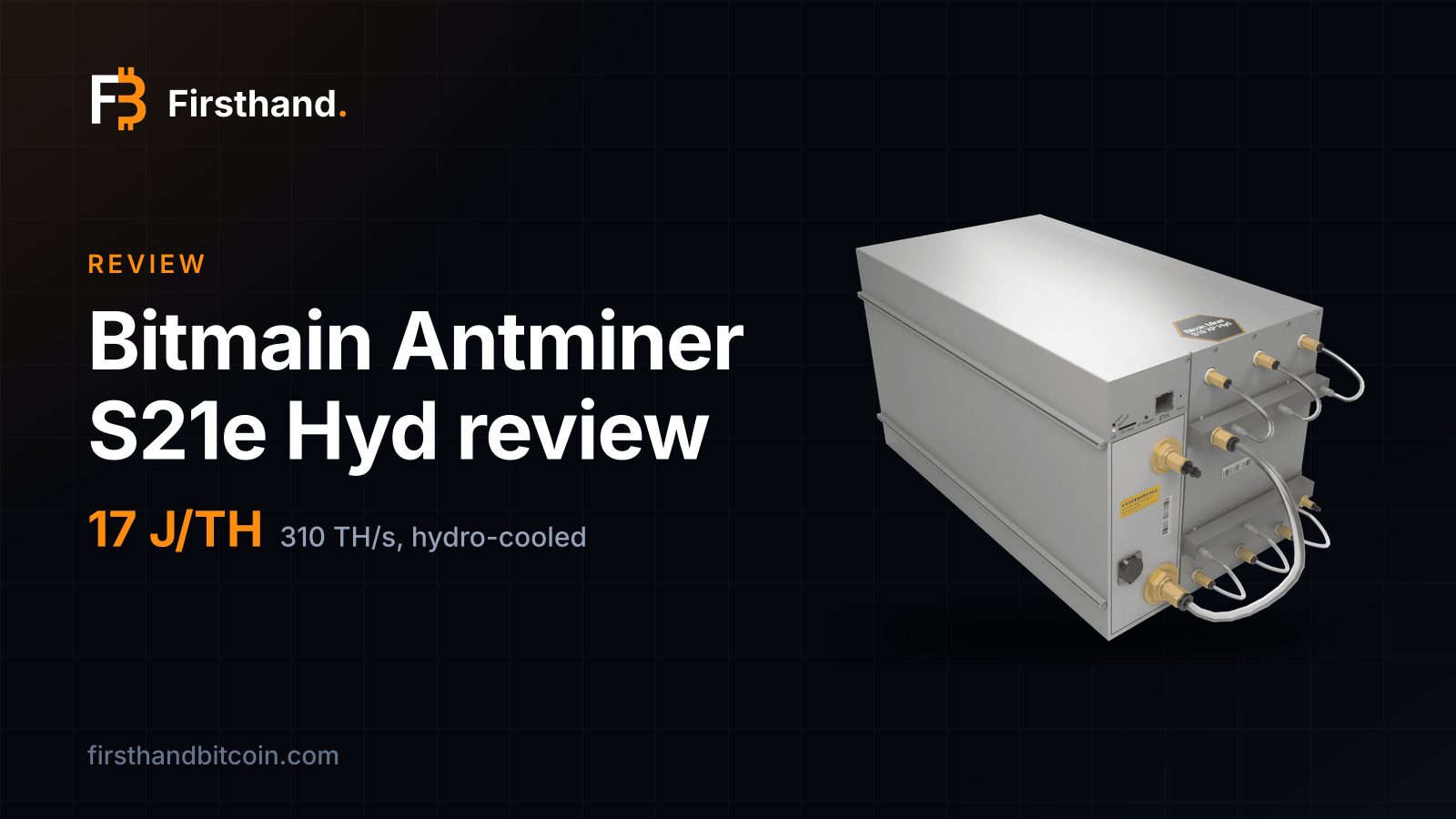
Bitmain Antminer S21e Hyd (310 TH/s)
The bottom line
The S21e Hyd is Bitmain's water-cooled entry machine: 310 TH/s from 5,270 W in the bin we list, 17 J/TH. In the UAE, at 6¢, it makes a bitcoin for about $56,000 of electricity and returns roughly 44% in its first year at today's price. At Nigeria's 3.9¢ the coin costs about $36,400 and year one is 53%.
Bought once its price settled, in April 2026, it has mined and kept 0.0251 BTC for $1,380 of power: $765 of cashflow against a $2,842 landed cost. That is 168 days into a four-year machine. Between now and the 2028 halving it has another 0.082 BTC in it, worth about $10,219 with bitcoin back at its previous high, roughly 3.9× its hardware by the halving.
What you are buying is a low price per terahash on water-cooled hardware: $4.52 today, against $8.82 for the 13 J/TH S21e XP Hyd. What you pay for it is electricity: a coin costs about $42,800 to make on the XP and about $56,000 here, at the same site. The entry price is the case; the efficiency is not.
Scores
| Criterion | Score | Why |
|---|---|---|
| Cashflow | 7/10 | Makes a bitcoin for about $56,000 of electricity in the UAE and returns roughly 44% in year one. It has covered 27% of its hardware so far and is on track for about 3.9× by the 2028 halving. The low entry price does the work. |
| Longevity | 5/10 | At 17 J/TH its line is $24.48 a petahash a day at 6¢, above the roughly $20 that hashprice would fall to after a halving at today's conditions. At Nigeria's 3.9¢ the line is $15.91, which clears it. |
| Efficiency | 5/10 | 17 J/TH is a middling figure for water-cooled hardware today: the S21e XP Hyd runs at 13 J/TH, the S23 Hyd at 9.5. |
| Quality control | 5/10 | Scored as unknown rather than as good. The machine has been on sale for about a year and we found no operator reports of its boards in the field that we could cite, so there is no record to score. |
| Serviceability | 6.5/10 | Hosted in the UAE, an in-warranty unit goes direct to the manufacturer's warranty centre close to the facility. A 12.8 kg unit is simple to handle. |
Weighted on what an owner gets back per dollar over four years. The entry price lifts cashflow; 17 J/TH and an unproven failure record hold the other scores down, and the halving test at 6¢ is why it stops at a 6.
Buy it if
- Your power is at or below about 5¢ and you can run a water loop. At that rate the machine still clears its power if network hashprice halves from its 7 October level of $40.74 a petahash a day.
- You want water-cooled hashrate for the least money down. At $4.52 a terahash it is among the lowest-priced water-cooled machines we list at this efficiency or better, and its first-year return of 44% in the UAE is close to the S21e XP Hyd's 50%.
- You are hosting at Nigeria's 3.9¢, where its line is $15.91 a petahash a day, comfortably under half of today's hashprice.
- You are building a fleet and want a low-cost position that can be replaced out of what it earns, as the [roof-and-building guide](/blog/machines-are-the-roof-not-the-building) describes.
Walk away if
- Your power is above about 10.0¢. At that rate the machine does not clear its electricity at today's hashprice.
- Your power sits between 5.0¢ and 10.0¢. It clears today, but with conditions held flat it would stop clearing after the 2028 halving above 5.0¢: you would be leaning on bitcoin recovering.
- You want the cheapest coin. The [S21e XP Hyd](/blog/bitmain-antminer-s21e-xp-hyd-review) makes one for about $42,800 in the UAE against about $56,000 here, and the S23 Hyd for about $31,300.
- You have no water loop and no plan for one. Hydro hardware needs a coolant circuit, which is why it lives in the UAE with us rather than in an air-cooled hall.
What Bitmain shipped
The S21e Hyd is the water-cooled member of Bitmain's S21e line. It comes in three bins, 288, 310 and 332 TH/s, each at 17 J/TH and drawing 4,896 W, 5,270 W and 5,644 W in our store record. We list all three. The 310 TH/s unit, at 5,270 W, is the one the figures in this review follow.
According to the minerstat listing the 310 TH/s unit measures 410 by 170 by 209 mm, weighs 12.8 kg and takes 380 to 415 V, and it dates the release to August 2025. YesMining's listing gives the same dimensions, weight and 5,270 W. Bitmain's own product page could not be opened, so the specs are those of our store record and these two listings, which agree.
It sits one tier below the S21e XP Hyd, and well below the S23 Hyd: less efficient, and cheaper per terahash.
Priced for a machine that has finished settling
The first price we hold for the 310 TH/s unit, on 14 November 2025, was $3,281, which is $10.58 a terahash. It is $1,400 today, $4.52 a terahash, for the same hashrate. That is a settled price, the best entry price we have on record for it, and it is why this machine is in the conversation at all.
Set against its water-cooled peers at 17 J/TH or better it is among the lowest-priced per terahash. The S21e XP Hyd costs $8.82 a terahash, the S21+ Hyd $6.93, the Whatsminer M63S+, also 17 J/TH, $7.56, and the S23 Hyd $23.52. The guide to what a miner costs all-in shows what sits on top of the box before it is running.
The first price we hold, in November 2025, was $10.58 a terahash. It is $4.52 today.
What a coin costs it
At 6¢ in the UAE it makes a bitcoin for about $56,000 of electricity today, against a bitcoin price of $82,320. At Nigeria's 3.9¢ the same coin costs about $36,400. The S21e XP Hyd makes one for about $42,800 in the UAE, the S21+ Hyd for about $49,200 and the S23 Hyd for about $31,300.
The return per dollar tells the other half. In its first year the S21e Hyd returns about 44% in the UAE. The S21e XP Hyd returns 50%, the S21+ Hyd 48%, the M63S+ 36% and the S23 Hyd 31%. A lower price per terahash buys more hashrate for the money, and in the first year that outweighs a dearer coin. Efficiency pays later.
Over its run since April 2026, electricity has averaged about $55,000 a coin. That is a short lifetime average; the figure to plan on is today's.
Where the halving puts it
A machine's line is the hashprice at which it stops covering its own power. At 17 J/TH a petahash uses 408 kWh a day: $24.48 at 6¢, and $15.91 at Nigeria's 3.9¢. Network hashprice was $40.74 per petahash per day on 7 October on our hashprice chart, so the S21e Hyd clears the 6¢ line today by about two-thirds. The most it can pay for power and still clear today is about 10.0¢ a kilowatt-hour.
The 2028 halving halves the coins a petahash earns. At today's price and difficulty that puts hashprice near $20, which is below the 6¢ line and above the Nigerian one. That is today's conditions held flat, not a forecast: it is why every projection we publish assumes the old high returns, and the forward figures here do the same.
This is the cost of 17 J/TH. A 13 J/TH machine has a line of $18.72 at 6¢, under that halved level; the guide to efficiency and halvings shows where the line sits for every J/TH figure. It is the profile of a machine that crosses to cheap power once: it starts where the water plant is, and moves to Nigeria when a full year of figures says the cheaper site is decisively better.
What owning one is like
We looked for operator threads and repair write-ups on the S21e Hyd and found nothing specific to it that we could stand behind, so none are quoted here. The machine has been on sale for about a year, and a reliability score needs a record that this one has not had time to build.
What a fault costs is the part that matters. Every ASIC develops faults, and in the UAE an in-warranty unit goes direct to the manufacturer's warranty centre close to the facility; it is a line item, not a catastrophe. It is also a water-cooled unit, which is why it is hosted where the water plant is. The guide to air, hydro and immersion covers what the loop means for an owner.
We found no operator reports of this machine's boards we could cite. We score that as unknown, not as good.
Our two cents
The S21e Hyd is a good machine at a very low price per terahash. Today it clears its power at 6¢ with room, it clears it at Nigeria's 3.9¢ even after a halving, and it is among the lowest-cost ways we list into water-cooled hashrate at this efficiency. A buyer building a fleet on a small first cheque has a sound reason to pick it.
A buyer who wants the cheapest coin should look one step up: the S21e XP Hyd makes it for about $42,800 in the UAE against about $56,000 here, at a first-year return of 50%. The figure below ranks what beats it on cost per coin and then on year-one return, in stock today. A coin that costs less to make is a coin you keep more of.
- Bitmain Antminer S23 Hyd (563 TH/s) — 9.5 J/TH, In stock, $31,299 of electricity per bitcoin, 26% year one
- Bitmain Antminer S21j XP Hyd (495 TH/s) — 12 J/TH, In stock, $39,391 of electricity per bitcoin, 40% year one
- Bitdeer SealMiner A3 Pro Hyd (666 TH/s) — 12.5 J/TH, In stock, $40,649 of electricity per bitcoin, 31% year one
Sources and further reading
- Bitmain Antminer S21e Hyd (310Th) specifications — minerstat, 2026
- BITMAIN Antminer S21e Hyd 310T 332T 5270W Bitcoin Miner — YesMining, 2026
Which machines this covers
- Bitmain Antminer S21e Hyd (310 TH/s)
- Bitmain Antminer S21e Hyd (288 TH/s)
- Bitmain Antminer S21e Hyd (332 TH/s)
Disclosure
Firsthand Bitcoin sells and hosts mining hardware, including this machine. No manufacturer, distributor or affiliate programme paid for or reviewed this page and we take no commission on the links above. Historical figures are computed from daily bitcoin price and network hashprice, each day valued at its own prices. Nothing here is investment advice.