Home / Blog / Canaan Avalon A15 Pro+
Outlook · Oct 9, 2026 · 4 min read
Avalon A15 Pro+: 7% less power than the A15 Pro, and it still needs Nigeria after the halving
Canaan's A15 Pro+ is rated at 240 TH/s from 3,720 W, 15.5 J/TH. It turns the same electricity into about 7% more bitcoin than the A15 Pro it follows. On those numbers it clears its power today at every site, and after the April 2028 halving only at Nigeria's 3.9¢.
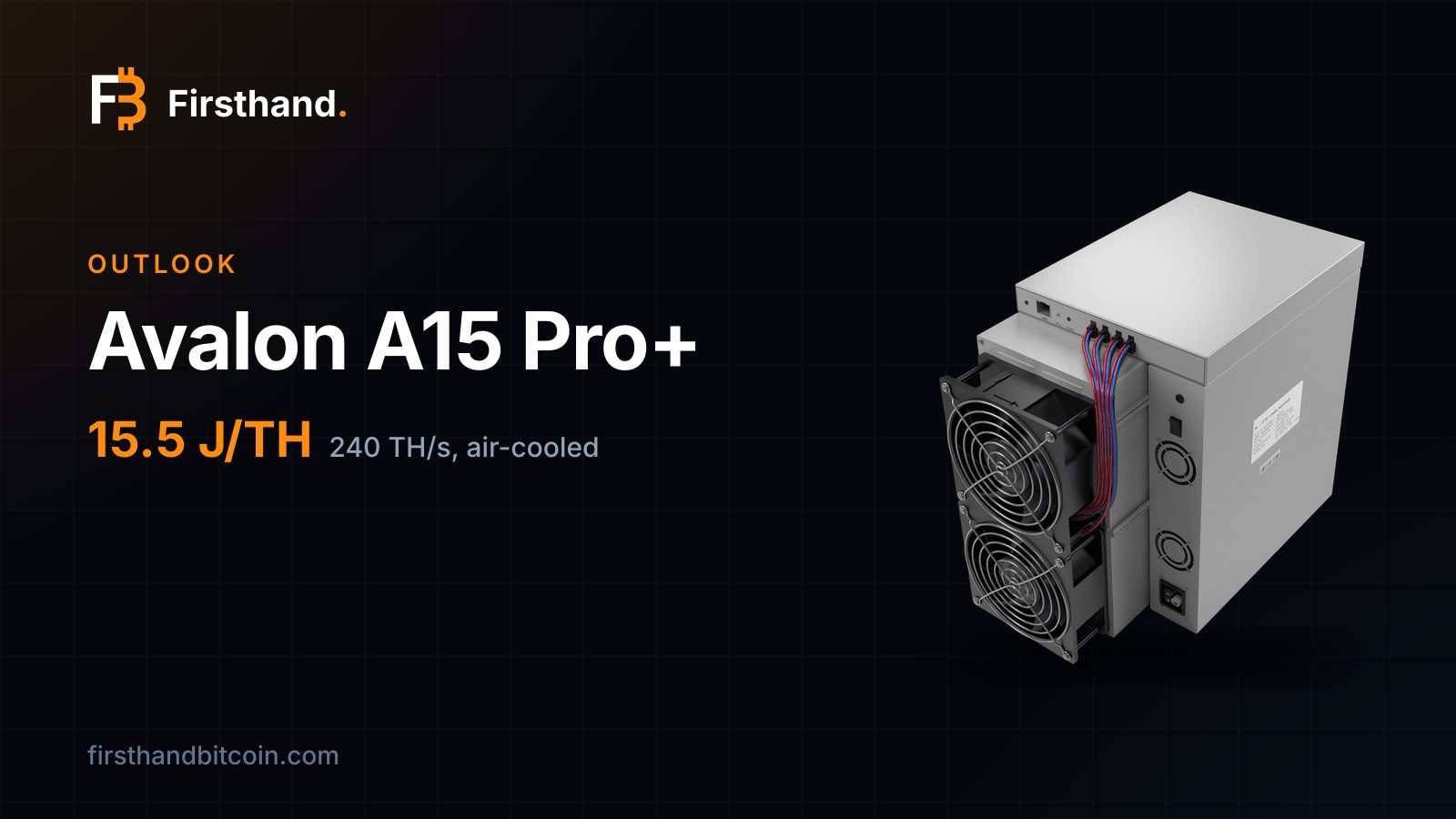
Canaan Avalon A15 Pro+ (240 TH/s)
Canaan's third step in two years: 240 TH/s from 3,720 W
Canaan's air-cooled Avalon line has moved in steps. The A1566, released in April 2024, was rated at 185 TH/s and 18.5 J/TH. On 7 November 2024 Canaan launched the A15 series, with the A15Pro at 16.8 J/T, and put the gain down to "continuous improvements in chips and embedded software in the past months". The A15 Pro+ is the next step on from that machine.
Our store record gives its spec: 240 TH/s from 3,720 W, which is 15.5 J/TH, a 14.9 kg air-cooled unit rated for -5 to 35 °C at 75 dB, announced on 28 July 2026. Canaan's own shop pages could not be opened when we wrote this, so the spec is the store record and nothing beyond it. It is the same kind of machine as the A15 Pro we reviewed, with more hashrate for about the same power draw: 240 TH/s against 221 on 3,720 W against 3,669.
More hashrate from almost the same power draw: 240 TH/s on 3,720 W, against 221 TH/s on 3,669 W.
Seven percent less energy for every terahash
The A15 Pro runs at 16.6 J/TH and the A15 Pro+ at 15.5, so each terahash takes 7% less power. The same power bill buys about 7% more bitcoin. The step before it, from the A1566's 18.5 to the A15 Pro, was 10%. Canaan's air-cooled line is getting better at a steady, modest rate, and this is a tuning step rather than a new generation.
At Argentina's 6¢ the A15 Pro+ makes a bitcoin for about $49,200 of electricity today, against $52,700 for the A15 Pro and $42,800 for the 13.5 J/TH S21 XP, with the market at $82,785. At Nigeria's 3.9¢ the A15 Pro+'s figure falls to about $32,000. Bitmain's S21 Pro, at 15.0 J/TH, is a touch more efficient than the A15 Pro+ and makes one for about $47,600.
The price sits above the S21 Pro's
The reference price we hold for the A15 Pro+ is $9.98 a terahash, $2,394 a unit. The A15 Pro is $7.14 and the S21 Pro, Bitmain's 15 J/TH air machine, $7.67. The S21 XP, at 13.5 J/TH, is $11.55.
That is why its first-year return is the lowest of the four: about 33% in Argentina, against 37% for the A15 Pro, 42% for the S21 Pro and 36% for the S21 XP. The coin is cheaper to make than the A15 Pro's. The box costs more for each terahash, and a new step has not yet settled to where its efficiency puts it.
A reference price is not an offer, and a new machine's price moves as stock arrives. The efficiency is the part that stays. Whether the price is there on the day you buy is the part to check.
- MicroBT Whatsminer M74S+ (332 TH/s) — 12 J/TH, In stock, $38,067 of electricity per bitcoin, 34% year one
- MicroBT Whatsminer M73S (560 TH/s) — 13 J/TH, In stock, $41,239 of electricity per bitcoin, 40% year one
- Bitmain Antminer S23 (318 TH/s) — 11 J/TH, Pre-order, $34,894 of electricity per bitcoin, 31% year one
At 6¢ it does not carry through the halving; in Nigeria it does
A machine's line is the hashprice at which it stops covering its own power. At 15.5 J/TH a petahash uses 372 kWh a day: $22.32 at 6¢ and $14.51 at 3.9¢.
Network hashprice was $39.71 per petahash per day on 8 October on our hashprice chart. The April 2028 halving would cut that to near $19.86 at an unchanged price and difficulty. That is below the A15 Pro+'s line at 6¢ and above it at 3.9¢, by more than a third. The A15 Pro's line is $23.90 at 6¢, so the new machine moves the break-even rate from about 5.0¢ to 5.3¢, and it stays a Nigeria machine after the halving.
This is today's conditions held flat, not a forecast. It is also the reason efficiency is worth paying for: the 13.5 J/TH S21 XP has a line of $19.44 at 6¢, level with the halved figure. The long version is in the guide to efficiency and halvings.
The A15 Pro+ is the same Nigeria machine the A15 Pro was, with 7% more room.
Where it would live, and what a fault would cost
Air-cooled machines start at our Argentina site, at 6¢, where repairs are done on site and billed at the cost of the parts. It is a Canaan machine, so a fault follows Canaan's route rather than Bitmain's. It is a line item, not a catastrophe, but one we cannot yet put a number on for this model.
After one crossing, to Nigeria's 3.9¢, when the trailing year says cheap power pays better, it is the same machine on a third less power. That crossing is the plan for any 15 to 16 J/TH air machine, and it is why the figures above are read at both rates.
What would have to go wrong
The record. The A15 Pro+ has no field record we can stand behind. We looked for operator reports of its boards and found none, so none are quoted here, and we score reliability as unknown, not as good. The A15 Pro's own record is short, and a tuned machine is still a young one.
The rating. Canaan's A15-series release said its figures came from "laboratory results in a controlled environment" and that it does not guarantee the same results in the field. At Nigeria's rate there is room: a machine 20% worse than its nameplate would still sit under the halved hashprice there. At 6¢ it has none to lose.
The price. A machine that costs more per terahash than the S21 Pro, and runs a touch less efficiently, has to earn its place on something else: a different maker, a different supply of units. Against the A15 Pro the saving per coin is real, and whether it repays the higher price is a question of years, not months.
What it means for a miner
If the rating holds, the A15 Pro+ is an air-cooled Avalon that turns the same electricity into about 7% more bitcoin than the A15 Pro, starts in Argentina, and reaches the April 2028 halving needing Nigeria's 3.9¢ to keep covering its power.
Output is never guaranteed: the rating is Canaan's, and the figures here are today's conditions held flat. If you are buying for the first twelve months, the cheaper boxes above return more today. If you are buying to keep coins through the halving, put it beside the S21 XP and the machine page, and check the price on the day.
Sources and further reading
- Canaan Upgraded Avalon Miner A15 Series with Superior Performance — Canaan Inc. (PR Newswire), 7 November 2024
Which machines this covers
Disclosure
Firsthand Bitcoin sells and hosts mining hardware, including this machine. No manufacturer, distributor or affiliate programme paid for or reviewed this page and we take no commission on the links above. Historical figures are computed from daily bitcoin price and network hashprice, each day valued at its own prices. Nothing here is investment advice.